
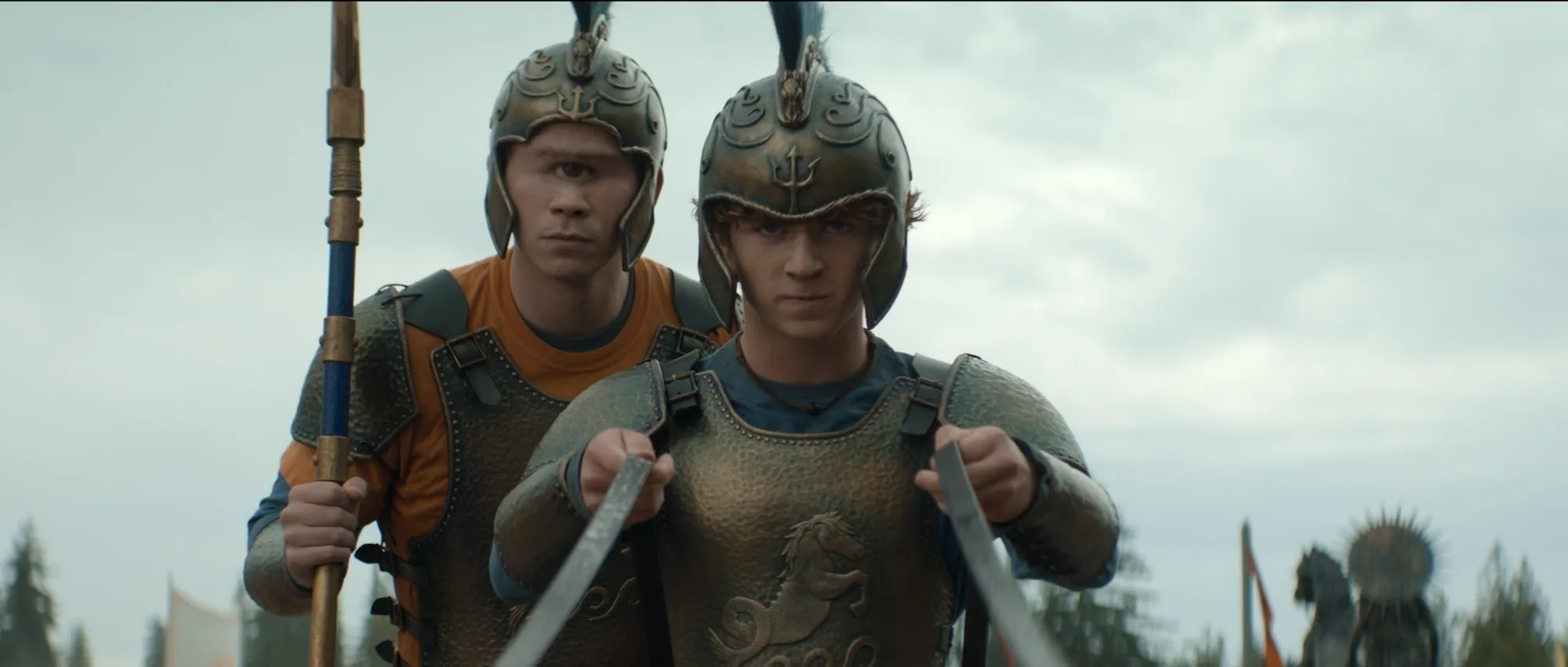
The chariot race in season two of Percy Jackson and the Olympians was a major undertaking that required balancing iconic imagery with modern safety standards. Recognized as a fan-favorite sequence from the books, the production team felt a deep responsibility to do the scene justice while adhering to their core rule: keeping the show grounded and real. In a recent interview with Temple of Geek, Cinematographer Jules O’Loughlin takes us behind the scenes of this epic moment.
Drawing from Cinematic History: Ben Hur Inspiration
O’Loughlin viewed the chariot race as one of those iconic moments in a career, similar to the feeling of shooting a Western. To prepare, he used the 1925 silent film and the 1956 Charlton Heston version of Ben-Hur as primary visual references. By studying these legendary examples, the team aimed to capture a classic sense of scale and vibrant action while utilizing modern cinematography techniques like reduced shutter angles to move feel sharper and more visceral.

Prioritizing Safety First
A primary concern for the production was improving upon the dangerous methods used in early cinema. O’Loughlin noted that in the 1925 Ben-Hur, over a hundred horses were killed during filming, a reality that is unacceptable on a modern set. The Percy Jackson team established strict protocols to ensure the safety of both the young actors and the animals. This meant they could not use many of the out-of-control techniques seen in historical films, necessitating a more controlled and technologically advanced approach that didn’t sacrifice the grounded feel of the world.
“Our actors had to be safe, and the horses had to be safe. So in the 1925 version of Ben Hur, I think a hundred to one hundred and fifty horses were killed during the shooting of that sequence… on a modern film set, you can’t use many of the techniques that they used back then.”
Innovation with Process Trailer Technology
To capture high-speed, close-up action shots without putting the cast in danger. Special effects supervisor James Paradis developed a creative solution using process trailers. Typically used for car scenes in modern filmmaking, these low-profile trailers are hauled by trucks to allow actors to perform without having to drive. For this sequence, the team took real chariots, removed the wheels, and mounted them onto these purpose-built trailers. This allowed the director and cinematographer to sit in the lead truck with monitors. There, they’d maintain proximity to the actors to capture their expressions while they raced through a real outdoor environment.

Mechanical Choreography and Fighting
To simulate the chaos of the race, the two process trailers were designed to be interactive through a sophisticated pulley system. This system allowed the trailers to move independently. One could move north-south while the other moved east-west relative to the hauling truck. This mechanical choreography enabled the chariots to be locked together safely at high speeds. In this controlled environment, characters like Clarisse and Tyson could perform intense stunts in safety. Such as fighting with swords and physical jostling, while real horses and stunt doubles provided the wider-angle action in the background.
The Season 2 finale of Percy Jackson and the Olympians premiered on Wednesday, January 21, 2026, on Disney+ and Hulu. All episodes of Season 2 are now available to stream, with Season 3 already confirmed to be coming soon.



![House of the Dragon | Season 3, Episode 2, “Queen’s Landing” Breakdown & Review [Podcast]](https://i0.wp.com/templeofgeek.com/wp-content/uploads/2026/08/house-of-the-dragon-s3-e2_3-jpeg.webp?fit=640%2C321&ssl=1)


![Review: House of The Dragon, Season 3, Episode 1 “Salt and Sea, Fire and Blood” [Podcast]](https://i0.wp.com/templeofgeek.com/wp-content/uploads/2026/06/harry-collett-jpg.webp?fit=640%2C360&ssl=1)


One thought on “Jules O’Loughlin on Engineering the Epic Chariot Race for Percy Jackson”