
A remote cabin in the woods can be a nice reprieve. It can also make you come face-to-face with your own personal demons. Project Songbird starts off with Dakota, a tortured artist who just can’t seem to write her next album. Due to past success, the pressure of future hits and life itself hangs over her. In an attempt to quiet the noise, she agrees to a month alone in the woods. Few amenities, her recording equipment, and the hopes this will birth her next CD of hits. However, music isn’t the only thing she finds in the trees.
Psychological Horror
As you navigate the world, there is no gore simply for the sake of itself. Gameplay sessions were rife with anxiety. The tension in so many rooms and hallways was palpable. Admittedly, it wasn’t the fear of monsters that had me feeling this way. Instead it was the worry of “what’s next.” The “what’s next” being the next story beat — although there is a certain something whose jump scares got me every time.
Project Songbird’s narrative speaks to the horrors of being human. The highs, lows, successes, and failures that are simply part of being alive. Other horror games that operate similarly are the Silent Hill series. Admittedly, Silent Hill has much more blood and guts. However, it’s the psychological aspect of being a sentient being that creates the comparison between the two. The story begs the question of “are we more than the sum of the bad things that have happened to us?” And if we are, can we face the work to rise above? I won’t to spoil the story as this game is well worth picking up.
But Project Songbird tells this story structured around that of an artist who can’t harness the magic to create as they used to. Enter record labels and a manager that can’t (or won’t) take no for an answer and the pressure begins to build.

And that is how you find yourself in a remote cabin in the woods. The first horror is the lack of indoor plumbing. The cabin is tiny and barely fits a bed alongside her extensive collection of recording equipment. The goal is simple: write her next album, with the old trope of writing in a cabin by a lake being the vehicle to drive her success. Unfortunately, the first session is a complete failure and quickly this stay becomes more complicated. Not only do players have tasks to address such as a failing water filters in the pump house and chopping wood. She soon discovers that she may not be as alone as she thought.
A bump in the night rouses her and the barren woods buzzes with voices urging her to go one way versus another. The rabid chorus is almost too much and then you notice a glowing ball of light. One you must follow deep into the woods. There is a repeated pattern of a red door, its significance revealed later in the story. Behind said door is the key to unlocking her musical potential. It also unlocks memories Dakota would rather keep hidden. I found it interesting that the thing that allowed her to create was also the thing that haunted her most deeply. Pain is a powerful muse.
Cabin In The Woods
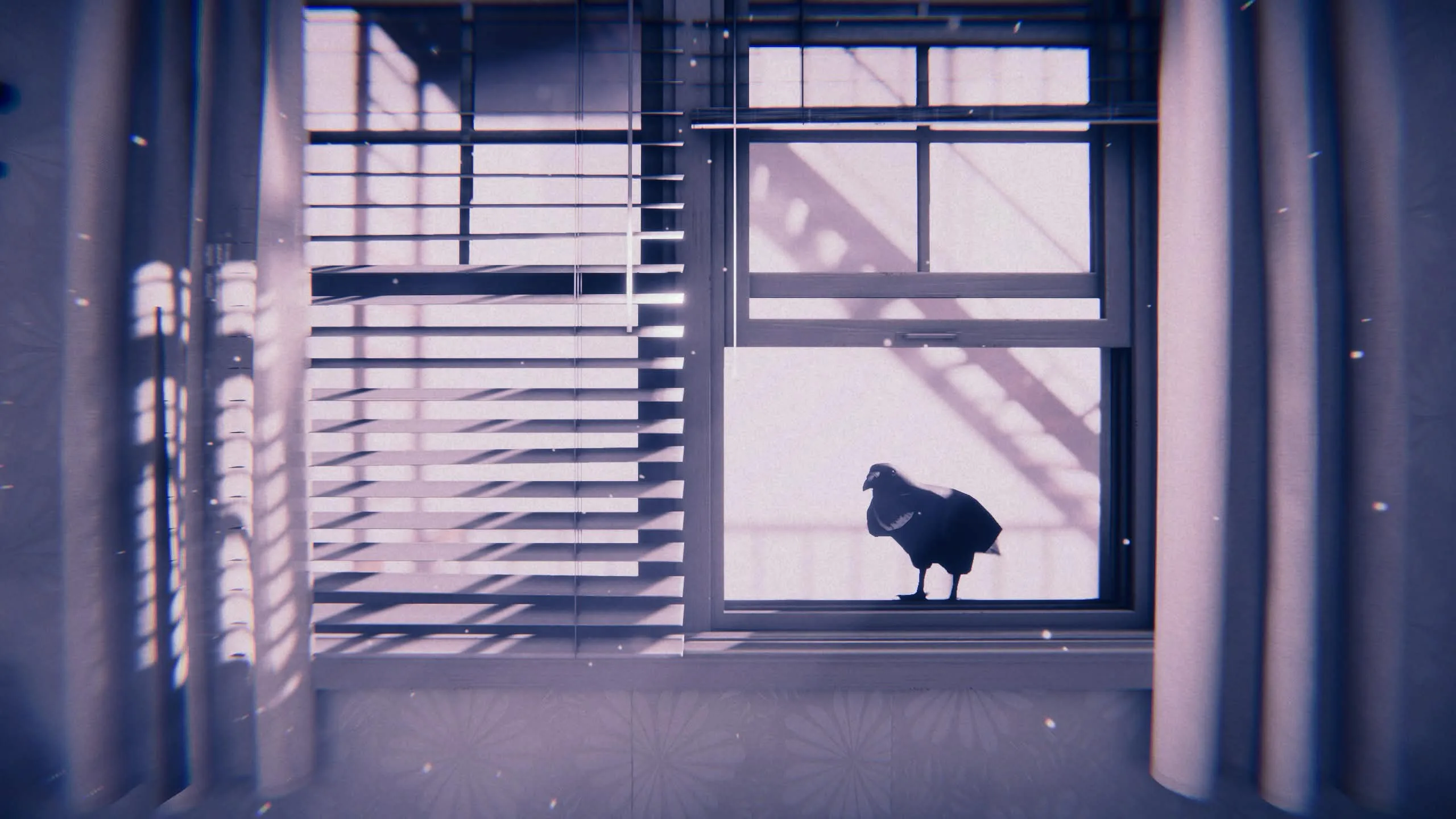
While players get to spend a bit of time in Dakota’s apartment, the majority of the story is told in a small log cabin in the woods. The game is HUD-less, so there’s no mini map or anything cluttering up the screen. I found that this let the visuals shine. Project Songbird is gorgeous. There was great and deliberate care in the world building. I found myself wandering paths simply to take in the lighting, the fields of flowers, and the woods itself. If you’ve ever been out in the middle of a forest you know how the light filters through the trees. And this game nails that.
As a kid who grew up camping, hiking, and generally just playing outside it called me back to those memories. There is also this film grain quality about the game that adds to incredible backdrops. A fun feature upon beating the game is the ability to try different graphic overlays upon subsequent play-throughs.

The sound design is also wonderful. I passed my headset around to my parents so they could hear the opening sounds of crickets chirping in the night. There is a two minute recording of Dakota standing in the doorway of the cabin during a storm, hearing thunder crash in the distance. I also snatched my headset off a time or two when things got a little too spooky. Despite that, I absolutely believe this experience is best enjoyed with a headset. The nuance in the sounds is lost when playing across speakers. Thuds in the distance and other minute details help create a world that is stunning to look at and listen to.
Nuts and Bolts
Mechanically, this game is not incredibly difficult. As you progress through the story, players find varying objects to aid in their journey. From a screwdriver and flashlight to bolt cutters and a hunting rifle, each tool has its place and is fairly easy to use. Main items, such as weapons, are accessible via an item wheel. Quest specifics items such as keys are located in inventory until their use becomes apparent. Project Songbird rewards exploration as you can find bullets, batteries, and healing items strewn throughout the game. There is definitely a bit of item managing that occurs throughout a play-through.
While I never ran out fully or got stuck because of this, I can see where this could happen if players aren’t careful or curious. It can be hard to check every corner when danger can also be waiting, but its necessary. Sometimes you’re going to have to traverse that dark area without your flashlight. I just closed my eyes and ran.
Dakota finds individual bullets and eventually two guns. She also starts out with the axe you use to chop firewood. Ammunition is scarce and yes, its best if you can learn how to parry. Again I never found myself in a tough spot due to lack of ammo, but I was also very aware of counting my bullets. This meant I’d have to go toe-to-toe with monsters, scared or not. I did die a few times. However, the combat didn’t feel overly complicated and none of the beings felt hard. Combat provided a release for the tension built but wasn’t a focal part of the game. At times, enemies serve as another part of a puzzle players must navigate.

There are multiple puzzles throughout Project Songbird. Each was fun and not incredibly difficult. This is absolutely the game where that random slip of paper with the number 8 written on it does come back to haunt you. Paying attention to the visuals as well as to the sounds around you can be the make or break for completing a puzzle successfully. As a Millennial, I do get to flex that being able to read an analog clock is a skill the game requires for one such puzzle.
Verdict
Despite being a chicken when it comes to horror games, the previews for Project Songbird caught me. I can say that the game did not disappoint. In fact, my initial sentiment was blown out of the water upon completing the game. I was not prepared for just how good Project Songbird is. The narrative is strong. It’s relatable and heartbreaking. As mentioned it forces us to look at both the beauty and ugliness of being human. We, as players, face our own feelings and experiences. Everyone has wondered if we are good enough. We have all felt like we are not. And we have all wanted to quit when trying became too much to bear. The world is beautiful while also being terrifying. The sounds, the music; all come together to create an unforgettable experience.
I spent about 10 hours on my play through beginning to end. With so many games in my back log, I enjoyed the length. There is also a new game plus mode as well as some fun modifiers unlocked after first completion and I plan on jumping back in. Puzzles are fun but not overly difficult. Combat is not the focus, which may deter some players but I found it made sense for the story the game was trying to tell. The load screen does warn of some visual jumping that can occur.
It didn’t happen often, but the game’s warning prior made it trivial when it did. Mechanics and gameplay were easy to learn. Menus and player UI are simple. Hot tip: read the in-game journal. Not only are clues to puzzles there but so too are an expansion on Dakota’s thoughts. In a world full of AAAs, Project Songbird is beacon among them proving that a game with heart doesn’t need a million dollar budget to shine.
Verdict: 9/10
Project Songbird is out now on PC, PS5, and Xbox X|S.


