
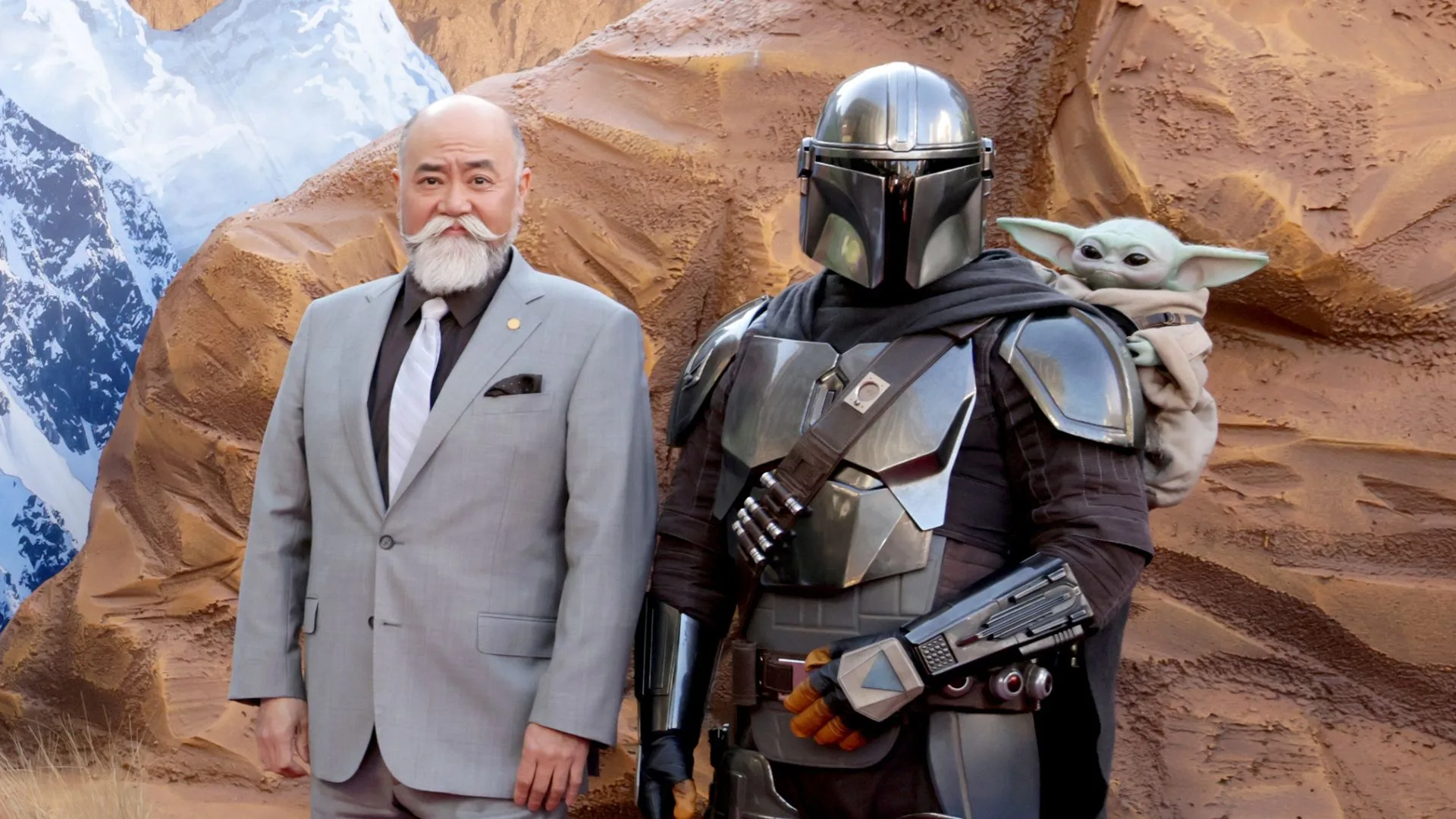
For adult collectors and lifelong fans, geek culture is often a lifelong pursuit of reclaiming a specific feeling. It’s a chase after the limitless possibilities and innocent joy of childhood, a time when a simple cardboard box could become an interstellar cockpit. Actor Paul Sun-Hyung Lee (Kim’s Convenience, The Mandalorian) understands this down to his core. Sitting down with Temple of Geek, Lee opened up about his deep roots in the Star Wars fandom, his massive personal collection, the toxic shifts in modern internet culture, and the surreal, full-circle moment of climbing into a screen-accurate X-Wing cockpit as Captain Carson Teva.
Chasing Nostalgia and the Collector’s Lifestyle
For Lee, collecting isn’t just a hobby; it’s a lifestyle and a profound source of comfort. Looking at the extensive display units stretching across his basement, housing high-end Hot Toys figures, prop replicas, and helmets, it is clear that his connection to the galaxy far, far away has only deepened with time.
“As adult collectors, we’re chasing that bit of nostalgia, right?” Lee reflects. “That feeling that we had when we were kids. Recreating stories, making up your own stories, inserting yourself into that world and being fully immersed in it is something that I think all of us kind of want to sort of go back to. It is a period of just sheer joy.”

That immersion became essential during the “wasteland” years following the release of Return of the Jedi, an era when toy shelves were empty, and new on-screen stories didn’t exist. Like many fans of his generation, Lee found refuge in Marvel’s comic books and Timothy Zahn’s groundbreaking Thrawn Trilogy novels, which “scratched an itch that I didn’t realize I’d had.”
When the prequel trilogy kicked the marketing machine back into overdrive in the late ’90s. An absolute oasis of action figures and playsets replaced the desert. Today, backed by what he playfully calls “adult money,” Lee continues to share that joy via unboxing videos and reviews on his personal YouTube channel.
“Everything moves pretty fast sometimes,” Lee says. “So it’s good to just sort of slow down, touch the grass, unplug from your phone, and just play with your toys. No shame.”
The Power of Positive Fandom and Confronting Outrage Culture
While Lee proudly champions the joyful, creative side of fandom, he doesn’t shy away from addressing the darker shifts in modern internet spaces. Reflecting on recent events, like the overblown fan outrage surrounding a nostalgic Super Bowl teaser spot featuring Tauntauns and Sam Elliott, or completely fabricated clickbait rumors involving Lucasfilm leadership, Lee points to a broader, cultural impatience.
“We’ve become less patient as a society,” Lee observes, noting our dependency on the instantaneous dopamine hits of social media. “And I find outrage culture a fascinating thing to watch. Negative content sells, and I hate that so bad because it’s fruitless at the end. It’s just a lot of noise, a lot of negativity… We’re being conditioned to be angry all the time.”
Lee views the extreme “my way or the highway” fan perspectives as a fundamentally flawed way to engage with art, a toxic mindset that mirrors the fictional villains fans claim to detest.
“It’s very much that Sith mentality,” Temple of Geek host Nick Williams agreed in line. “It’s like, ‘My opinion is fact, or you’re wrong. You’re either with me, or you’re my enemy.'”
Lee’s advice for combatting this cycle is simple: starve the trolls, change the narrative, and support positive spaces. “How do you kill a troll? You don’t feed it… I’d much rather watch a video about 10 reasons why I love something instead of 10 reasons why I hate it.”
The Chance Encounter That Led to Carson Teva
Lee’s transition from a passionate Star Wars cosplayer to a canonical fixture of the “Mandoverse” reads like a script itself. It began at the 2018 Unforgettable Gala in Los Angeles, an event celebrating Asian North Americans in media, where Lee was attending alongside his fellow Kim’s Convenience cast members.
Out of nowhere, a woman jumped in front of him whom he hadn’t seen in 25 years: director Deborah Chow.
Two decades prior, the pair had worked together on a single-day short film shoot in Toronto’s Chinatown when both were just starting out. Chow went on to direct standout episodes of The Mandalorian Season 1 before helming the Obi-Wan Kenobi series. “She didn’t know I was a huge Star Wars fan,” Lee laughs, recalling how he grabbed her arm to explain that he had multiple screen-accurate cosplays sitting at home.
Chow revealed she had been actively trying to reach him. Executive Producer Dave Filoni had watched Kim’s Convenience, loved Lee’s performance, and wanted to write a role specifically for him. After reviewing photos of Lee’s personal cosplay gear, Filoni jokingly told Chow that Lee could “just show up on set with his costumes.”

Weeks later, Lee flew out to visit the set, stepping onto the revolutionary ILM StageCraft digital soundstage for the first time. He even caught a top-secret glimpse of Grogu. Months later, his agent called with an official, audition-free offer from Lucasfilm for a character codenamed “The Foodie Pilot.”
Climbing Into the Star Wars Cockpit
When it came time to shoot his scenes as Captain Carson Teva, Lee found himself working under the direction of the late Carl Weathers. For a lifelong fan, stepping inside a physical X-Wing cockpit, a piece of practical staging grandfathered down from the production of Rogue One, was nothing short of religious.
“When I was five, six, and seven, I used to imagine I was an X-Wing pilot,” Lee shares. “I had this cardboard box that I sat in, and I drew all the controls with a magic marker… Cut to sitting in the volume, and you’ve got a star field projected all around you. There’s the Razor Crest off to my right. And beyond that is another X-Wing. I am in full costume with my helmet on. I am in an X-Wing.”

The immersion was so intense that when the digital effects team was tracking the cameras, the surrounding LED star fields dynamically shifted.And so it created the physical illusion of movement. “I felt like I was doing barrel rolls,” Lee remembers. “The cockpit was locked down to the ground, but you are convinced… It’s so realistic looking.”
What was originally intended to be a brief, two-episode appearance quickly snowballed. Filoni and Favreau kept finding reasons to bring Teva back. Utilizing him as a narrative linchpin to bridge various corners of the New Republic era together.
Standing with Every Generation of Star Wars Fandom
Lee’s journey reached a surreal crescendo during Ahsoka, where Carson Teva appeared before a New Republic defense council panel. Looking back at the sequence, Lee realizes the scene effectively united multiple generations of the franchise’s history in one room.
He found himself sitting alongside Mary Elizabeth Winstead (Hera Syndulla), Genevieve O’Reilly (Mon Mothma), the chaotic rebel droid Chopper, and the legendary Anthony Daniels clad in the iconic gold plating of C-3PO.
“It’s surreal,” Lee admits softly. “You’re not even aware of it until after the fact… I feel gratitude, humility, and just bewilderment and awe, because it’s like a dream. I dreamt of this stuff when I was a kid before I even realized any of this stuff could be real.”
Ultimately, Lee attributes the magic of working on modern Star Wars projects to the shared energy on set. From the technical crew managing the digital arrays to the background performers, everyone involved is fundamentally a fan at heart. By leading with that shared love, creators and fans alike can continue to expand the universe for the next generation.


One thought on “Paul Sun-Hyung Lee on the Magic of Star Wars and the Power of Positive Fandom”