
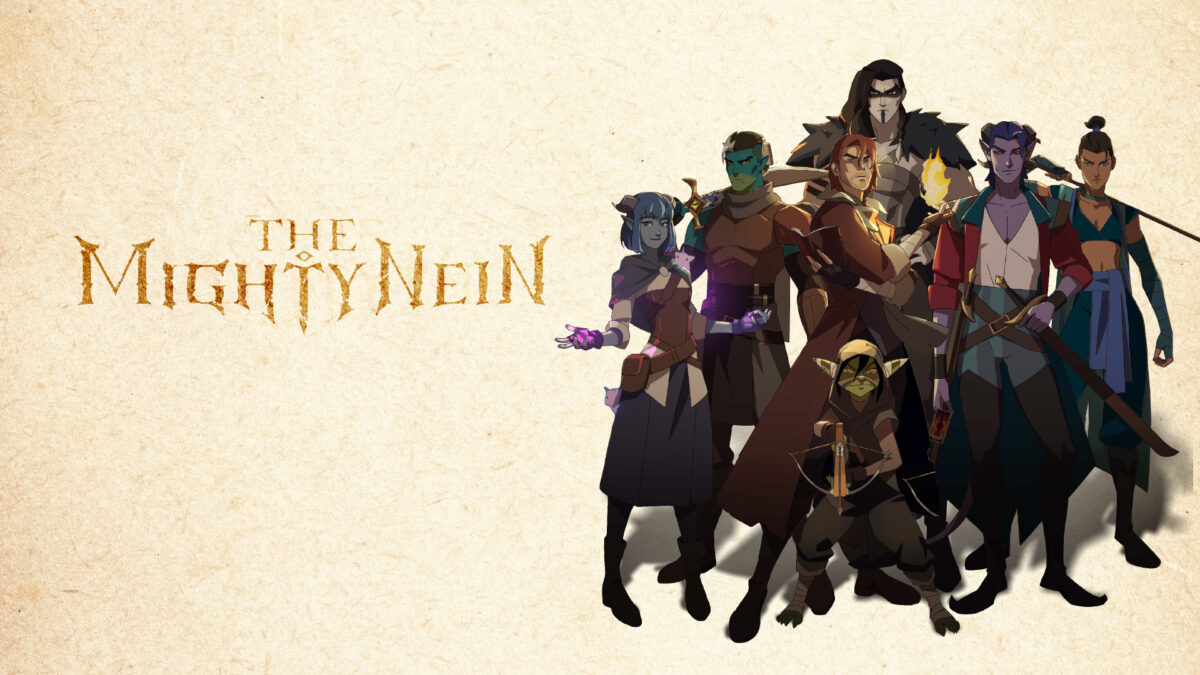
Critical Role brings their world of Exandria to life in the animated series “The Legend of Vox Machina” and “The Mighty Nein.” While both these series are set in the same world and adapt “Critical Role” stories, they feel entirely different as shows. Part of this difference is established through the score and vastly different soundscape. Where “The Legend of Vox Machina” takes a more traditional fantasy approach, “The Mighty Nein” leans into a darker, grittier tone via electronic inspiration.
Award-winning composer Neal Acree helms the score for both series. He brings the stories to life through music that enhances not just the stories, but the emotions and character arcs as well. He does an impressive job setting the animated series apart from the first moments of “The Mighty Nein.” Acree brings a wealth and depth of knowledge not just as an acclaimed composer but as a long-time fan of “Critical Role.”
In an exclusive interview with Temple of Geek, Acree reflects on the score of “The Mighty Nein.” He explains how characters “earn” their score through emotional moments, using Caleb as an example. Acree also hints at how his knowledge as a fan helps inform his approach to characters like Yasha and Essek. He also praises Sam Riegel’s skills as a musician and his dramatic instincts in regards to storytelling through music.
Neal Acree Explains His Approach To Characters “Earning” Their Theme
Temple of Geek: Travis [Willingham] in the past has talked about how “The Mighty Nein” score is sort of a “Tron” meets “Lord of the Rings” vibe. What was the process of melding electronics with the more epic fantasy aspect? And were there any musical influences that you took inspiration from?
Neal Acree:
The big challenge is the show obviously has a traditional fantasy style, in a sense, but the desire was to do something that sounded different, set it apart from “Vox Machina,” and try something new and fun. So, it was a little bit of a challenge to use the typical electronic approach that might be more beat-driven or based not necessarily on scoring to picture and making the music fit every little dramatic moment the way that traditional scoring is. So, I had to find a way that had the best of both worlds.
What I would generally do is every time I would set out to score a scene, I would think “If I were to drop an electronic artist track on top of this, something that was kind of pre-existing and had maybe a groove to it or something, how would that feel in the scene?” So I try from a completely different approach, maybe have something be a pulse that goes through a whole scene. Something that as a baseline sounds like it was just, again, dropped into the scene. And then on top of that, find ways to have it blend a little better with the drama.
Temple of Geek: Well, one of the things that’s so cool about “The Mighty Nein” is it has more of this darker, grittier feel and this political thriller espionage aspect to it. I feel like you set the tone instantly with that immediately in the first episode. How was it for you being able to play in this very different kind of subgenre of fantasy? As opposed to being more traditional, like, “Oh, we’re going on an adventure; we’re collecting these treasures” that we got a lot of in “Vox Machina”?
Neal Acree:
It was fun, to say the least. I was a fan of “Might Nein.” I watched the campaign while it was streaming. And so it was really fun to get to see it unfold in the show. Obviously, being a darker show, you kind of lean into darker sounds, darker textures. The emotional aspects are a different approach because with fantasy you have, it’s just different kinds of emotions, but as a composer, I’ve always really gravitated towards those emotional moments in films. When I watch a movie, I wanna be moved by it. So whatever emotion it might be, that’s always something that I’m trying to find a new way to convey, that emotion through sound.
Temple of Geek: I think that comes through really clearly with how you tie the music to the characters. Because it is not necessarily, this is this character’s theme song. It’s more based in, it seems, the emotional themes that we’ll see with the characters throughout the season. How did you decide what moments to really land in as their musical piece? What did you want to highlight for them?
Neal Acree:
My approach for scoring characters is not to do a theme for every person that happens every time they’re on screen from the first time you see them. Just because it gets, oftentimes in a scene, especially like with “Vox Machina,” the characters are doing a lot of things together very quickly. And the scenes will move through a lot of different emotions and everything. So to get tied up in having to be this person’s theme, and of course I do that, and I try to have thematic moments for everyone, but my approach has always been to have the theme be tied to an event or something that happens on screen.
So it’s almost like characters earn the theme, and then that stays with them for the remainder of the series. So in the case of Caleb, episode five, the very gut-wrenching scene there are thematic elements there that kind of continue with him beyond that. And the same thing with all the characters. If there’s a moment that the theme and the character join together in that moment, it’s a little more meaningful for me. And it’ll call back to Keyleth, who has had more than one theme because as her character has grown and she has gone on this journey and taken on her different elemental forms, each one of those has had its own theme, and that’s another example of not just having one character theme for each person. It’s more about the journey.
Temple of Geek: It’s amazing. Also, what a bummer to describe Caleb getting his theme as earned. Destroying his family.
Neal Acree:
Earned it the hard way, yeah.
Neal Acree Reveals His Process For Yasha’s Music & Hinting At Her Future In The Mighty Nein

Temple of Geek: I love the difference between the Kryn Dynasty and the Dwendalian Empire in their scores. Can you tell me a little bit about what your inspiration was for each of them? Because I feel like we really get that immediately in the Beacon Heist in the first episode.
Neal Acree:
It starts with Bulgarian choir [for the Kryn Dynasty]. I wanted something otherworldly, and that texture has always been something that is very evocative to me. So there is something ritualistic about having a chanting, mysterious choir. And actually, what’s happening on-screen, you see a group chanting on screen. So the music sort of had to work both as a score as well as something that could be coming from on-screen. So that ended up being the Kryn sound. Or really, it’s also tied to the Beacon as well. So, anytime you see the Beacon, you’re hearing Kryn stuff; it’s kind of all tied together. As for the Empire, especially in that opening scene, there’s a little bit of, you want to just drop people in the deep end. In case anyone is wondering what kind of musical sound the show is going to have, we made sure it was very clear from the beginning. So, I went all out on that one.
Temple of Geek: I think Yasha is one of the characters I’m really curious about for you, because we only get snippets of her. So I feel like her music had to have that very scary orphan-maker intimidation, but we also get that flashback that is much softer. What was your process for her, especially knowing we’ll see more of her down the line?
Neal Acree:
Yeah, I mean, I just wanted something intimidating, primal, and very powerful but also very soft and gentle. And the character and just the dichotomy of the struggle within. I can’t say too much, since only one season has come out. But I definitely wanted something that it was very apparent that what you were seeing, the state she was in, was not who she really was. That there was another side of her, which at the very end of 1×08, you see a glimpse of who might be underneath.
Temple of Geek: I really love how we got to build “The Mighty Nein” kind of being together as opposed to “Vox Machina” where we were already there. So you got to lay the groundwork a little bit for that. But I also love how you’re able to weave in some of the “Critical Role” music that we know from the original stream. What has that process been like of being able to have those Easter eggs? Building to the group as well as getting to bring in music that fans already know.
Neal Acree:
Yeah, for the beginning, I thought “Welcome to Wildemount” would work really well for this. And of course there was some discussion as to, well, “Your Turn to Roll” is the Campaign Two song, but I had already used that in “Vox Machina.” The reason being is that it just had a lyrical quality that lent itself really well to fantasy scoring. The strings just really worked really well as a heroic theme. So, I had already used that for “Vox Machina.” And theoretically it’s the same world and the same IP. So, I could have used that.
But [we] wanted to have something different. And also, I just felt like “Welcome to Wildemount” had a quality that lends itself to electronic music. That had that kind of slow build. Even Colm [McGuinness]’s amazing original version of the piece is very textural and has this melody; it worked really well for me in electronic music. That was my push from the start to use that theme. And then of course as the characters are coming together, the plan was to have the theme slowly plant some Easter eggs and finally have the big heroic moment where they are all working together and the theme joins them. I think that’s when they’re taking down the toad, when you finally hear it all together.
Neal Acree Breaks Down The Electronic Element Of The Mighty Nein’s Score

Temple of Geek: I loved it. When I saw that, I was like, “We’re in, we’re here. Yes!” One of the things I think is really cool too, especially with the carnival in that theme, is that we get that very whimsical feel to it. And then we still have the vibe and the sound of it, but it morphs into that action sequence. How do you balance that? Because you are bringing two themes together to change the mood and to change the intensity of the scene.
Neal Acree:
That’s always a challenge. You want to have contrasting moments, and by the time the attack is happening and everything is total chaos, I want everything to feel like a cohesive piece. Over the course of the episode that builds towards something where everything feels like it’s this linear moving thing. But at the same time when you get dropped into it, you really want to feel that contrast.
Temple of Geek: And then I’m a bit of a nerd about pirates. So I love that we got the Vandran electronic pirate vibe. What was your inspiration for that? Because it was perfection.
Neal Acree:
Oh, thank you. For legal reasons, “Pirates of the Caribbean,” you can’t ignore that that exists; that is a thing, and it is also something about that lends itself to, there is certain music that just kind of lends itself to electronics. Although it was a bit of a challenge to find something, again, you don’t want to just replace the orchestral instruments with electronic instruments. Try to do something that stays, that is authentic to electronic music as much as possible. So, it’s just manipulating textures and adding distortion on strings. It’s fun to get to experiment with trying new sounds, finding new ways to convey familiar feelings.
Temple of Geek: Was “Mighty Nein” score more challenging than “Vox Machina”?
Neal Acree:
In a sense it was. I think both of them were very challenging at first. Just to figure out, what is the sound. By the time I had been doing several episodes, it started to get easier and easier because you have unlocked the puzzle and you know what to do. The challenge with “Mighty Nein”: “How do you convey the traditional emotions that people expect to feel during these things, but do it in a way that’s not traditional at all?” So anytime I would find myself going to strings or something orchestral, which is my go-to for certain things, I’m like, “Oh, I can’t do that because that’s a traditional approach.” So I was like, “Okay, well, if I’m gonna do this again, I’m gonna put some weird effect on it that’s gonna make it sound weird.” Or also trying to find ways to avoid even starting with strings and be like, “What is the weirdest sound I can throw into the scene that still makes you feel this emotion?” So a lot of it was kind of reinventing the wheel and finding brand new ways to do things that normally have a way to use language for traditional scoring.
Neal Acree Reveals Which Campaign 2 Moment He Wants To Score Most

Temple of Geek: This question might be a little tricky just because I know we’re avoiding spoilers. But as someone who watched campaign two, maybe vaguely, is there any moment down the line that you’re excited to score potentially?
Neal Acree:
Yes. I mean, one of my favorite moments was Jester with the cupcake and with the witch. That was just brilliant, and watching Laura [Bailey] pull that off was like watching a basketball playoff game, final seconds and someone makes the three-pointer, and it’s like, “Whoa.” So I am hoping that is something that I get to work out in the future.
Temple of Geek: Did you have either a favorite score or piece to work on for this season? Or one that was maybe the most challenging but most rewarding as well?
Neal Acree:
Yeah, both of those would be the Caleb burning down the house scene because that’s just, I mean, oftentimes, if a show is really well written, you can watch it before I even start writing the music. You watch it with a very rough animation, and I can already feel the emotion of it. And how do I do justice to this? So, I spent a week on that scene, living in that space, which is one of the challenges of the job. You kind of have to be method in the sense that if you want the audience to feel the emotion of it, you have to feel it yourself and find something that really conveys that. So for whatever reason, I was just like, really because it moved me so much, I wanted it to be really special. So I just spent a lot of time, just playing with the textures and getting it as good as it could be.
And then I’d come in after work and my wife would be like, “What’s wrong?” You don’t realize what I have been living. I have been living in this scene, this horrible scene, for a week now. But again, something about when it works, when it all comes together and you see the final version and you realize, I don’t question where it came from; my job is to make the emotion as powerful as possible. And when it’s out there and it works, it’s the best feeling. Even though it was very difficult in an emotional sense.
Neal Acree Teases How His Knowledge About Essek’s Longterm Story Guides His Score

Temple of Geek: One of the things that is very cool about “Mighty Nein” is we get to explore a lot of the story we didn’t get to see in Campaign Two. Because it is a lot of things that Matt had set up, but the players didn’t necessarily decide to explore. So you get to really kind of set the mood and the tone for those. Was there, as a fan of Campaign Two, any moment when you were like, “Oh, this is so intriguing, and I’m really excited that I get to be a part of the first time that fans get to see it”?
Neal Acree:
I loved the Trent arc and Essek, getting so much more of that. I just love the political intrigue. I mean, that really– that whole storyline really goes deep into that. So that was a lot of fun. And you know, Essek, you keep like, “Really, Essek? You know, that’s– come on.” So many moments where you’re, as a composer, like, how do I play this? Are we rooting for him? Are we not? It’s kind of in the middle. You have to kind of play what’s on screen and think a little bit about what’s in the future, but also, what are you trying to convey at this particular moment in the story? To think about the rest, how’s he going to land later when you felt a certain way?
Temple of Geek: Did that knowledge, especially about a character like Essek, make it more challenging for you? Or was it something where you were like, “Oh, this is very fun because I can sort of lay groundwork for what we’re going to have way down the line”?
Neal Acree:
I think, I mean, it’s nice to have that bigger picture. So you can think about, you might approach things slightly differently. If it’s just a one-dimensional character that just does one thing. You might do it a certain way, but if you know there’s something down the line, you might think ahead to how you might be teeing something off. I don’t know, I always try to think of it as this big puzzle, and in a lot of ways I’m helping to make the puzzle with the storytellers. And the way you set up the pieces is how it pushes things in a certain way, and you try to leave yourself enough thematic room to revisit things. And that’s really—it’s fun to take those little pieces that you might have planted earlier on and work with them later on.
Temple of Geek: And then because this is set in the same universe as “Vox Machina,” is that something that’s even in your head when you’re composing, or are they just completely separate for you?
Neal Acree:
I mean, just because the sound is so different, thematically, not even approach. I mean, honestly, working on the two shows, how can I make these sound as different as possible? Because I’m the same composer, I have to find ways to push myself in different directions just to make sure it sounds as different as possible.
Neal Acree Praises Sam Riegel’s Musical Mind & Instincts

Temple of Gek: What has been your favorite part about collaborating with the cast members who know these characters so well?
Neal Acree:
It’s the best. Sam and Travis, who’ve been executive producers since the very beginning, are such incredible collaborators. Sam underplays it, but he’s actually a very gifted musician who understands drama on a level that I learn things from him all the time. Musically, he has great instincts, and getting to work with them has been wonderful. It’s such an honor to be able to add music to these stories that these friends have created over 10 years. I feel, again, just so lucky as a fan, to be able to be playing in this space and coming up with music for these adventures. It’s very rewarding every time. They’ve been very gracious and complimentary and made me feel like, I’m on the right track with it. And it’s been a wonderful collaboration.
Temple of Geek: You said you are working on the score for season five of “Vox Machina.” I assume you are working or have worked on the score of season two of “Mighty Nein.” What have you learned from your experience with “Vox Machina” of working on it for multiple seasons that you are excited to take or have taken into “The Mighty Nein” season two score?
Neal Acree:
They have been such different journeys in a sense. I think they do inform each other a little bit. It’s almost like “Vox Machina” gave me the tools to be able to do “Mighty Nein.” Yeah, and in a sense that also meant that as soon as I started working on “Mighty Nein,” I had to forget all the tools or everything I learned, but from a dramatic standpoint, it gave me something to jump off from. It gave me, “You have established this one world and this one sound approach; now you have something to do the exact opposite of.”
So the two kind of inform each other partially in a sense of trying to make sure that they sound as different as possible and still capture the same emotions. You want the audience to feel the same after watching the shows. Even if I love the idea, people listen to it and have no idea that I did the music because I like surprising people. I like doing very different things back to back and flexing some creative muscle because it’s fun to be able to do different kinds of things, different sounds as a composer. So really, yeah, it’s just been great to be able to have those two different worlds, different sides of the same world, that I have been able to do very different things with it.
Temple of Geek: Was it easier with “Mighty Nein” knowing you were doing multiple seasons, having had that experience of doing multiple seasons, and seeing the evolution? Or was it like, “Oh, these are so different that didn’t even really matter”?
Neal Acree:
The seasons we were working on it back to back. To the audience it’s two seasons separated by a very long time. For me, it’s one long stretch. So, it makes it easier in a sense. There isn’t any real downtime where you’re having to think about it. It’s kind of just you keep moving and you learn. And again, each episode, and I had talked to Sam and Travis about this, every episode is so different than the one before it. Even with the Kryn, Essek, and Trent stuff, there are things that carry through. But I felt like every episode a completely different thing was happening, a different approach. That made it kind of a fun challenge with every episode, but also, it didn’t give me the chance to get into a rut or anything. It was like every time here’s a new thing. Let’s jump on this new challenge here.
The first season of “The Mighty Nein” is available to watch on Prime Video now.


One thought on “Neal Acree Deep Dives Into The Mighty Nein Score”