
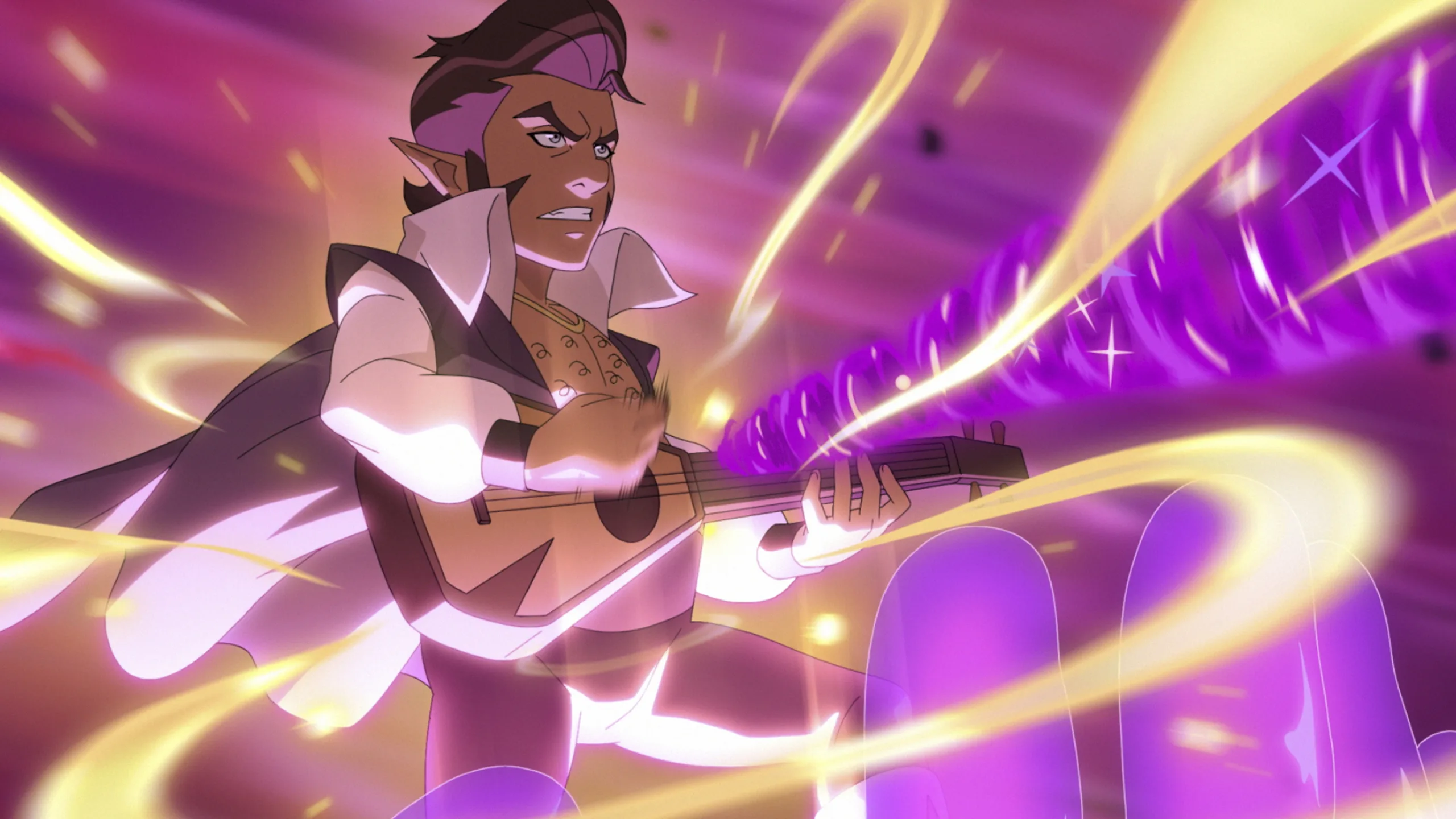
“The Legend of Vox Machina” continues to up the game every year as they bring the intense, action-packed adventures of Vox Machina to life through masterful animation. Each year the team manages to outdo themselves with even more impressive action sequences and creative approaches to storytelling.
Season four brought back the looming threat of the Whispered One, which was introduced in the first season. But in the aftermath of the Chroma Conclave the vacuum of power has been filled by the Whispered One and his followers. Vox Machina attempts to uncover the secret behind this cult and the powerful individual they worship. However, the Whispered One proved much smarter and more powerful than the heroes anticipated, leading to a brutal and devastating cliffhanger in the season finale.
In an exclusive interview with Temple of Geek, Sung Jin Ahn and Arthur Loftis discuss the Kraken and Bard battles. Ahn shares insight into the collaboration between the writers and animation team. Loftis discusses the world of Exandria in the aftermath of the Chroma Conclave’s destruction.
The Collaboration Between Animation & Writing Is Even Stronger In The Legend Of Vox Machina Season 4

Temple of Geek: Well, first off, I want to say this season is spectacular. I don’t know how you guys are able to up the ante every single season, but you do.
Arthur Loftis:
We’ve learned a lot. I mean, obviously it gets crazier every season and I think season three taught us a ton of lessons about how to manage insane scope. There’s a whole cast of dragons. So this season, in a way, not having to deal with the cast of dragons gave us room to up the ante in other ways. We could redirect our energy into things. Giant robot fights or giant dragon fights.
Temple of Geek: One of the things I was curious about was the back and forth of the animation with the writing. How much the animation maybe influences the writing of the storylines. Because I know Trinket isn’t in as much because animation-wise, that’s just not super feasible.
Sung Jin Ahn:
Yeah. And bless Sam, Travis, hard too, because I had a certain experience with animation production already going into it and they were just so open to learning about the process or going into it. One of the things in the earlier, I think by season one, I was vibing out, okay, let’s see how much of the Trinket plays in the sequence. And then by season two, I remember setting up a call with Sam and Travis literally saying, “Is it possible to omit Trinket this season?” And they’re like, “Yes.” But I’m like, “I know Trinket’s awesome, Trinket’s great.”
But I said in other podcasts or whatever, or in the animation world, everyone spends their time drawing people. And so a lot of the artists and animators, there’s a select bespoke animators who specialize in animal, but for most part, everyone just practice drawing people for most of their lives. So animals are notoriously hard unless you have a specialist setup. So when I was like, is there any way? And they’re initially like, no, we really can’t. Trinket is still part of the campaign and character roster. But over time, I think the collaboration, the middle ground was like, well, there’s this amulet, we’ll use that. More and all that stuff. So it’s like creative solutions as we go along.
Temple of Geek: Were there other aspects that were maybe impacted by animation? Either because it was something that was in the script where you were like, “Hey, that’s not possible,” or something where you’re like, “I actually think this could work better.”
Sung Jin Ahn:
Yeah, there was generally, man, it’s hard to pull specifics now over the course of all these seasons, but there was definitely instances where this is a season one reference, but there was season one, I believe, episode four of the Wraith episode, which is really cool and we really want to push the horror aspect. I think we did a great job. But in the original early version of the script, there was a swarm of wraiths, a bunch, and we’re like, “Can we contain it to just three?”
Because it just helps the whole lessons more thing and just lessen the track and we still feel like we can still set up the horror. So they were great enough to like, okay, let’s see how it goes. So the collaboration aspect’s always still there, but that is an example of there is a concept back and forth from transition of script to final picture where it will definitely be written a certain way and we will try to do our best to uphold written.
But then there are definitely key scenarios or just big moments where it’s so taxing to execute it in a visual format. And my philosophy for animation, animation is the art of limitation and being very specific when you want to go full force on the animation, but that just means you can’t go full force all the time for everything. So calibrating some translation of script is definitely a constant, I think, aspect of working on the show from all the seasons and all that jazz. Yeah.
Sung Jin Ahn & Arthur Loftis Talk Post Chroma Conclave Exandria

Temple of Geek: One of my favorite aspects of this season that was a huge part of it, but I also liked that it was more background thematic was that we’re seeing a world post crisis. So we see how the Whispered One has weaved his way into this power vacuum that the Chroma Conclave being gone and with Vox Machina going on retirement, vacation, whatever they thought it was. How did you guys want to include details of that, be them big or large in even the background to show this post Chroma Conclave crisis, Exandria?
Sung Jin Ahn:
Yeah, I mean, I think specifically from the story and artist side, because those intention of big pictures were already inlaid in the writer’s room, but obviously we’re still constrained to each episode as just a certain amount of runtime and we have to get the pace going. So there were some earlier board and thumbnails where, especially in the beginning, the first few episodes in season four, we really tried to take our time because we want the audience and the viewer to sit in on how the world has changed.
But of course just the nature of just runtime and making sure the edit is flowing, we have to omit just those pacing shots and all that. I think naturally when the storyboard artists start adopting the script, they want to really elaborate on that because it is a cool aspect of, oh, a world after the events ended season three and now with a whole different influence taking place, because you kind of just want to live in that world. So there was always a broader intention from the script and we try to elaborate more in the storyboards, but then when it came to edit, we had to pull back stuff out because overall we had to prioritize just the overall narrative and the pacing and all that.
Arthur Loftis:
Yeah, I feel like that wasn’t as pointed at in the original campaign. And it feels like to a large degree, the writing this season is sort of like taking the world that has been built by Matt and obviously everyone in the course of making the show, the original campaign and then trying to sort of think about, well, what does that actually look like when an apocalypse hits your society? And now you have to figure out what to do with all those people that are kind of left behind after all this carnage has taken place. So it seems like that’s a really interesting theme that they were playing with in the writer’s room.
Temple of Geek: Was there anything working on season four that you found surprising during the process or in a script or anything just in general that surprised you while you were working on it?
Sung Jin Ahn:
The biggest thing that surprised me is you mean there are no more dragons? They’re all finally gone. The Chroma Conclave is officially for sure, for sure. And that was just me. It was nice after especially spending two epic seasons building up the dragons and stuff. It was a nice breath of fresh air for at least me and maybe the story team too, because also it’s such a different technique to approach that kind of storytelling because obviously the size and scale is such a big difference. So yeah, I was just appreciated to get back to normal fantasy stuff.
Arthur Loftis:
Yeah. I think my favorite thing about that shift is you’ve got the heaviness of season three. It’s very much like the world is going to end. These dragons are going to kill everything, and then suddenly you drop yourself into season four, and it’s like the most ludicrous cartoon Grog song drawing. It’s just the energy shift from three to four is insane. And for me, it felt like a return to form. It’s like, oh man, this is all the fun stuff that I kind of missed. I loved the dragons. They were such an awesome challenge. And seeing how good they ended up looking was obviously very satisfying. But yeah, I just love the upbeat tone of those first few silly episodes. And obviously then we get back into the heavy stakes stuff for the back half. It gets pretty intense again. So it’s a fine one-to-one.
Sung Jin Ahn:
We got to stay on brand.
Temple of Geek: Too light and breezy for too long and you guys go, “We got to kill someone.”
Sung Jin Ahn:
It’s a little too cozy for too long.
Arthur Loftis:
Yeah. We need another blood sacrifice.
Sung Jin Ahn Breaks Down The Bard Battle In The Legend Of Vox Machina

Temple of Geek: I really loved the Bard battle. I thought it was so well done and so well animated. How do you guys approach something like that where you are bringing what’s essentially an auditory fight to life but in a physical way that we can see on screen?
Sung Jin Ahn:
Yeah, I will say so for me, I’m experienced in animation and directing animation and all that and TVH, fights are hard, right? Musicals are just like fights, so they’re equally as hard. And then now it’s a musical fight. So I’m just like, ooh. So we were always intimidated by that. I think we kind of knew it was coming down the pipeline and I know it’s something that Sam was very passionate about, especially given his background with his musical background and stuff and all of this singing and stuff.
I was honestly dreading it just because it’s complex. It’s complex. But again, working with the team and with Critical Role, I’m always gracious of how collaborative they are. So for example, in that Dark Barn fight, the script did initially say, okay, it’s going to happen in the cyclone and stuff. But I was fortunate enough when I was in the writer’s room with them, they would ask me, okay, so how can we set up this fight to be producible in animation?
And we like to give the illusion of grandness, in a limited space. So that tornado cyclone that they’re pretty much battling within that cyclone, that was a product of trying to strategize a way of, okay, contain epic fight within, but still make it feel chaotic. And then once you’re in the side club, we’re just cutting around. It doesn’t really matter. You don’t even know where you are. You just know that stuff is happening and it’s epic and there’s stakes. But yeah, that’s kind of behind the scenes things we’re planning for something like that, even making just a … It’s a simple decision, but a big decision of how can we … Okay, multiple characters are going to fight in this area.
How can we create this illusion of where we don’t have to worry about tracking their placement or exact hookups and just more free, flow and chaotic energy. It’s more forgiving in that sense, especially for action. But honestly, for that fight though, Sam wrote the song, I believe, and then him and Peter, they do their … I think Peter writes the songs and then Sam sings it. So they already gave us an early version. Pretty much that’s the railroads that we needed to translate it from script to storyboards and then to animation.
Arthur Loftis Reflects On The Kraken Battle & How It Changed From The Campaign

Temple of Geek: Completely agree. And then do you guys have maybe a favorite monster or just antagonists in general that you’ve gotten to work on? Because the monster seems so intricate, especially Arthur, when you were saying there’s the 2D, there’s the 3D aspects all kind of merging together.
Arthur Loftis:
For me, the Kraken is probably my favorite thing in the series in terms of Bad Guys, even though we don’t see it for very long. Just the levels of psychic manipulation that seemed to be going on. It’s Keyleth getting into her own head, but the monster is taking her own fears and projecting it back onto her in her own voice and how that’s tied into her mother, not really knowing what happened to her mother. And I’m sure we’ll see where that lands someday.
But yeah, it’s a really cool … It’s not just a big thing that they fight. It really has stakes for her, personal stakes that we get to fully see how much that affects her emotionally. And then on top of it all, there’s just so much going on inside that room, that singular room with just gigantic tentacles and all the effects in the world. And I think our compositors really reached a new level of technical ability this season. The lighting on everything just looks unbelievably good. Every shot just feels like it was a little puzzle that we had to put together and I couldn’t be happier with it.
Arthur Loftis:
I love how much I’m not in the mixes, but Sung Jin and the whole sound team does so much with sound for this show, especially with the layering of voices to create different things. I think there’s four or five layers of different kinds of toned down versions of Marisha for the Kraken voice and it’s layered in with Travis’s voice too. It’s pretty ridiculous.
I remember watching [the Kraken fight] episode originally and it’s pretty brutal. In the original campaign, they are just dying for several hours straight on stream and it’s hard to watch. I mean, first of all, that episode’s full of cool stuff. I mean, you’re basically jumping back and forth between three awesome little plot lines and then the Kraken Fight itself was awesome.
We kind of learned so much from the Dragons. We were allowed to take things that we’d figured out from doing 3D in previous seasons and then combine it with 2D animation and background painting. And in some scenes it’s pretty seamless. It’s actually hard to tell what’s 3D and what’s not. So we’re really proud of how that came out. And I think it’s like a nice end piece to cap off Keyleth’s story going progressively higher, higher up in the Ashari society.
Duck Lionel Almost Played A Much Larger Role In The Legend Of Vox Machina

Sung Jin Ahn:
Yeah. I mean, I could exactly repeat exactly everything Arthur said, but I also have my own twist. It’s not exactly a monster, but Duck Lionel, I wanted more Duck Lionel. And I tell you what, we composited the shit out of Duck Lionel. Originally when Duck Lionel showed up, it was just a normal Duck in a scene on our background and we’re like, “How can we glow up this Duck as much as possible?” I got fascinated with the Duck. I was like, I made the composite team spend almost too much time on the Duck Lionel. And I think Duck Lionel’s only there for two or three shots and it mainly just stands there. But if you know this. Yeah. For the Keenine beer, we had subtle shading with a special cash shadow on it. Duck Lionel got extra treatment from just because of my own selfish, my own selfish desires.
Arthur Loftis:
It came to the point where there were shots where you were like, “Maybe we should put the duck in there.” We put all this work in already.
Sung Jin Ahn:
Yeah. I kept getting tempted at the episodes after episode eight after the dark bard fight. I always wanted to just slip in Duck Lionel and just shot as little find Waldo Easter egg.
Temple of Geek: Oh my God, that would be amazing.
Sung Jin Ahn:
Maybe there’ll be some extra Duck Lionels out there, maybe not. The world will never know. Only after I say it to myself.
Temple of Geek: Oh man, I love it. This season’s so good. Truly, I don’t know how you guys are able to do this with every season because every season is better than the last in a way that I would never anticipate from TV. It’s just so well done. Thank you guys so much for taking the time to talk to me today. I could talk to you about this show for hours. It’s so good.
Arthur Loftis:
Let’s never leave this call.
Temple of Geek: We live here now.
Sung Jin Ahn:
No, I mean, we appreciate all your kind words and I think Arthur and I definitely appreciate everyone who’s been enjoying it, but also everyone that we got to work with, we feel so privileged to … It was kind of like a lightning and a ball situation where, because it takes so many people to make a show of this caliber of scale and we’ve met so many talented artists along the way and it’s kind of like … I don’t know if melancholic is a correct word, but things are coming to an end, people are rolling off. So we appreciate the journey and everyone’s passionate and how they put into the show. And I’m glad that it’s resonating and showing through in the audience really reciprocating that.
Arthur Loftis:
Yeah. I guess just to add to that, it’s been a dream job for me this whole time working with my best friends and working on- [It’s all about me.] Yes. And one of my favorite things, I mean, I really do love this story and obviously we look up to Travis and Sam and the whole team so much. I mean, Matt is just an incredible storyteller without compare. So it has been a dream and it’s just so nice to see the audience responding well to it. We’re really happy to see it going over them.
All four seasons of “The Legend of Vox Machina” are available on Prime Video now.


