
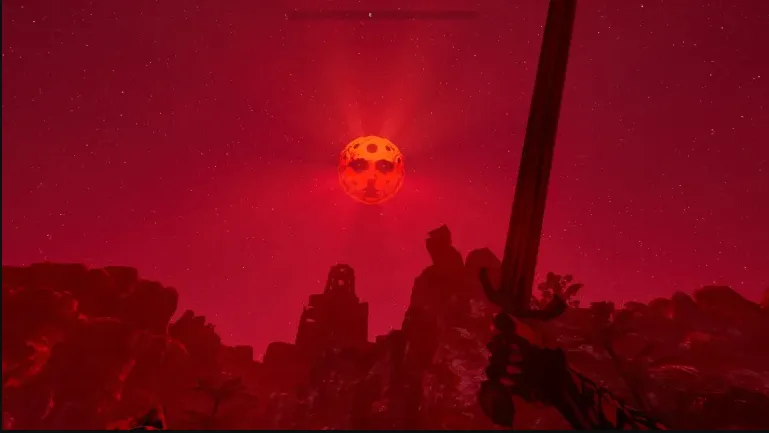
The crew over at NerveLabs, the developer and publisher of The Lantern of the Laughless Saint, knew exactly how to market this game. Tired of waiting for Bethesda to release a new game in the Elder Scrolls franchise, NerveLabs decided to make their own Action-Adventure RPG inspired by Morrowind. Their social media garnered attention through their posts, poking fun at Todd Howard and demonstrating how Lantern maintains a certain charm that is absent from modern Bethesda releases.
Lantern plops you onto a mysterious island where you are in search of a mystical, god-like being called The Saint (voiced by Matthew Mercer). You believe The Saint is the voice inside your head, beckoning adventurers to heed his call and build an audience in the theater that lays in the center of the island. Scattered across the island are several villages filled with all sorts of characters, from your curmudgeonly merchant to your village seer who experiences ambiguous visions. You must help the villagers throughout the island, with each successfully completed questline adding another friendly body to the audience in the theater.
Staying Connected
The atmosphere crafted by the fully voice-acted dialogue and striking art-style that pays homage to the early 2000s graphics transported me 20years in the past (in the best way possible). There are no quest markers, no waypoints — other than custom waypoints on your map — and little information in the quest log. The developers, whether intentional or not, created a setting that demands the player’s attention. I felt compelled to stay immersed and focus on the dialogue. I know if some of these more modern quality of life features were included (such as quest markers or detailed quest logs), I would overly rely on them and it would break my immersion with the narrative. The absence of these features never hindered my enjoyment of the game.
“The nature in which the main quest was crafted means no NPC goes to waste”
The game puts a heavy emphasis on connection and exploration. In order to complete the main quest, you must interact with many inhabitants and help them with their problems — which usually result in obtaining a side quest. The option that grants you a quest is hidden behind branching dialogue paths, requiring you to pay attention, be inquisitive, and show a willingness to help. And once you’ve proven your goodwill and completed their questline, the villager’s soul will make their way to the theater to be in attendance for whatever the Saint has in store for you. Though, the Saint only asked for “souls” to be in the audience. So you could show your heroism and help the villagers with their issues, or you could simply kill 25 of them to fulfil the main quest’s requirements.

With either option you choose, the nature in which the main quest was crafted means no NPC goes to waste. Each character has their own story line, often paired with an opportunity to assist them in some way. Rarely do I feel the need to talk to every NPC in an RPG, but here, not only was that welcomed, I was rewarded for doing so.
Skills, Perks, and Leveling Up
Some of my favorite mechanics within Lantern are the skills and level up system. I love when an RPG allows you to improve your skills simply by using them. Sprinting everywhere? Convenient and productive. Spamming jump? You’re not being obnoxious, you’re just trying to level up your Acrobatics skill. This type of skill system rewards you with the sense that everything you’re doing is incrementally making your character stronger. The progress, while slow, feels impactful. By the end of my playthrough, my sprint speed was noticeably zippier, my damage reduction from armor increased, and I was one-shotting most enemies. You can also increase your skills whenever you level up, which rewards you with five skill points and one perk point.

The perk system is another fun mechanic that adds distinctive, and sometimes silly, situational attributes to your character to give you a unique playstyle. Some perks are as simple as “gain 20% more armor if every clothing slot is filled.” Others can drastically alter your gameplay, such as The Fool which lowers your health, magic, and stamina to one. There’s a long list of perks that can eventually be unlocked, adding more elements to cater the playstyle to your personal preference.
The perks and skill system, along with a variety of equipment and spells that can be found throughout the world, allow you to fully craft your character. One-handed weapon master, sorcerer, or even the notorious stealthy archer are all viable playstyles you can slowly piece together throughout your playthrough.
Extra Features
No Morrowind-like would be complete without my personal favorite feature: console commands. For those of you who have not had the pleasure, console commands are ways to give players developer-like features to control the game outside of your typical options. For example in Lantern, pressing ~ and typing “tgm” enables god mode, granting you the powers of invincibility. These features never felt necessary in order to enjoy the game, but I’d be remiss if I didn’t mention how grateful I was for their inclusion. It felt comforting to know, if I were to get stuck or overwhelmed, the solution to my problems were just a few keystrokes away. This was yet another example of how the game nails the nostalgia factor without feeling archaic.
Another surprise included in Lantern is co-op gameplay, both online and split-screen. The developers at NerveLabs know the fun in playing games with friends, so they wanted the game to be fully playable in co-op. I was unable to test this feature, but based on forum comments, it sounds like an even more enjoyable experience. When you join someone’s game, your character is currently tied to their save, but the developers are working on a fix to be able to bring that character to a single player save.

Early Access and Performance
Lantern was released into early access, but the developers made sure the game was fully playable from start to finish before being out in the world. During my playthrough, I never experienced any major bugs or crashes that impeded on my ability to complete a quest. Every other day, a new hotfix patch is released, mostly fixing bugs, making small optimization tweaks, or even adding minor content such as new playable races.
I played on an RTX 4080 Super and haven’t had any performance issues, cruising with a steady 60fps with graphic settings on “foolish” — the game’s equivalent of max settings. Occasionally, while running from a village to the open world, the game would hitch for a second as it loads the environment, but it never truly impeded on my gameplay.

Verdict
There are a few nitpicks I have with the game, such as enemy variety, but it was never enough to detract from how much fun I was having. The Lantern of the Laughless Saint is a charming and bold game that innovates on an old formula. It asks you to meet it halfway — throwing away modern quality of life features — and rewards you with a compelling world built from each quest, culminating in a grand finale that left me in awe. For anyone out there who thinks fondly of Morrowind or classic open-world RPGs as a whole, I highly recommend this game to satisfy that itch.
Score: 8/10
The Lantern of the Laughless Saint is available in early access now on PC. Reviewed on PC, code provided by the publisher.


