
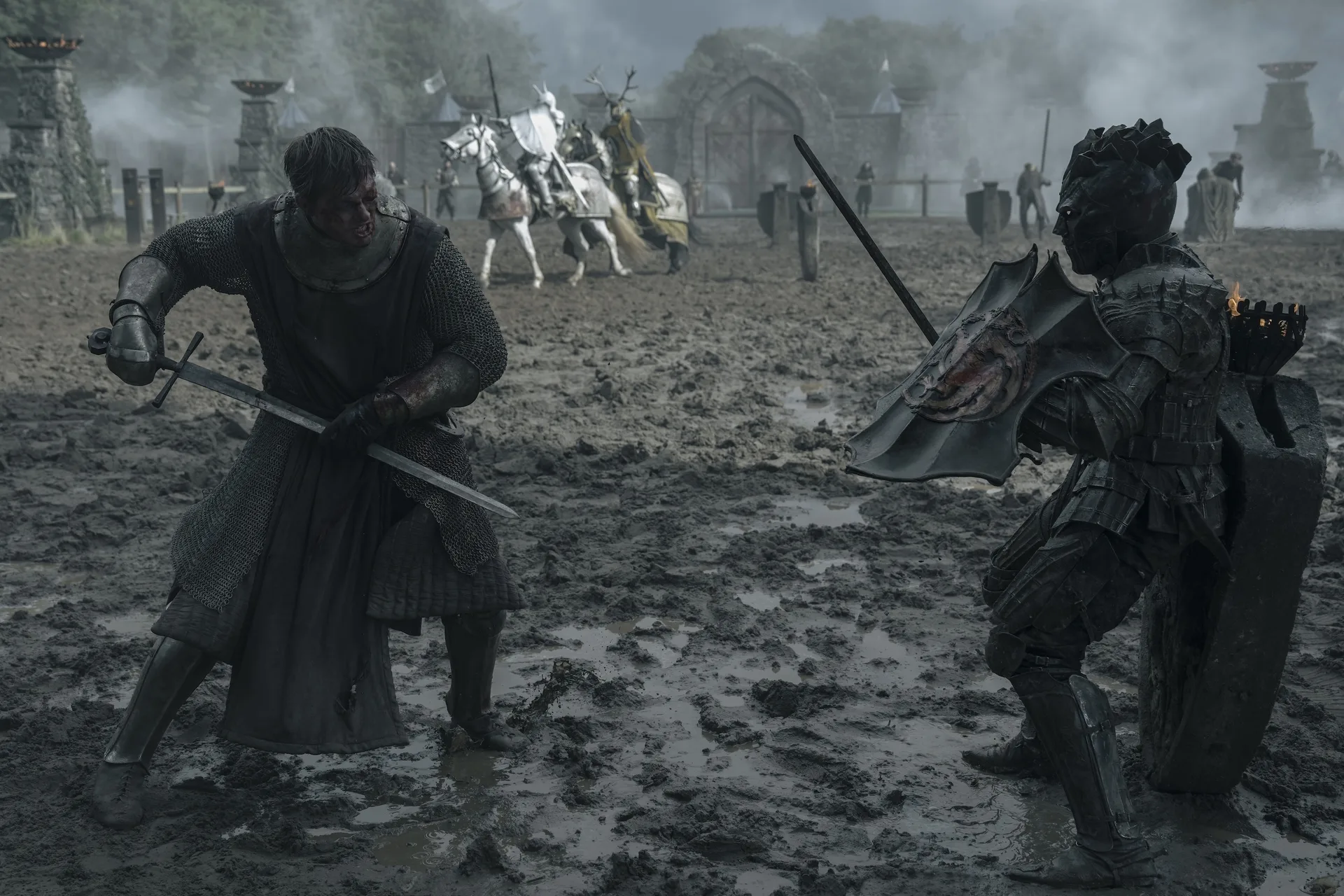
Executing the intense Trial of Seven battle required a mix of camera techniques, custom setups, and meticulous choreography. We spoke with Emmy nominated Cinematographer Gustav Danielsson about his work on “A Knight of the Seven Kingdoms.” The impressive battle in Episode 5, “In the Name of the Mother” earned him an Emmy nomination for “Outstanding Cinematography For A Series (Half-Hour)”.
Choreographing the Epic “Trial of Seven” Battle
Suhaila (Temple of Geek): Let’s dive right into episode five. It’s my favorite episode of the show for many reasons. We get the start of the battle, then we go into a long flashback of Dunk when he’s younger which spans half the episode, then we get back to the action. There’s a lot happening in the battle, between the characters, the camera work, the lighting and fog, the in-helmet shots, the hand-to-hand combat, and the action in the background. And as the audience, we get transported right into the middle of the battle. It’s impressive the amount of work that went into it. So let’s start with the battle sequence.
Gustav Danielsson: It was a massive work to conduct that whole battle sequence. You have the stunt performers doing their stunts and you have horses riding in the background and every time you need to reset something these horses need to go back. So every shot takes a very, very long time to shoot.
Danielsson: This is a battle sequence that is well scripted. Ira Parker, Owen Harris, and I talked a lot about this battle sequence and how it was going to be conducted. What I think was very important for this battle sequence is it differs a little bit from how we shot the rest of the show because it starts out quite slow, quite humorous. But then a couple of events take us into a situation where he might die. And when I read the script, that’s what I felt like, “Okay, now he’s going to die.” And I thought it was very important to create that feeling, that really kind of dark mood. It’s set in the morning, you have the morning mist in the morning light, and it’s probably been raining this day because the field is all muddy. So you have all these elements that adds to this story.
Danielsson: Before we started shooting, there’s the storyboard work with a storyboard artist. And all these shots are broken down into an image per shot. And then those shots are divided between the different units. So everyone knows how it’s supposed to look like and who is involved.

Suhaila: Was there anything that was story-boarded that once you actually got on the ground and were shooting, you had to improvise or change?
Danielsson: Definitely, you always improvise, you always change. Because you can imagine in your head how something is going to be but then when you’re standing there, it might not look as effective as you thought. Or maybe the stunt double comes up with something that looks so much better. So you’re always adaptive to what you have in front of camera and what you might find out while rehearsing a one small segment of this sequence. In the end, if you see the storyboard, it’s very close to what we did, but the end product is I’d say even better than the storyboard.
Centering Dunk’s Perspective
Danielsson: I think it’s very effective that we went from that wide perspective and then zoom into our hero Dunk. And you get really close. Especially his POV through the helmet shot and through the visor. This battle, it’s from his perspective. And that’s what’s important because up until that moment we invest so much time in this man, Dunk (and Egg, but Egg is not in immediate danger right now).
Danielsson: But you invest so much in him, so you don’t need to have like hundreds of people dying, like in the original Game of Thrones show. What makes this different is it’s just one person. Who’s about to die. So it’s very important you keep his perspective and you stay very subjective to what he’s feeling and fearing.
Suhaila: I had purposefully not read the novella before watching the show because I wanted to experience it firsthand. And I thought he was dead. The second time he falls down, I thought “He’s gone, it’s over.” I had tears in my eyes. So it was really effective and made the stakes feel so high.
Suhaila: I loved being in the perspective of Dunk because, we as the audience, obviously, have never been in battle before. And this is Dunk’s first time and he’s fumbling through it and trying to figure out. And we’re with him. We’re not seeing the rest of the battle. We’re experiencing his emotions. In the beginning he’s trying to get started and he’s so afraid he’s he’s stuck there. And then he finally moves forward and then immediately gets gets a hit. Very realistic in that regard.

Viewing the Battle Through Dunk’s Helmet
Suhaila: I want to talk about the the shots from within the helmet because those are so striking. Every time we’re inside the helmet with him, hearing him breathing, not seeing everything that’s happening, there’s this anxiety that comes up. At one point we see the mace, at another point we see a flash red blood. Can you talk about those shots and how they were created?
Danielsson: Yes, they were shot in in different ways. One of the shots that is the most prominent is one that comes up in the very beginning of this fight. When he actually is riding towards the horse and you have this big wide shot just traveling really fast to the back of his head and then you’re inside the slit of his helmet.
Danielsson: And that shot was executed by our second unit Director Rob Inch and Florian Robin, our stunt coordinator. Had a very very small camera it’s it’s a Ronin 4D. It’s the size of a fist, so it’s quite a small camera compared to our normal camera package which is an Alexa Mini LF with lenses which builds up to be much bigger. So it’s a very small camera and it was mounted on Florian’s chest as he rides towards the other rider. Since this little camera is on a small gimbal arm, it’s balanced. You get that that feeling of a POV instead of a shaky handheld shot.
Danielsson: And it is an actual visor mounted in front of the lens. We had ideas about doing this visor in post but we decided to go for the real visor. There’s some small details there. But that means also you have to dedicate yourself to this visor shot which was a good idea.
Suhaila: Yeah, it worked.

Disorientation, Fog, and the Raw Feel of Battle
Suhaila: You were focusing on Dunk’s perspective and focusing on the battle with him, but also showing the organic battle happening behind him and having it intersect. Obviously the choreography and story-boarding helped. With the camera work, how did you balance elements like the fog and the low lighting? Showing Dunk and Aerion front and center, while having enough of the background visible that we’re seeing what’s happening in the battle, that is also important.
Danielsson: To be fair, the fog is not always consistent during this battle. Sometimes you see a little bit longer when you’re supposed to see a bit little bit longer and sometimes it’s a little bit more fog. It kind of comes and goes. It’s not easy to add fog to this battle. And a lot of this fog is also fine-tuned in post by a very talented post team that made it look like all the fog is in camera but that’s not true. So you can have variable fog on this battlefield which is great when you want to tell a story. Sometimes you want to see the audience and sometimes you don’t want to see the audience you just want to see a dark shape riding towards you through the fog.
Danielsson: But in the script, you can actually read “then Beesbury dies” etc. but on screen no one’s gonna know who’s gonna die, and no one knows who comes out through the fog or who kills who. But it’s not really important. It’s just how sad things have turned because of this seven on seven. Where friend killed friend and and then he’s about to die. It’s got this silhouette, almost abstract feeling.
Danielsson: And it’s great camera work by our operators, catching that, panning quick, load something else. And they had people standing next to the stunt people just throwing mud to create that kind of mayhem. But it’s all very choreographed and all these shots take some time to set up. It looks like it’s all shot a little bit sloppy, but it’s not. It’s a big choreography to make everything in the right place in frame.
The first season of “A Knight of the Seven Kingdoms” is available on HBO and is set to return with a second season. Check out our review of the first season on our podcast.



![House of the Dragon | Season 3, Episode 2, “Queen’s Landing” Breakdown & Review [Podcast]](https://i0.wp.com/templeofgeek.com/wp-content/uploads/2026/08/house-of-the-dragon-s3-e2_3-jpeg.webp?fit=640%2C321&ssl=1)


![Review: House of The Dragon, Season 3, Episode 1 “Salt and Sea, Fire and Blood” [Podcast]](https://i0.wp.com/templeofgeek.com/wp-content/uploads/2026/06/harry-collett-jpg.webp?fit=640%2C360&ssl=1)


