
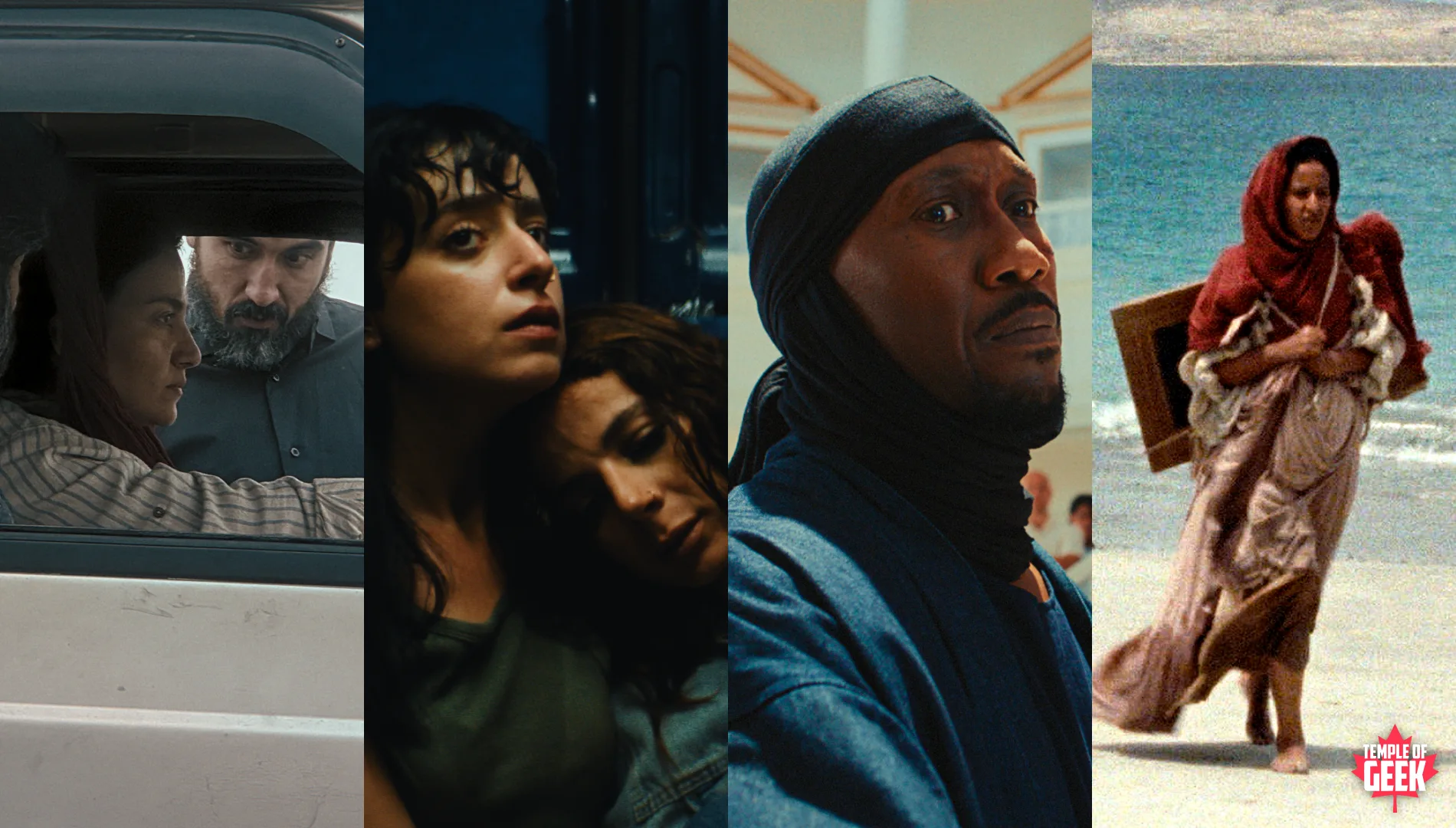
There’s something special about hearing your language on screen. Watch beautiful, heartwarming, and sometimes heartbreaking stories told in Arabic, Farsi, and Turkish. Here is a list of films with North African, Middle Eastern, and Muslim representation to watch this festival.
TIFF is back September 10 – 20, 2024 for its 51st edition — 11 days of Canadian and international cinema. Expect special events and talks with some of the biggest names in film. Including TIFF’s Industry Conference: a place to connect with film professionals and explore the art and business of cinema.

Your Mother Your Mother Your Mother
Latif (Oscar winner Mahershala Ali) is a devout Muslim and a loving family man who also happens to be a contract killer. He has a strict code: he never uses guns and he only accepts targets the world would be better off without. After his beloved wife dies, Latif resolves to end his criminal career and focus on caring for his three children — but his longtime employer Mike (Laith Nakli, TIFF ’25’s Lucky Lu) has other plans. Latif is having a hard enough time finding breast milk for his baby girl and wants no part in Mike and cowboy Haun Yoon’s (John Cho) rapidly escalating feud. But, as his bloodstained past comes back to haunt him, he may have no choice in the matter. The latest from writer-director Bassam Tariq (Mogul Mowgli) is an audaciously inventive Texas-set action thriller, also starring Egyptian-American Abubakr Ali.

Atonement
In Baghdad, in 2003, US Marine Lou D’Alessandro (Boyd Holbrook) and his unit open fire on two ostensibly hostile vehicles. Three passengers are killed before it’s revealed that those vehicles were carrying three generations of a civilian family. A decade later, following a dishonorable discharge, Lou is back in San Diego, haunted by the incident. Meanwhile, Mariam (Hiam Abbass), the matriarch of the family torn apart on that fateful day, has begun a new life in Glendale with her daughter’s young family. She’s profiled by journalist Michael Reid (Kenneth Branagh), who was also in Baghdad when the tragedy unfolded. Desperate to explain his side of the story, Lou asks Michael to broker a meeting with Mariam. Though terrified of reopening old wounds, Lou believes this might be everyone’s best chance to finally heal.

Trees Are Watching
Iranian Kurdish auteur Bahman Ghobadi blends psychological horror and ecological allegory as he depicts the eerie haunting of a writer (Eva Green). Darya returns to her hometown of Mardin with her deaf daughter and grows haunted by past memories of Spin and Nihal, twin sisters she knew as a child. Residing in their former family home — which is bordered by mass deforestation save for an ominous pair of trees planted for each sister — Darya’s unease is suddenly exacerbated by nightly visitations of a malignant entity that takes a seemingly benign form: a chair made from local timber. Soon ruminating on her checkered relationship with Spin and Nihal, the latter of whom claimed to be terrorized by a similarly fearsome fixture, specifically a maternal witch said to lurk in the home’s noisy toilet, Darya’s sanity begins to wane.

Djinn Wedding
Set in a remote Anatolian village, “Djinn Wedding” follows four siblings through three distinct stages: childhood, adolescence, and adulthood. Since their occupation of the house they live in is considered unlawful, a kind of curse hangs over the family’s fates. Deniz (İlhan Şen), the eldest son, is able to leave the village to study in the city. His beloved sister Ceren (Demit Özdemir) has no other way out but marriage. While their younger brother, Halit (Kaan Yildirim), is forced to remain in the village to take care of their disabled brother, Yasin (Sarp Bozkurt). During Ceren’s wedding, long-buried memories begin to resurface.

The Day I Smoked a Cigarette with my Father (Short Cuts 2026 Programme 06)
Sameh Alaa and Robin Vouters’ animation brings the warmth of charming, bustling neighbourhoods of 1960s Cairo to life in this touching tale of a father returning home from prison after many years and attempting to repair a fragile bond with his eldest son.

Conversation With The Sea حوار مع البحر
Convicted by an Israeli court, Kamal (Kamel El Basha) must repay the overdue social security contributions owed by his son, who died twenty years earlier in the Red Sea. With no evidence but the name of an Israeli woman found in a report, Kamal must prove his son’s death. All while re-establishing contact with his circle of friends and family, who haven’t seen him in years and hold a deep grudge against him. In a highly safeguarded society, his investigations reveal numerous tensions between communities, and the difficulty of proving his son’s innocence.

Furies
In a stifling, sticky Beirut, two sisters (Maria Nakouzi and Rym Mroue) devise a meticulously planned, yet dangerous, nighttime caper to recover their money and fund a life-saving procedure. Teaming up with two men with shady pasts (Issam Bou Khaled and Hasan Akil), the sisters go all out in a thrilling race against the clock.

Edward Said: Between Worlds
Edward Said had an unusual prominence as a public intellectual from his base at Columbia University. He wrote foundational texts such as “Orientalism” and “The Question of Palestine”, and frequently appeared on television to explain the Palestinian cause and battle willful distortions. When he died of leukemia in 2003 at age 67, the world lost a vital and complex thinker.

Thirteen in Gaza
Raghad (Mary Ziyara), a 13-year-old girl, has lost her home and most of her family in a bombing in the Gaza Strip. She now lives with her father (Firas Al-Masri) in a displacement camp, where she’s entering puberty in a crowded environment devoid of safety, privacy, and care. Meanwhile, her father faces hard choices and a moral dilemma involving Khalil (Ghassan Salem), the local boss, in order to ensure their survival.

The Fortunate Isles
While the unforgiving landscape maintains ultimate power, Fátima (Luisa Ahl Laabiad), a woman enslaved to a decrepit and deteriorating Marquis on a desolate archipelago, must contend with her near-term pregnancy and the island’s few other parched and malcontent residents. As her master refuses to relinquish his paltry water supply to his desperate citizens, and his son closes in on his fief, an insurrection brews. Now, Fátima must balance her loyalty to herself, her love, and her future child against a corroded power dynamic.

Head to Head
In this “film within a film” structure, Ghasideh Golmakani tackles not only the way women are portrayed by her fellow male directors but also their place in Iranian society. Using all the questions she had, Golmakani makes a brilliant use of humour to depict the relationships between men and women. “I’m not torturing you,” says Bahar to an uncooperative actor. “We’re recreating a perfectly normal situation with costumes used in our cinema.” Then censorship intervenes, and the film crew steps outside its original setting to confront its own ambivalences with those of the outside world. The mockery rises to a whole new level, in which an old woman appears as the guardian of traditions, and thus an accomplice to the oppression experienced by women.

Rescue
“Rescue” opens with a harrowing abduction in the waters of the Mediterranean close to the Libyan coast. Director Sine Plambech and her film crew are accompanying the Geo Barents, a rescue ship operated by Doctors Without Borders that’s trying to save a rubber boat packed with migrants in distress. Suddenly, a third vessel approaches, piloted by Libyan militia members. During a frantic scramble in the open water, some migrants are snatched by the militias, while others reach the Geo Barents. One of the rescued migrants, Hani, tells the film crew he has just been separated from his family. His wife Roro, his young son, and their two-month old daughter have been kidnapped by the militia.



![House of the Dragon | Season 3, Episode 2, “Queen’s Landing” Breakdown & Review [Podcast]](https://i0.wp.com/templeofgeek.com/wp-content/uploads/2026/08/house-of-the-dragon-s3-e2_3-jpeg.webp?fit=640%2C321&ssl=1)


