As the League of Legends trading card game Riftbound nears its first anniversary at the end of October, its growing and passionate fanbase eagerly awaits the release of the game’s fifth set Radiance. Like previous expansions, Radiance introduces a host new cards, mechanics, Legends, and more into the TCG. As Riot Games and the Riftbound team reflect on nearly one year of the game being out, Riftbound’s Regional Qualifier event in Los Angeles was in full swing. During the event I had the opportunity to sit down with Dave Guskin, Riftbound’s director, where we chatted about a nice variety of different topics.
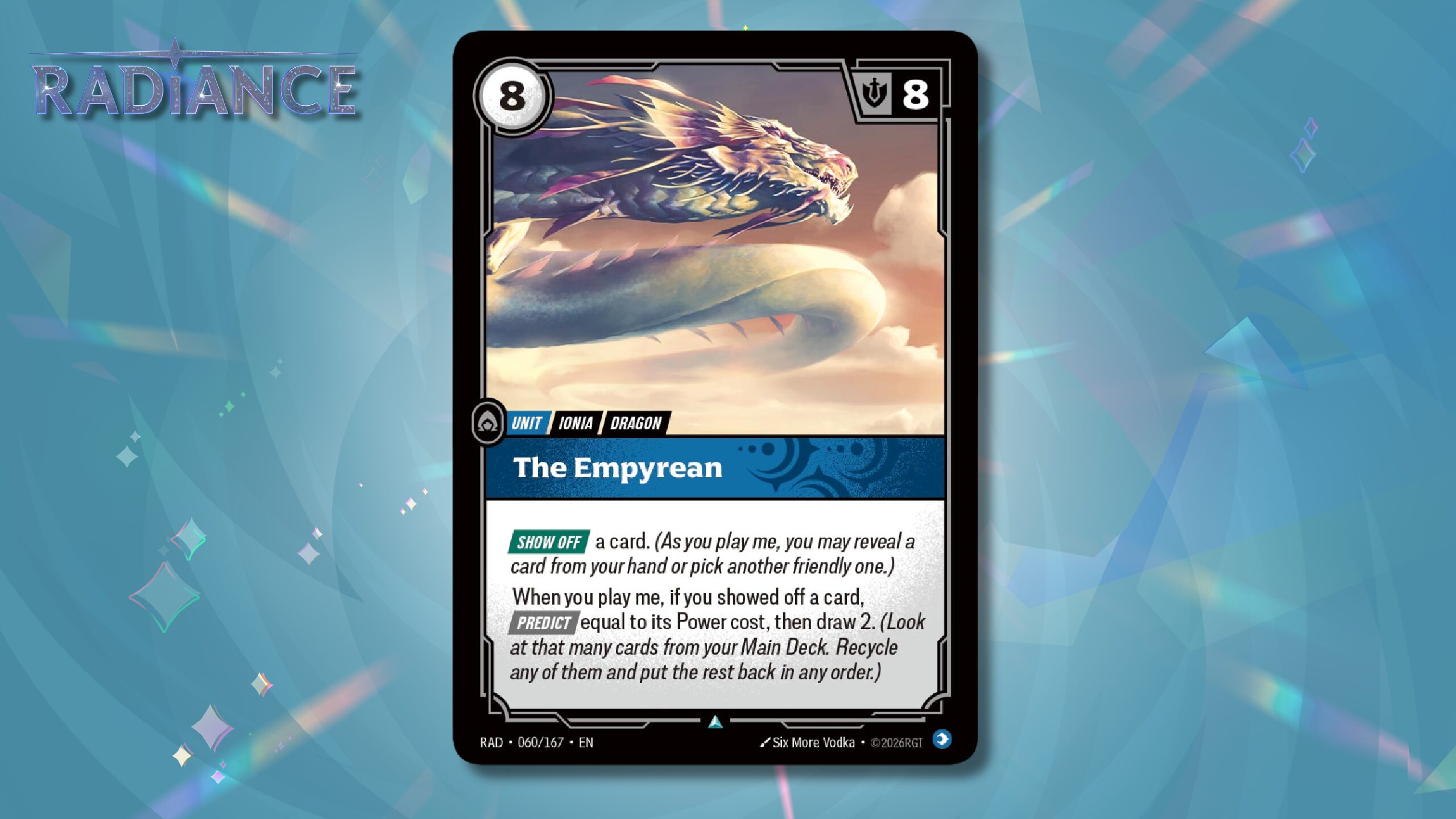
Everything from card bans, design philosophy, tournament entry procedures, and more were discussed, and the full interview has been edited slightly for clarity and easier reading. And for more Riftbound Radiance, check out our exclusive reveal card, The Empyrean.
Interview With Dave Guskin, Riftbound Game Director
Temple of Geek (ToG): So to start, thank you for moving the Legends to the common slot. What’s the feedback been like?
Dave Guskin (DG): [Laughs] First of all, it’s great that, when the community has something that they care about, they let us know. Obviously, sometimes people are quite passionate about it. And I think one of the nice things about that was we were already in parallel talking about moving the Legend to its own slot because for limited [draft and sealed]. It’s just better to make sure that there are enough Legends for that format. So that was that was sort of the impetus of that. I think I would have preferred to do it sooner. There are some minor tweaks we made to sets beyond Unleashed, where this first became a really loud problem. But I think set six Legacy is the first time we’ll see it.
ToG: I’m local to LA and there’s a huge Riftbound scene here, and I know a lot of people who both played casually and competitively, who weren’t able to get into the Regional Qualifier event (RQ). Is there a future where you give priority sign ups to people who maybe have a bye or who have won a Summoner’s Skirmish, or any sort of metric like that?
DG: Yeah, it’s a good question. It’s one of the driving forces behind getting the Riftbound gaming network together, right? Where we have our own tournament platform software now, is that we’re able to do more kind of customize things for a Riftbound. So definitely something we’re looking into is trying to figure out how to make it better and easier to sign up for events. I’m not sure we’ll ever be able to have an event where we can accommodate the sort of demand we saw for RQs like this one, but I think there’s a lot of great ideas out there around. Like, who should get priority? What does it make sense to do in terms of reserving spots?
ToG: And I’m sure it’s something that, at the end of the day, is still out of your control with how many people want to come.
DG: I think the “real solution” is something we’ve already started putting in, which is these Showdown Series events. These are third-party events that can kind of accommodate some of the demand where you want an event local to you. That’s sort of the big event, but we can’t bring RQs everywhere and have them be enormous.

ToG: So I’m sure you’ve been asked this a lot today, but I’m curious about bans. A lot of the card bans the team’s made have been kind of based on lack of interaction, like with Arena’s greatest, Obelisk of Power. You don’t really interact with those types of cards. Some players would argue that Dazzling Aurora is one of those cards. So now that Stacked Deck is gone, is Aurora your new target? How are you analyzing it?
DG: Yeah, it’s an interesting case because, since the beginning of the game, and then especially an unleashed once Elder Dragon came out, I think it’s been at the very top of people’s minds. This is the menace, you know. I have to figure out how to play against this. I think in some ways, Aurora is good for Riftbound and that it’s a way to play the game a little differently. It’s a strong deck that you can learn pretty quickly. But it still has a lot of depth and strategy to it. That said, there’s a lot of decks that you could say that for, and some of them are quite frustrating to play against. And especially times where it’s really hard to interact. A lot of things you can do with Elder Dragon and Aurora, especially in combination with cards like Flurry of Blades and things like that, are quite difficult to overcome. And so I think we’ve got our eyes always on situations like that where it’s like, this is really frustrating. I don’t know how to interact with this. I know how to get better against this. And when that becomes too loud or the deck becomes too powerful, those are times when we would take action. So I’m definitely watching to see if Jayce Aurora is the monster of the tournament. Aurora has never performed super well in the top 64 of events. It’s been good at various times. We’ll see if that holds out. But even if it doesn’t, some of it also comes from understanding how people are interacting with it; their local Nexus Nights, playing casually, and making sure that there are tools you can use that you feel good about. You don’t have to just feel like you have no chance.
ToG: You’re a couple years ahead in terms of the design process, and with the Lux infinite combos gone now, are you looking at other infinite combos and are allowing some to stay versus more powerful ones are going to get the boot?
DG: So combo decks usually are trying to perform on a different axis. They’re going to ignore the regular game and do their combo and that’ll win me the game. To some extent, Aurora is like this, but it does still play a little of the game as it exists, because you still need to score points, for example. Whenever there’s a combo like that, we sort of look at two things. One is how reliably can you execute the combo? And the other is, how difficult is it to stop the combo if you’re trying to go after it? And I think when both of those things are severe, that’s when we’re thinking “we like have to stop this”. The Lux infinite combo, I think, got to a point where it was both incredibly consistent, and there wasn’t really any way to interact with it, especially with the cards that are printed thus far. Into the future, we’ve printed more answer cards, and that helps. It’s not like we know exactly what the next infinite’s gonna look like, right? We can’t test literally every car interaction, every other card engine. Players are great at that because there’s thousands of you and that’s awesome. But we’re never going to find everything. I want to make sure the combo decks can still exist as long as they’re not a 10 out of 10 deck. If it’s like one out of 10 or out of 100 games that I get to execute my awesome combo, that’s not bad for us. I just want to make sure you’re not facing it at the top tables if you’re competing at that level.

ToG: And having a healthy amount of different archetypes is good for the game long term as well, right?
DG: Yeah, exactly. We want to be able to have texture in the game in that way. If everyone’s just always jamming the same size units into each other and playing combat tricks, that’s cool, but that shouldn’t be everything.
ToG: So you mentioned making changes to how the game works, like with sideboard slots recently increasing from eight to 10. Do you have other plans to change the structure of how decks are built in any way?
DG: It’s hardest to change cards that already exist. It’s easier to change the rules, but still difficult. And it’s easiest probably to change tournament rules or deck construction rules, or how the game starts, things like that. Those are things that we’re constantly talking about and looking at. And thinking about if something is really the best that it could be Can we change it? What’s the cost to change it? Is it easy for players to learn the new system? How much better is the new system, that sort of thing. So, I would say that when there’s opportunity to make changes like that, and we think, this is this is all upside, or it’s worth the downsides. I think those are times when we change.
ToG: What would you consider worth the downsides? Do you have an example?
DG: Yeah, so maybe the player going first is winning too much, right? Winning the dice roll results in a 100% win rate. Let’s imagine that what it is. We could change the rules to make it so that the first player doesn’t win as much. We could, for example, take things away from the first player or give things to the second player. With taking things away from the first player, the downside is maybe everyone has to change the way their decks are built. But giving new things to the second player might be a way to address that first player winning problem without worrying too much about if everyone has to remake all their decks. So that’s like one example. I think there are other ways to think about it where it’s like, the cost to learn, or the difficulty to execute, or how much it incorporates risk of future content, right? So those are the things where if we can minimize those downsides, and there’s significant upside, then it’s probably worth it.
ToG: Okay, let’s change gears a little bit. You previously said that the plan is to have every League of Legends Champion in Riftbound as a card. Hw close are we to that being a reality?
DG: Closer than it might seem, I think. Although, as we fill out the entire roster, I think the ones at the end might be the hardest to find the right fits for. The ideal situation is whenever we bring a champion into Riftbound, we’re picking the right place for them, the right kind of complementary champions in the same set, the right theme for the set. But I think we’re getting there. I would say there’s still a distance to go. But my guess is in the next few years we can probably hit almost all of them.
ToG: So when you design a set, do you have the characters in mind that you want first and then design mechanics from there? Or do you have the mechanics first and kind of pick and choose who fits that vibe?
DG: It goes both ways, actually, it sort of ebbs and flows. With Unleashed, for example, where it had this jungle theme. I think that theme came first and then we filled in the right Champions to fit in. But sometimes it’s sort of ground up from us asking if we think these mechanics are awesome and they fit together, or if these Champions are ones we want to get in the game at this point for a variety of reasons. This first year especially, was sort of a year of experimentation. I have a science background, so I’m always thinking in terms like, “what’s the physics experiment we could do here”? And in this case, I think it’s trying a lot of different constructions of sets. There’s lots of different ways to get to the end result of a coherent, awesome set for both theme and mechanics.
ToG: So with Vendetta, we had the first enemy-Domain (color) Legends. I’m curious if there are there plans to do more or is this like a one and done thing?
DG: Yeah there are plans to do more. When we were first constructing the systems of Riftbound, and we said we’re going to do these two-color combos out of six colors, we set aside those three enemy pairings because we wanted the Domains to feel very at odds with each other. So we reserved those opposite pairings as something cool to do in one of our future sets. But then we knew once we did it, players would want to have more, and we don’t want it to be that anytime you ever play red-green, you have to play Akali, Rogue Assassin. And so that’ definitely something that’s on our minds, we do want to make sure there’s more options for these color pairs.
ToG: So let’s pivot a bit over to Radiance. What were the challenges when designing Domain-neutral (colorless) cards that can fit in any other deck like Neeko, Bleeding In? Because with each color, they have certain ideals or properties that work together. What was it like balancing colorless cards?
DG: Yeah, I think the most important thing to think about when making something neutral that can go on any deck is that I don’t want to give a tool to a deck that it really shouldn’t have, right? So you’ll see this in any game that has neutral cards that can go on any deck. They have to be a little bit careful with how good the effects they give are because if, for example, we have a Domain that’s really bad at killing units, and we make a neutral card that’s really good at killing units. Well, now all of a sudden, every domain’s good of killing it. So I think part of it is trying to make sure that it’s a little bit weaker than you might expect for a card that’s not neutral. But maybe it does something that’s a little bit oddball, it’s a misfit and doesn’t necessarily fit in any Domain. And I think Neeko, which is sort of this premier neutral-Domain Champion has that aspect of being something cool and different. We’re not going to be think that this Domain is the best one at adding Legends to your Legend zone. That doesn’t make any sense because we wouldn’t do it that often.

ToG: Is Neeko the only neutral card in Radiance or are there more?
DG: I can’t confirm or deny. I will say that, I think, neutral cards are a well that we will likely go back to. Because I think that it is an interesting space to explore. I don’t know how much depth it has. That’s going to take time to explore and test, but it’s something that’s interesting. And when you’re like “I wish I had this tool for every deck”, neutral is a chance to do that.
ToG: I don’t know how it would work, but do you have plans to do a neutral-colored Legend?
DG: Yeah, it’s something that we have talked a little bit about. What cool things can we do with Domain combinations ranging from zero, neutral, up to three or four? What would that even look like? I think that that’s space for Riftbound to explore over a longer arc. I think in this first year, maybe even in the second year, there are fundamentals to explore here. Have we even really explored all the cool things to do with movement? It’s definitely a question of, if there’s opportunity to explore it, I think we will.
ToG: So Radiance is the game’s fifth set. As time goes on, and more and more new mechanics are introduced, what’s the challenge with trying to balance a set like Radiance on its own for limited formats (draft and sealed)? Versus mixing it in with the other four, what sort of work goes into balancing the cards?

DG: So this is a really good thing to talk about with Legacy, a set that’s coming up next year. I think the sort of tension and the two problems to solve are when you make a limited environment, you want to make sure that when you open packs, you can see the connections within that one set, right? So the Fury cards should interact well with the Fury cards. And when you think about things like, this Legend is in this set, and these combinations of things work well with it, but maybe these two Legends could use these two cards in different ways. That’s all within the same sett. When you expand out into the constructed environment where you’re maybe adding card from a new set, like Radiance to older sets, a lot of it is about, what can I reinvigorate in terms of old strategies or old Legends? What are the old cards that work well with the new Legends, and how I want to make sure they fit in as puzzle pieces into that wider environment. And those two things are somewhat at odds because when you’re opening the pack, you want to get all the tools within that one set. When you want to connect with the other sets, you got to make sure you’re denying some of those tools because then people look at other sets for those tools. And it’s backwards and forwards. It’s quite a complex problem. That’s a lot of work. So a lot of it just comes down to testing, trying things out. First trying limited, and then trying constructed and going back and forth and start tweaking things until you get it right.
ToG: So when you test internally, you don’t start with constructed?
DG: So it depends on sort of the timeline, right? Up to Radiance, we’ve mostly started testing with constructed. We’ve done a little bit of limited testing, and a little bit of draft, but not very much. When you build a set, like with Legacy forward, where limited has been a priority for us and making sure that it plays well, you start with the commons and uncommons, because that’s when people are going to open in their packs. And generally, we have done that. The one monkey wrench for Riftboundis, because we have Legends and Champions you can rely on, that kind of changes the structure and texture of it so that you’re not just playing with commons and uncommons. You know you’re going to have the Legend, too, especially now that they’re [going to be available in the common slot]. And so we have to think about that when we build limited, and that sort of dovetails nicely into low-powered versions of that deck. Because a casual player might not have all the access to all the awesome rares and epics, and they’ve been building a low-power version of the deck, and then it kind of builds into the high-power versions. So that’s generally the flow. It doesn’t always work that way. It depends on how well we think things are going and also where the big risks are.
ToG: So sticking with Legacy, it’s one of the larger sets in the game, with over 300 cards. And it’s designed specifically to better support the draft format.
DG: Yeah. Legacy’s got a lot of cool stuff in it, a bunch of new Legends to build around and they interact in cool ways. But on top of that, we’ve also tried to make it a great environment for limited games.
ToG: Okay. So then from a competitive point of view, are there plans to introduce draft as more of a main event thing, similar to the Magic: The Gathering Pro Tour?
DG: Yeah, we’ve talked about it. I’m not sure exactly how we’ll do it, but I think we want itonce limited becomes an awesome thing to play and to demonstrate mastery in, that’s a great fit for competitive. And we love to integrate that into the whole ecosystem. How we do that, not 100% sure. We’ll experiment a bunch like we did this year and where it fits in and where players want to play it and how that goes.
ToG: So you’re almost at one year of Riftbound being out, how does it feel to get here? It feels like it’s been a lot longer than a year.
DG: Yeah, a lot lot’s happened in the last year. It’s been awesome. I think one of the cool things about Riftbound is how quickly it’s grown and how quickly the community has grown up around it and adapted into what we’ve made and made it their own. This has been awesome. I think the other things that have been interesting is, as we start to introduce new, awesome things for collectors, to see that part of the audience get engaged, thanks to League of Legends fans
ToG: So looking back, are there any lessons you learned? Or anything you can look back on that maybe felt like a mistake?
DG: There are some things I’m not really sure were predictable in the moment, but in hindsight we obviously know some things would have been better in other ways. The first one is Proving Grounds and the unique cards in the, I think it was with good intention. In the course of making unique, simple cards for Proving Grounds, some simple cards can also be quite strong. You’ll see that with Master Yi, Wuju Bladesman, Lux, Lady of Luminosity obviously has had her day in the sun, and Annie, Dark Child for the first season. I think that that put a little bit of extra pressure on competitive that I wish we had maybe thought ahead and made the cards either not unique or not competitively available. I’ve talked publicly before about how I’m not that happy about how print runs went. But in the end, it’s probably not bad that, if you had Proving Grounds, you actually have the core of some decks that are pretty cool to play. And the other one is that we always knew that there was the possibility of high demand for Riftbound, and we tried to get ahead of that, but it grew faster than we even expected. And I think being able to get ahead of some of those supply issues early on in Riftbound’s history. I think we’ve started getting on top of it a lot more, which is great. But that’s something that, with the full benefit of hindsight, I think maybe we would have planned for a good case, but what is the extreme case that we can be planning for and how quickly can we make that work?

ToG: And you’re doing Proving Grounds two, which is going to have a higher print run and with cards better in the main set, right?
DG: Yeah, that’s right. So Proving Grounds two, not exactly sure what it’s being called, but with Legacy doesn’t have any unique cards. So they’re all [cards you can open in booster packs].
ToG: Okay, awesome. So, looking forward to year two, how does it feel? What are you excited for the most?
DG: I’m really excited for Legacy. I’m a limited player at heart when I play TCGs, so I’m excited about that. I think there’s some really cool stuff that we’re doing with exploring Runeterra and showing off cool parts of the IP as part of our new illustrations. Some really cool mechanics, some returning mechanics that I think will play in different ways. And I think that’s really good for the game.
Radiance, Riftbound’s fifth set, releases worldwide on October 23.