
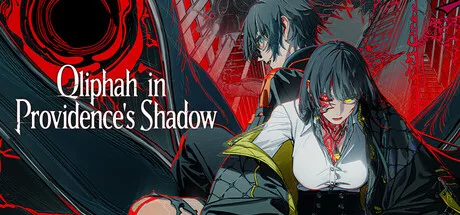
Descend into a contaminated Tokyo in a brand new world brought to players by Arc System Works. Combining the slower pacing of a narrative-driven game with frenetic combat, Qliphah in Providence’s Shadow is the first of its kind for me as a player. The world-building is quite intriguing and has the art to match. Having two protagonists at odds with one another draw the player in. This dynamic made me want to keep playing just to see how the two would get on throughout the game.

It’s Pronounced “Kli+Fah”
Qliphah in Providence’s Shadow opens up in a post-apocalyptic Tokyo. An event known as the “Collapse” has occurred with the city decaying as terrifying beings known as Anomalies roam its streets. Players meet Rena Hizuki and find themselves nearly instantly into a battle with an anomaly. The game holds your hand here with this fight being a tutorial into the battle system used throughout the game. Don’t let this slower-paced fight fool you. It only speeds up from here. Upon successfully dispatching the anomaly, Rena meets Soma Hoshigami.
Despite the danger of decaying Tokyo, Soma finds himself attacked by an Aberration while out working. What should have killed him leaves him in a purgatory of a half-turned state, a mutant. He is both man and anomaly and under the Public Safety Mutation Response Division’s definition – dead. The very same department Rena just so happens to work for. Mutants being categorized as dead mean that their future typically includes true death. Rena is taken aback at how he has retained his humanity despite the attack and he is taken into custody as property. Instead of being killed in truth, Soma joins Rena in her fight.
Outside of the horrifying monsters roaming the streets, there is an especially dangerous drug known as “Tiny True” circulating out on the streets. The drug’s victims are found with stigmas, glyphs carved in their bodies. Most commonly the victims are the youth of the city, transforming an already bad situation into something much worse. Both Rena and Soma most face the Anomalies as well as the cult behind Tiny True. Together they must attempt to right the wrongs antagonizing Tokyo.
Fast-Paced Fighting
The tutorial players experience with just Rena at the beginning expands to include Soma. Both are controllable by the player and swapping between the two in fights becomes crucial as each character’s attacks and skills have cool downs. Countering enemy attacks is the goal, with two circles of the same color (either red, blue or yellow), one expanding and one contracting, to eventually meet indicating the timing for a counter. When the two circles overlap, using an attack that is the same color as the circle by either character at the right time can result in a counter. Counter properly and two things occur. No damage is done to your party and stacking up enough counters will stagger the monster, allowing for massive damage to be done.
There is also dashing and dodging, adding movement to the speed of combat. Players can also slow and stop time to bank attacks. Slowing down time to create chains of attacks is cool in theory, but I didn’t understand how to work it in successfully. I was always attempting to match the colored circle indicating how to counter an enemy’s attack. Banking attacks often meant my character was not doing the correct corresponding attack to properly counter. Having the ability to pause combat felt great as it’s quite fast-paced and sometimes I needed time to catch up.
I felt, while fighting with just Rena, that I was getting the hang of combat. Adding in Soma showed me just how confused I was. While interesting, I never really got the hang of how battles were intended to play out. I was mostly button mashing my way through most of the fighting. Finding out that combat scales with skill was probably the main reason I got through most fights. I never felt like I never quite mastered the battle system but was still able to progress. The fighting itself looked very cool – lots of colors and movement – but I was lost often and would get the end battle scorecard without having much understanding of how I got there.
Narrative-Driven Storytelling
I have played narrative adventures before and this game, despite the combat, feels like it fits best under that moniker. The story is told through visual-style scenes and cut scenes. I often felt like I was watching a movie or anime instead of playing a game in these moments. And there isn’t necessarily anything wrong with that. It does create an interesting juxtaposition between how quickly the fights move and then sitting back to watch the next story beat unfold.
Another way the story is told, and guided, is through a massive interactive map. The next mission and optional fights are highlighted and while the player can see the entirety of the map, this game very much has linear progression. Players cannot click into a location until it is time to go there. Again, another choice that is completely fine. Not all games need to allow for open world exploration. There is a fair amount of reading to be done within this menu, providing the player key context and backstory the cut scenes don’t show. As an avid reader myself, I enjoyed how this part of the story was told. Several of the cut scenes felt as if they “talked over” the player’s head and it wasn’t until I started reading through some of the files on the menu that I began to get the full story.

Verdict
Qliphah in Providence’s Shadow is an interesting ride with both its highs and lows. I enjoyed the visual story telling combined with the actual reading required to get the entire tale. A contaminated Tokyo with Anomalies stalking the remaining citizens is an intriguing premise. And while the world and its ideas were alluring, I unfortunately never felt the pay off. The combat is fast-paced and fairly confusing. I never felt like I had time to learn and understand its flow. And while combat skills were unlocked throughout the story, none really felt like they made much of a difference to a fight’s outcome. Battles often felt repetitive and become something I pushed through to get to the next story-telling segment. Overall, I feel like this game has some incredible bones but fell short of making it all synergize.
Jamie’s Score: 7/10
Qliphah in Providence’s Shadow is available now on PlayStation 5, PC, and Nintendo Switch.


