
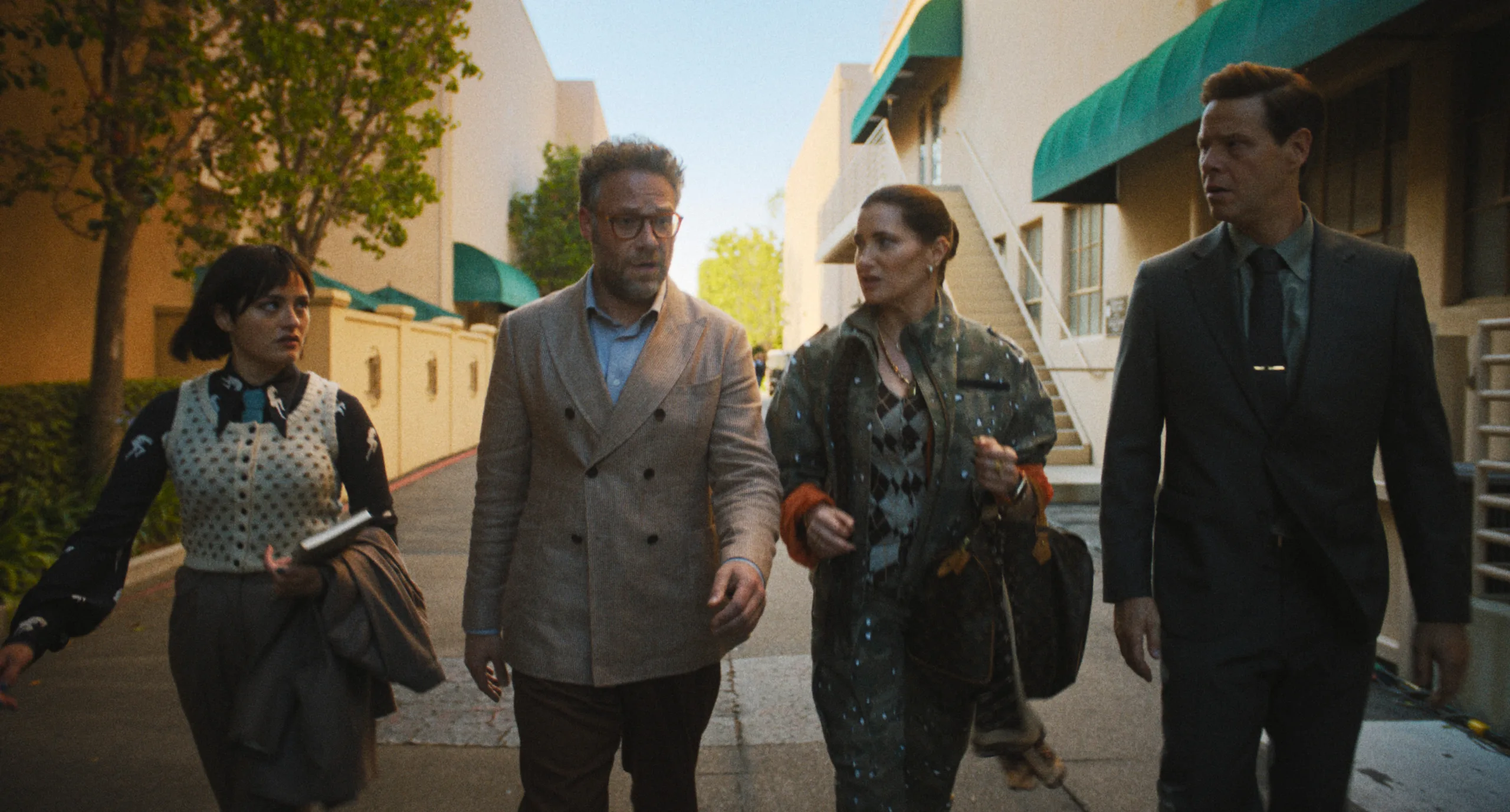
Temple of Geek sat down with set decorator Claire Kaufman to discuss her work on the show “The Studio” and her Emmy nomination. Kaufman shares her process for creating the unique, retro aesthetic of Continental Studios and the various sets and movies in the show. Because of the specific style and short timeline, Kaufman and her team manufactured most of the furniture, with personal touches for each of the main characters’ spaces. Blurring the lines of on-screen and real sets, Kaufman worked with many creative departments to bring the world of “The Studio” to life. Creating believable environments for audiences to enjoy, Kaufman hopes the film industry continues to build sets and praises the craftspeople in Los Angeles without whom this show would not have been possible.
Suhaila (Temple of Geek): Congratulations on another Emmy nomination! Amongst so many nominations and awards you’ve already received, including Oscars, BAFTA and Critics Choice. How does it feel to to get this nomination specifically for a show that’s so meta, looking at the behind the scenes of the industry?
Claire Kaufman: Anytime you start a show, you just never know where it’s going to go. I had no doubt in my mind this show was going to be amazing, just from the group of people that I was working with. But, the way it’s been received is amazing, and I’m so proud of my team and I’m so proud of the work we did. You just always hope that you are involved in a project when all the worlds come together, the cinematography, the wardrobe, the production design. And this I think is a perfect example of that happening on this show.

Creating the Unique, Retro Aesthetic of Continental Studios
Suhaila: Let’s dig into Continental Studios, because that’s the big one. A lot of episodes are shot inside the building itself and the studio lot. The aesthetic of the building is very like retro, art deco, Spanish revival. What was it like putting together all of the decorative pieces, furniture, textiles, etc. and creating Continental Studios as we see it?
Kaufman: It was really interesting when I met with Julie [Berghoff] and we talked about this office building she was designing. My first thought was, “oh, wow, how am I going to find furniture?” And not only furniture that aesthetically is correct, but in multiples. So I knew pretty instantly that we were going to have to manufacture almost everything for that office. I dug through and figured out pieces we could say had been introduced along the way, maybe in the upholstery. Julie and I talked about what would be built-ins, like sofas and pieces. I wanted to have a clear line through all the pieces.
The idea was that it’s a studio leftover from the 30s that’s hanging on and had a few upgrades. Julie and I talked how there’s something really amazing about having an Apple computer on a Frank Lloyd Wright desk. So, I just chipped away and figured out the pieces. We built coffee tables, side tables, Matt’s very heavy desk, and the conference tables. We incorporated the block design into the wood of the tables. It’s such a large, cavernous space. We didn’t necessarily need a lot of pieces, we needed the right pieces and we needed the scale to be correct. From the sconces to the furniture to the artwork. We needed these big bold strokes to make that space work. And I’m really happy with the way it turned out.

Bringing Matt’s Personality into His Office Design
Suhaila: I do want to talk about Matt’s office in particular, because we see his personality in it. What elements did you put in there to reflect him either in the furniture pieces or even something like the books? The details that we may not have actually like seen on screen but that are selected for him in particular.
Kaufman: He’s such an interesting character because in his heart, he just he loves movies. So we really tried to get that across with some of the dressing. The old leather director’s chair would have been something he bought on eBay because it belonged to a famous director he admired. We tried to get some of his movies in there through posters. And that he has this archive and that he spends his life studying movies, and wants to know everything about every movie that’s ever been made. So old cameras and we wanted him to be into music, so he had a record player. We also put in some old pieces, like a rendering of the exterior of Continental Studios he would have kept from the past, awards, and other bits and bobs.
Individual Character Spaces Continental Studios
Suhaila: Then there’s all the other characters and each of them having their own spaces and desks. How did you go about furnishing all those individual spaces and having them be reflective of each character?
Kaufman: You look at Sal and he’s a bit of a guy. So, we just tried to play up that he’s really into sports, he probably does betting on the side. We tried to make him, certainly not as cool as Matt, but loves his job and has been with the studio for a while. So we tried to give him cigars, decanters, things like that to reflect his personality. And then Quinn is so interesting because she’s young, and we wanted to give her this little nest to be in with all her scripts. We talked about her being into artwork and finding great pieces from Mary Kornowski Gallery. We tried to give each space its own personality and reflect who these people are. But at the end of the day, they all wanted to be there and they all love movies. We tried to get that across.
I’ve done very stark sets and I’ve done hoarder sets. But for me, it really is in the details. Anybody can pick a beautiful desk. It’s really like what you put on that desk, whether it’s three objects or 30 objects. Trying to get across to the audience I’m telling a story about who these people are. And I want that story to come across very quickly.

Artwork at Continental Studios
Suhaila: There’s also a story to be told about Continental Studios as a space. The furnishings, the artwork, the huge mural with like the big C shining down. Could you talk about the artwork that we see throughout, like the movie posters? There’s one that looks like the Vertigo movie poster in a big art piece.
Kaufman: I actually worked with my own graphics person, Kevin Kalaba. We went to the writers, and they gave us a list of titles. And we decided which titles fit best from the 30s, 40s, and 50s and really wanted to design these posters through the decades. We looked at many artists and movie posters. Kevin did a wonderful job making up these fake movie posters for me. I found the staircase Vertigo picture in Matt’s office, and when we showed it to Seth [Rogen]. He said “It’s great. Can we put a dead body on it?” and I was like “Absolutely. Amazing. Love it. Let’s do it!” I can’t take credit for the big mural; Julie worked on that with another graphic designer.
We had a short load in for that project. I had six weeks from beginning to the first day of shooting, which of course had to be Continental Studios. So there was no buffer. It was amazing being at a studio with all these amazing crafts people. I had the wood shop going at Warner Brothers, I had the metal shop, drapery, upholstery, the prop house with other vendors around Los Angeles. So I cannot speak highly enough about why we have the best craftspeople in the world in Los Angeles. And they were really the reason that I was able to make this happen in the window that we had because it was it was tight. But we did it.

Props and Set Pieces for In-Show Movies
Suhaila: With all the different crafts people that you had to bring in, and all the different aesthetics, movies, sets, all the different changes on the studio lot, there’s so much going on. Even in the backgrounds as characters were walking around, there’s different props and set pieces, areas that look like a halfway put together set, entire sets for the movies like Chinatown. How did you manage all of that?
Kaufman: We were lucky to have the scripts. That’s always incredibly helpful, especially when working under tight deadlines. I’ve worked at Warner Brothers a lot and knew the backlot very well. It was amazing to get the scripts and talk about doing these movies within the show and how elaborate or small they would be. That was coupled with golf cart tours through the lot. I’d go back to Pee Wee Herman’s Great Adventure and you see the backlot with the showgirls. It was a throwback to that, but I also wanted it to look real. All the pieces were dressed to be specific. We would talk about “Well, they’re going to fo this tour and we’re going to have the Spartacus movie or the vampire movie going on and he vampure movie”.
That coupled with the Ron Howard film on the lot, even the little zombie apocalypse. You’re basically taking these barren streets and turning them into a movie set. So it was a lot of fun. The crew were all game and the grips let me roll in their carts. So it was it was really a group effort by everyone.

Props for Background Vignettes on the Continental Lot
Suhaila: Did you borrow any prop pieces from other movies that were shooting at the same time? Or was all of that created just for the show here?
Kaufman: No, every single one of those vignettes was created from scratch. We originally tried to do Chinatown on a smaller street at Warner Brothers. And unfortunately, it was not available to us. And I was like, wow, this street is massive. But, it was bringing everything in and bringing all the lights and all the flags in. And I’d gone to Chinatown to do some some research and take some photos. And I came back to Julie and I said, I think it’s so important for us to build the arch. It’s the piece. And it was, we did it really smartly. And it wasn’t a huge cost to us. We knew that most of it would be seen at night. And it was really about the lighting.
It’s such a big part of my job now working with the lighting department and the DP. And I can’t speak highly enough about either one of those departments because they were amazing. It was so interesting for me because I’m not on set a lot of time when they shoot. So seeing all these behind the scenes camera moves that they were doing, I mean, my mind is blown.
Blurring the Lines Between Real and Built Sets
Suhaila: And with the shots where they move around through the set, everything has to be set from all angles. Even some of the sets that are showing the “behind the scenes”, that’s still a set. How did you go about doing that? And were there any blurring between the actual set that you built and the real set at all?
Kaufman: I knew pretty instantly that everything was fair game and there was no looking one direction. You do take that into consideration when you’re building out sets. We go on these scouts and they’re always very quick. Seth and Evan [Goldberg] had a vision of how they wanted to walk through these spaces, which is hugely helpful to every other department. It doesn’t mean that we had to dress less necessarily, but we really knew what was important, where the actors were going to stop, where the camera was going to be, what angles were most important to us. So it was just so great to work with them because they really had a vision for this show and they really knew what they wanted.
The one or is a perfect example. It was constantly evolving, but we really knew the path, the rooms, where they were going to go, where they were going to stop. Even at Patty’s house, I knew what was going to be important to showcase in that house. So that’s always really helpful.

“The Oner” Set Decor
Suhaila: So let’s talk about “the oner” because that’s one of the episodes that blew my mind. What was it like building out that entire set and having that sequence where they’re walking through? And everything having to be set live as they’re moving through, then set and reset and, you know, as they’re doing different takes.
Kaufman: For the oner, we had a good idea. It was [about] dressing out the bedroom as the wardrobe room, the makeup tables, the wardrobe racks. We worked really closely with the prop master [for] what the food is, the drinks, and where things needed to be displayed or dressed out for him. We were able to create that environment with my stuff and also with the real camera stuff. All the director’s chairs and monitors – that’s all real. It was nice to be able to show everything and use all that stuff.
That house – we got to just shoot in some of the most beautiful locations in some of my favorite houses around Los Angeles. That Silvertop house is certainly one of them. So again, just trying to showcase it, trying to dress it out, trying to make it believable for this movie script that we’re shooting and just working really closely with all the other departments and how we’re going to pull this off.

Suhaila: I love that we got to see like the real behind the scenes part of that. That’s one of those things with actually showing the behind the scenes and on screen, I’m always like wondering, “Okay, I know there’s like a set built, but where are the edges of it?”
Kaufman: The lines were definitely blurred. Some of it is real and some of it is us. It was fun to sort of blur those lines and nobody really could tell what was us and what was them. So that’s all you can hope for is having the audience believe that this is a real film set.
Historic Homes Used as Sets
Suhaila: It was fantastic all around! Was there a particular set that was more challenging than the rest? Either in terms of like how they were going to shoot it or in terms of like the technical aspect of creating the pieces?
Kaufman: Some of the locations like Matt’s house, they’re not easily accessible. Matt’s house is actually quite small. We ended up taking almost everything out and all the dressing is stuff we brought in because [the shooting crew] are a big footprint. I tried to be smart about how much stuff I put in there and how easy they would be to move around. Each location had its challenges. I’m a big fan of building sets because I can put a sconce or a nail anywhere I want. When you’re working in these amazing historic homes you have to be very cognizant of what you’re doing.

Collaboration with Other Teams
Suhaila: You mentioned Seth Rogen having input in this process, how involved was he? In terms of being hands-on as well as helping set the scene for what the aesthetic was going to be like for the different sets.
Kaufman: I love to do research and I love to put boards together. I do everything in trays. When I originally presented Continental Studios to Seth, Evan, and the writers, I remember one of them looking at me and saying, “Thank you so much for having all this. Like we can pick up, touch, and not doing this on an iPad”. This is like my big reveal. I work in an older style. But I’m a totally as a visual person and everything I do is visual. I love to lay everything out. For each big set, I would design a board, a look book, and we digitize everything.
Seth would always take the time to walk through, look at where we were going, and have opinions. But also be super appreciative of what we were doing. That makes for such a wonderful environment. And anytime he laughs, all is well.
For me, that’s really the most creative and collaborative moment I can have with a designer, seeing all of our stuff working together and coming together. And I think it really helps directors, DPs, everyone. It really gives them a sense, because looking at a floor plan and looking at stuff necessarily sometimes on a computer, it’s not even the real color. So it’s just a great way to work and display your finishes.

Movie Posters and CinemaCon
Suhaila: Then there’s CinemaCon, the last two episodes. There’s so many different locations, the party room, the actual stage, the side quest that Brian Cranston’s character goes on. And again, all the posters that were custom made. Can you talk about those episodes?
Kaufman: Those big posters for CinemaCon were actually done with Julie and her graphics person. I did all the posters in the actual Continental Studio and the offices. We dragged those light boxes around everywhere. For me and Julie it was about scale and what would be a quick read. So we came up with the light box idea and it was such a great graphic to have them be walking by. It tells the while story of the whole season of the show. Working and living at the Venetian in Las Vegas was interesting. For those scenes, we landed there, did a scout, and figured out camera angles to dress out the spaces as quickly as we could. Comic-Con was one of the last things we shot, and we did it on a stage at Warner Brothers. Julie came up with that amazing graphic and it works.
Sentimental Easter Eggs
Suhaila: Again, there’s so many different pieces and I can only imagine putting all that together. Were there any hidden Easter eggs that you put in or something that the audiences would not have noticed that you would like to shine a light on? Did you sneak your name in somewhere? (laughs)
Kaufman: Well, interesting enough, now that I think about it. Unfortunately, I’m not sure that you ever saw it that much. But in Continental Studios in the lobby, we had the display cases with all of the Emmys. And we had the display cases with all the Oscars. But we actually did this whole display case wall, where it was all these little vignettes of past movies. So, hopefully, we’ll see it in Season two a bit more. But I actually had done a vignette. I had my dad’s navy hat in there for a for a movie, little things like that. I had my old writing helmet for the blue felt. So yeah, so we created all these little vignettes within this display case. And you like to bring in those personal touches, for sure.
Favorite Set Piece to Create
Suhaila: Did you have a particular piece you created that’s that’s your favorite, either because it was technically something that was really challenging to work on or because it’s just cool.
Kaufman: Probably Matt’s desk. I worked with a friend, Adam, and he hand-drew all the furniture. We have to get everything cleared so it’s not an exact match. Working through that process and getting to manufacture so much furniture as a decorator is a joy. Because you don’t get that opportunity often. Actually getting to design stuff, picking the wood and finishes, and working through the design was one of the greatest moments for me. All those pieces in his office, almost all of them we manufactured.

The Amazing Craftspeople of Los Angeles
Suhaila: Is there anything that you never got a chance to speak about that you really wanted to shine a light on?
Kaufman: I can’t say enough about the craftspeople in Los Angeles. Honestly, it’s been a really hard couple of years. We’re losing prop houses and we’re losing resources. I really hope that people, understand that the film industry really is the backbone of the city. And I am excited about the tax incentive and changing the cap and really hope for the best because, it would be such a shame because it really is full of the most amazing craftspeople.
I don’t know where the business is going in the future. But I just really glad right here right now that I’m still able to work this way. We’re building sets like this. I’m getting decorate sets like this. And I really think it resonated with the audiences, you know, and I really hope that that’s how we continue because that’s what the business has been. And it’s what I’m hoping continues to be. With the changes that I know are inevitable. So we’ll see.
All 10 episodes of “The Studio” are available to stream on Apple TV+.
Want more? Check out our Temple of Geek podcast review of the first Season of “The Studio”.




![House of the Dragon | Season 3, Episode 2, “Queen’s Landing” Breakdown & Review [Podcast]](https://i0.wp.com/templeofgeek.com/wp-content/uploads/2026/08/house-of-the-dragon-s3-e2_3-jpeg.webp?fit=640%2C321&ssl=1)


![Review: House of The Dragon, Season 3, Episode 1 “Salt and Sea, Fire and Blood” [Podcast]](https://i0.wp.com/templeofgeek.com/wp-content/uploads/2026/06/harry-collett-jpg.webp?fit=640%2C360&ssl=1)

