
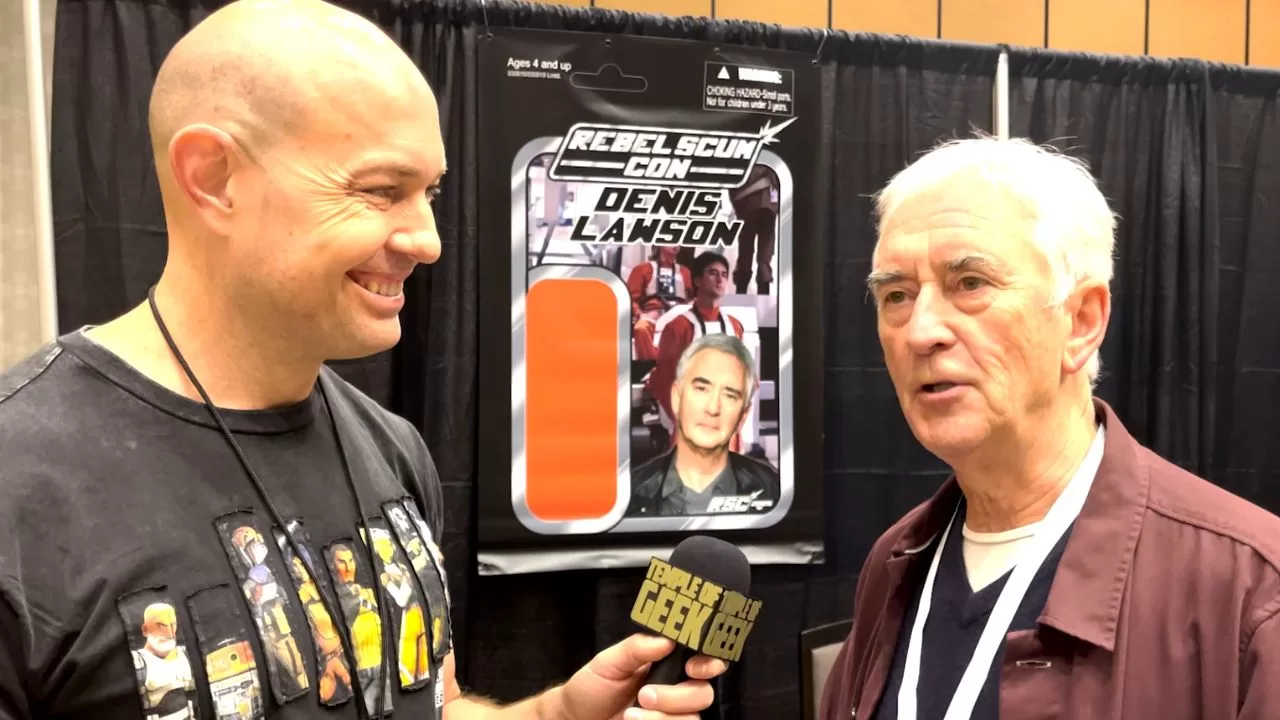
In an interview with Temple of Geek’s Nick Williams, Star Wars actor Denis Lawson, who plays Wedge Antilles, discusses the filmmaking on the original film, how he was cast, and more.
Lawson appeared as a guest at Rebel Scum Con, a fan convention celebrating all things Star Wars. The convention featured a variety of activities for fans, including panels, cosplay contests, vendors selling collectibles and art, and opportunities to meet and get autographs from Star Wars actors and creators.
Denis Lawson talks Wedge Antilles and filming the Original Trilogy
Denis Lawson describes his casting as strange. He met George Lucas in London in 1976, but nothing came of it. He had forgotten about the project entirely until his agent called him much later, informing him that filming had already started and they wanted him for the role. Lawson was busy with other acting jobs at the time, including musical theatre and television.
Denis Lawson: It was quite ad hoc and strange in a way. It was the summer of 1976, the very first movie. And it was a very interesting year for me. It was very, very hot in London. The UK was brown entirely. It was a drought. I met this guy earlier in the year called George Lucas in London in an office in Soho in the middle of London. He met various young actors, and nothing happened. And then I went to France. It was a very interesting year that year. I did two movies in France, which were both fascinating. Then I came back to London and suddenly got a call from my agent and said, “Oh, that movie that you met for the science fiction thing, they would like you to do it.” And I went, “What? Oh, I’d forgotten about it.” Because they’d already started shooting. So I went, ” Yeah, okay, fine. Let’s do it.” So I then turned up to shoot it and knew a lot of the other guys. There were a lot of young actors. I knew a lot of the guys because of London based and my age group and stuff. We’d hang around outside the sound stage and chat away and mess about and tell gags and jokes. And then you’d be called up one by one for the battle sequences onto this platform.
Filming Star Wars
Lawson recalls the filming process for Star Wars being very strange. The cockpit set was a wobbly wooden platform with a blue screen behind it. The actors didn’t have a full script, only their sequences of lines, and had no idea what the final visual effects would look like. He also noted that he was a familiar face with many of the other young actors on set. None of the actors knew what they were making. It wasn’t until a cast and crew screening months later that they saw the final, completed film. Lawson was “gobsmacked” by the revolutionary effects and realized the full scope of the project. He says he had no sense of the film’s future impact or fan following at the time.
Denis Lawson: You climbed a wooden ladder onto this platform. And at each corner, there were a couple of guys wobbling it around. Then you sat in this cockpit, but you couldn’t see. There was nothing in front of you, just the camera and George Lucas. And behind was the back of the cockpit. And then something called a blue screen. It’s the first time I’d ever heard the phrase “computerized camera.” Really impressive.
And in fact, we didn’t really know what we were in. We don’t think we saw a full script, in fact. We just saw our sequences of stuff, you know? So we didn’t understand what was going to be behind us or in front of us and how they were going to manipulate the material. We didn’t have any sense of that at all. And it wasn’t until months and months later, six months maybe down the line, and we sat down in a cinema for a cast and crew screening in one of the big cinemas in Leicester Square in the centre of London. And I mean big. And we couldn’t believe what we were seeing. It was gobsmacking. What they’d done with the material was just revolutionary. And we suddenly saw what we were in. It was just amazing. Absolutely amazing.
The Character of Wedge Antilles
Lawson was unaware of how significant Wedge Antilles would become. He considered it just another job and didn’t grasp the importance of the character until years later, as conventions and fan appreciation grew. He finds it amazing and delightful that people have Wedge as their favorite character.
Denis Lawson: To be honest, you know, again, those three movies I was in were coming in and out of other jobs. I’ve always been incredibly busy, and I was doing musical theatre and stuff like that as well, and television. And so what you’re talking about, the impact it had on my character, I had no sense of that at all at the time. It’s only that it’s developed over the years since the movies were released. That sense of this incredible sort of following the films have. And here we are at a con, you know, a what? Who knew what that was, you know? So it’s been really surprising and delightful. Fantastic.
I didn’t have a concept of the importance of the character until we’re standing here now, in a sense, until maybe 10 years down the line, something like that, you know.
Working with George Lucas
Lawson respects George Lucas, calling him a “genius.” However, he shared a funny story about the filming process. Lucas would try to give actors lines from a 20-page script one after another. Lawson had to tell him that as an actor, he couldn’t work that way. He suggested they work through the script line by line in a call-and-response format, which he found to be a great, spontaneous way to work.
Denis Lawson: It’s quite funny because George, listen, George is some kind of genius. No question about it. But George would be sitting by the camera with a script. And I remember there was like a battle sequence, maybe 20 pages of dialogue. And he thought, bless his cotton socks, that you could just, as an actor, give him one line after the other like that. And I said, George, that’s, no, that’s not going to work that way, George. I’ll tell you what to do. You say a line to me, and then I’ll say it back to you. So I’ll give him four or five different versions of that line. Then we move on to the next line. So we did it in that way. But of course, it was actually a great way to work. And then, of course, they took that material and as I say, manipulated it brilliantly within the final production.


