
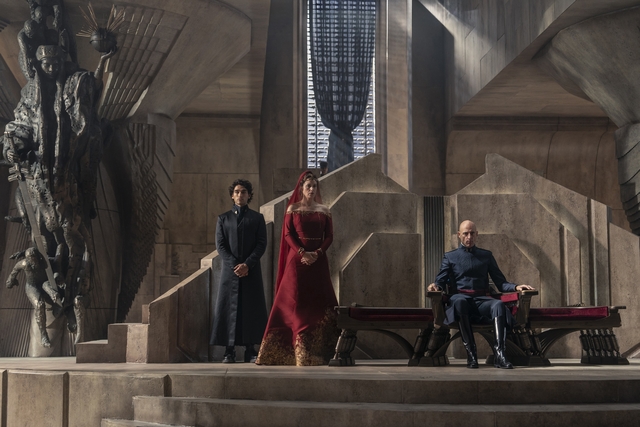
In an interview with Maria from Temple of Geek, production designer Tom Meyer discusses his work on the first season of “Dune: Prophecy”.

Tom Meyer Discusses the Highlights of Working on “Dune: Prophecy”
TOG: Congratulations on the Emmy nomination and a great first season of “Dune: Prophecy”.
Tom Meyer: Thank you, Maria. Yeah, I’m super excited. I’m excited not just for myself. I’m blown away and bowled over, but I’m also just excited for the recognition that it brings to the show and also to the more than 1200 people it took in the art department to bring this to life. I have an amazing team. I always say to my producers and to anybody who would listen, I’m only as good as my team.
I might have some ideas, but they’re enriched, made better, broadened, and developed by the scores of art directors, assistant art directors, illustrators, craftsmen, and carpenters. The craftsmanship on this is amazing. I think the recognition came because of the depth of what people got to see on screen. The detail, the sets, and the depth of the design which was executed by all these people. That’s why I’m really grateful to have this opportunity to really cheer for the team as well as myself.

Building a World for an Already Iconic and Inspirational Story
TOG: How do you approach creating such a vast world like the prequel of Dune? What is the biggest thematic challenge of designing a story that is 10,000 years before Paul Atreides?
Meyer: That’s a great question. I’ll sum it up in a couple of ways. When I first got a call about this, “Dune Part 1” had not come out yet. We wanted to be in the same tonal world as what Denis Villeneuve established, and that’s the connection. He allowed for a certain amount of time, depth, and beauty to be explored along with a wild and active science fiction story.
When I got the show, the first thing I did was read the first two trilogies by Brian Herbert because you can’t really dive into the “Dune” world without knowing the canon. Everybody from George Lucas to others refers to Frank Herbert’s original “Dune” and his subsequent books as seminal, inspirational pieces that we all draw from. To work on something like this, it’s important to know the canon. My researcher and I created a book club and sped read through these books. We went through about 5,000 pages of the six books in these two trilogies, as well as the original “Dune”, which I hadn’t read since college. We did this to have a foundation and know the canon. Alison and Diane’s mission for the first season was to knit this giant world into a story that people could watch and understand. We had six hours to explore and set up this world.

We had to choose which planets and characters to focus on, such as the Corrinos, the sisterhood (who become the Bene Gesserit), and the Harkonnens. The Harkonnens, though they have a bad reputation, are really fascinating and misunderstood characters.
The studio and the showrunners, Allison and Diane, told me they wanted me to explore the history of the story as a designer. They didn’t want the world to feel like it popped out of a science fiction box with glossy starships and shiny interiors. They wanted the world to feel old. Earth is a character in the “Dune” books. The people in the “Dune” universe are human beings from Earth, not aliens, and popular culture figures like Shakespeare and Van Gogh are in there.
They wanted the sets to feel a thousand years old. I thought about going to Rome, where you have buildings from different eras, all with a patina that makes them feel like they’re from the same world. We aspired to do that, especially on the Nobles’ planet, Salusa Secundus. The palace has details like our version of Corinthian columns and wainscoting that look old and are made of stone, but also have a science fiction twist to common materials.

On top of that, we wanted to layer in history from the books. In the throne room, you can see statues and artwork based on characters from the books, like Raina Butler and Serena Butler, and Voryna Traities in the great halls. We also had a tapestry made in India with all the flora and fauna of Seleucus Secundus. All these details give the world depth and allow the audience to get lost in it.
Designing a World without Technology
TOG: How did you respond to an expanding, developing world where sci-fi and technology are almost forbidden?
Meyer: That’s a great question. There’s a certain gothic quality to the “Dune” world and the Harkonnens. The world in “Dune: Prophecy” is 10,000 years in the future from today and 10,000 years before Paul Atreides. I wanted to build a world where you could see that buildings are being 3D printed. For example, the gray blocks on Wallach IX, the sisterhood’s planet, are repeated and have a mathematical and machine-like quality. The buildings were bequeathed to the sisterhood, so they were leftover buildings that the sisters turned into their school.
We were trying to find a way to have these found buildings be machined and then turned into something more personal. In the library, they put down a carpet and brought in books, which are a touchstone in Dune that gives a sense of history and warmth. The audience can relate to books, and it gives them a way into the world. Everything created for the show had a story.

You have to find a balance between these machine blocks and the primitivism of other planets. On Lankiveil, the Harkonnen ice planet, there’s a rudimentary feel to the wooden huts, and the same goes for Caledon. Each of these places has to have a machine version of something that feels a little advanced, but it’s still built from stone, wood, and earth.
On the capital planet, Zimea, where the Allied planets are, they would have the most advanced technology. But technology is gone, and everything should feel analog, with minimal screens. It should feel like an old tube television or a slideshow. This relies on good old-fashioned acting and relationships, without the need for a complex interface. The science fiction feels alien and in the future, yet common and relatable.
Tom Meyer Goes Into Detail About the Influences Found in “Dune: Prophecy”
TOG: What elements influenced the design of the Bene Gesserit’s culture and world?
Meyer: When you read the Frank Herbert books, it’s clear that they studied cultures from around the world. They’re pulling elements from different cultures and religions to get the essence of how people communicate and relate, without being too specific. This is where you get the mysticism and the sense of spiritualism.

In the opening of the show, we see the sisterhood praying together around a bowl, and their chants create a vibration in the water, which creates a sense of mysticism. Their battle language, which they do with their hands, is a private moment that you have to be part of the community to understand. We, the audience, are let into that language through subtitles. They have religious-looking books that were hand-bound, and we considered the stitching and symbology to make them feel valuable.
A set can be as big as a football pitch, and sometimes an object in your hand fills the entire screen. Both have to carry the same amount of weight and are equally important. The book or the knife is just as important as the giant set, and that consideration and depth have to be there.
Overcoming Challenges in the Creation Process
TOG: Was there a particular planet or set that was especially challenging to create?
Meyer: I think the challenge was the scope of what we wanted to achieve. We wanted everything to be real, so we were building sets multiple stories high. We employed pretty much every set company we could find and brought in artists from around the world. We had to do all this on a timeline. This is what I love to do, and the more you do it, the challenge starts to melt away, and you just care about achieving quality and fidelity.
We’re doing Dune, so there’s no location you can go to and just shoot. We did find some natural locations, like beautiful basalt caves in Hungary, for the Langkavel planet. We built onto them and expanded them with temporary structures. This is like adding gesso to a canvas; it gives you something to start with and build onto. You can’t tell where the real stuff stops and the new stuff begins. This mirrors how cities and worlds are built.

The Desire to be Swept Up into the World of “Dune”
TOG: What did you hope audiences would take away from the world you created in the series?
Meyer: I wanted them to get lost in the world and the story. I wanted them to remember the characters and the story. I wanted them to come away really thinking about the story and the space in a way that is different from other shows they see. It’s hard to surprise people, but the ability to surprise and ignite their imaginations is hopefully what they come away with. That’s why we like science fiction—to be wowed in story and scope and to dream about something we can’t imagine. My goal, and what you hear from studios and producers, is to see something you haven’t seen before. To dream up something new is pretty exciting.

TOG: What personally drew you to the world of “Dune”?
Meyer: It’s a touchstone. It’s canon, and for me, it’s the high altar of science fiction. I see it in so many other popular science fiction stories. To have the opportunity to come to the source material is a dream project as a designer. When someone asks if you want to design for one of the iconic, foundational materials, it’s not a question you ask twice. You say yes, and you have no idea how big it will be or how many years you’ll be on it. You just think about the material and the opportunity of the story. The excitement I get is the same excitement I want the audience to get out of it. I still remember the moment I got the call and the realization of the responsibility I had.

All six episodes of season one of “Dune: Prophecy” are available to stream on HBO Max at this time.



One thought on “Bringing the Dune Universe to Life: An Interview with Production Designer Tom Meyer”