
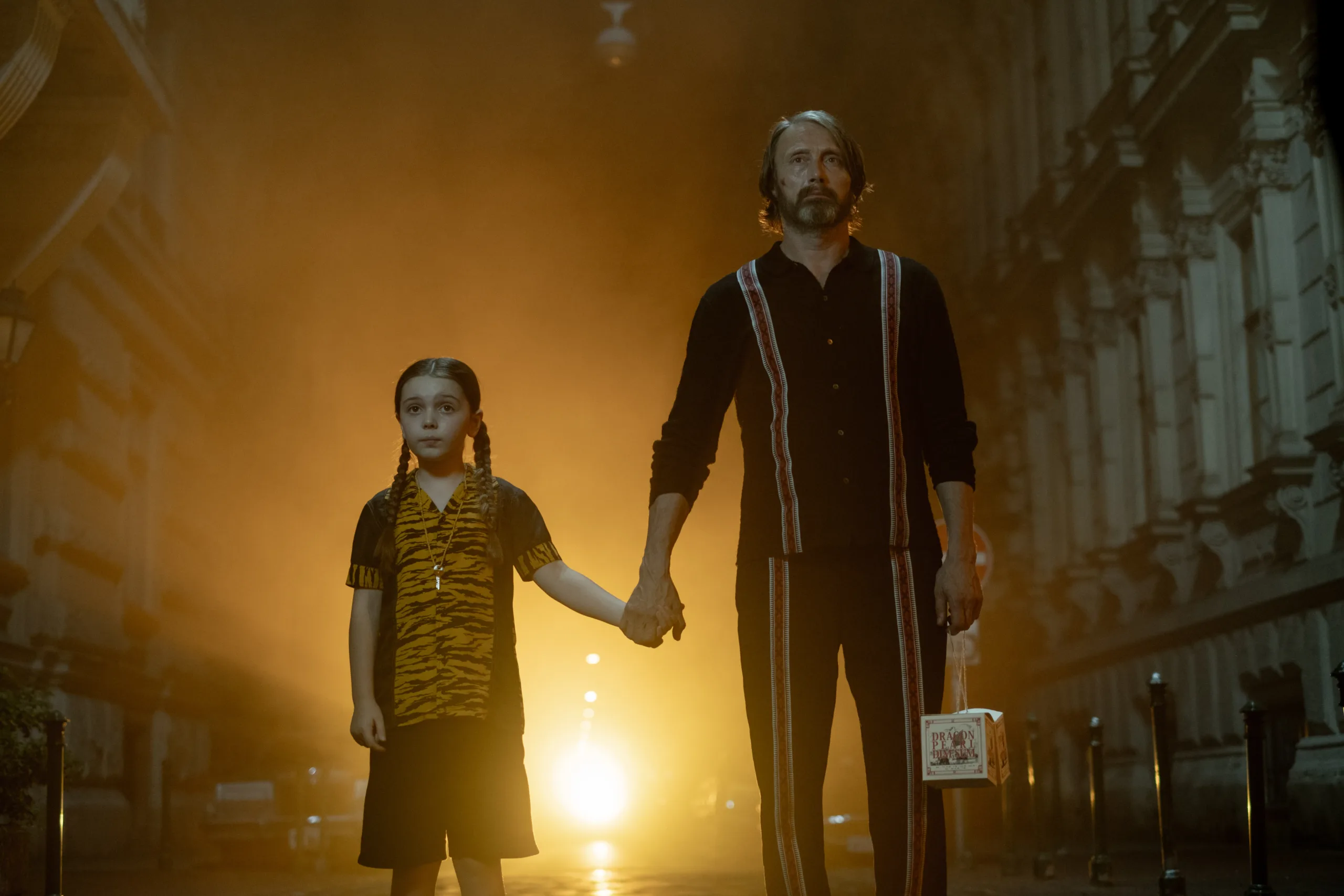
Director Bryan Fuller talks about the inspiration for Dust Bunny, his new horror-adventure film. He revealed it began its life not as a feature, but as an hour-long episode project television. When the story didn’t proceed, Fuller saw the opportunity to expand it into a feature film. Noting that it was designed to be an Amblin-style movie from the eighties to begin with. Dust Bunny had it’s world premiere at the 2025 Toronto International Film Festival (TIFF 50) as part of the Midnight Madness program.
Fuller (who also produces alongside Basil Iwanyk and Erica Lee) delivers the horror-adventure film Dust Bunny. The film stars Mads Mikkelsen, Sophie Sloan, Sigourney Weaver, and David Dastmalchian. The plot follows ten-year-old Aurora (Sloan), who hires her mysterious neighbor (Mikkelsen) to hunt the creature she believes consumed her entire family. The neighbor, a guilt-ridden hit man specializing in killing real-life monsters, suspects assassins targeting him may have been responsible for her parents’ fate. Accepting the job, he must protect the girl by battling an onslaught of human assassins. And finally accept that some monsters are real.
A Story Vetted by Spielberg: The Genesis of the Dust Bunny
The early version of the story had been vetted by Spielberg. Fuller received direct notes from Steven Spielberg himself. This influence guided the final feature script, ensuring the film paid homage to the specific genre experience Fuller enjoyed growing up.
Suhaila (Temple of Geek): How did that idea [for “Dust Bunny”] even come about? This idea that there’s this dust bunny monster under your bed, plus the floor is lava.
Bryan Fuller (Director): This was going to be done as an hour-long episode for an Amazing Stories revitalization that was happening at Apple TV+. And this story just didn’t make it through the process on that show. And I just thought, okay, instead of pushing this uphill, why not just turn this into a movie? It felt like it was designed to be an Amblin-style movie from the eighties to begin with. And had been vetted by Spielberg. And I got notes from Steven Spielberg directly on the episode that then applied to the feature script.
It really was about seeing something that felt like it was going to be a movie-going experience that I enjoyed growing up in the eighties. And it felt like a contained enough story that I could wrap my arms around. And also be a little playful with some of the design choices and the filmmaking that allowed me to do something signature.

Gateway Horror and the Spirit of the Eighties
Fuller drew inspiration from films that defined 80s genre cinema, citing classics like Goonies, Gremlins, E.T., and Poltergeist. He champions “gateway horror” movies for family audiences that have a little spice to them and can be scary.
Suhaila: Speaking of the eighties, what did you draw inspiration from in those stories? I have things that came to mind as I was watching from movies I watched or books I had read when I was younger. What was the inspiration for you?
Fuller: I love films like “Goonies” and “Gremlins” and “ET” and “Poltergeist” that often featured young protagonists up against odds that they are not trained to handle and yet somehow becoming their own heroes. I love gateway horror. I love movies that are intended for family audiences or bigger audiences that are also have a little spice to them and can be scary. You know, I just saw “Predator: Badlands”. And I was like, “This is great.” It’s a family “Predator” movie, you know, it’s a family monster movie of sorts.
I think what’s interesting in the genre is that we have so many avatars when we don’t have child protagonist characters that then become the entry point for young people. When I was growing up, those were often robots. Whether it was R2D2 and C3PO or Vincent and Old Bob from “The Black Hole”. You know, characters that weren’t adults, weren’t children. But were something else that allowed us to project our experience onto them. And immerse ourselves in the narrative in a way that we don’t often get to do when we don’t see people just like us.
Child Protagonists and
Fuller also shared his love for stories featuring young protagonists who are untrained but manage to become their own heroes. Tackling odds that adults cannot. This focus on the protagonist, ten-year-old Aurora, allows the film to explore themes of what is real versus what is imaginary. The central message: believe children and or listen to children.
Suhaila: The focus of the story is around a child and she brings this childhood innocence, this intelligence, this imagination. And you’re kind of left wondering for a little while, is she just imagining this? Are we just looking through her eyes or is this actually real? And obviously, the adults around her.
Fuller: That’s part of the fun of the childhood experience, I think, is what’s real, what’s our imagination, being able to build a vocabulary with adults so they can have an honest discourse with us, us being the kids in the picture. And are we sort of like seeing myself as, you know, through a child lens? I think that’s part of just, you know, being a queer person as well, is that you’re looking for characters who aren’t, like, fitting a standardized perception of who people should be. And oftentimes, there’s just a broader canvas in a child character for you to project who you were at that time and relate to them in that way.
And there’s something, I think if the movie has a very basic message, it’s believe children and or listen to children in a way. We were very much setting out to make a movie for a movie for children of all ages that, you know, that parents who like, you know, “John Wick” films or shoot them ups would see this and say, like, okay, there’s enough stuff for me, but there’s also a lot of stuff for my kid.
On the R-rating for Dust Bunny
The film is fundamentally a fairy tale in its structure and resolution. But one that embraces the darker, more thrilling elements of the genre’s origins. Despite an unexpected R-rating from the MPAA, Fuller insists the movie was made as a children’s film. He hopes Dust Bunny will become many kids’ first R-rated movie.
Fuller: I would love if “Dust Bunny” becomes a lot of kids first R rated movie, because we did plan on making a children’s movie and perhaps too spicy for the MPAA. But we don’t have any nudity. We don’t have any foul language. There’s suggestions of blood, but there’s no real arterial spray. And the violence is very sort of looney tunes, cartoon violence. In my mind, we were making a children’s movie, but the MPAA had other thoughts. There’s something about having kids central to a story that I still enjoy as an adult.
A lot of people think, “Oh, it has a child protagonist in it, therefore it is for children only.” But I look at films like, “Pan’s Labyrinth” or “The Devil’s Backbone.” Two of Guillermo de Toro’s masterworks that are all about kids being forced into circumstances that coerce them into growing up before they’re ready. And how they rise to the occasion and become their own heroes. I love those stories. And they never stop speaking to me no matter how old I get. I wanted to make something that was going to speak to kids. And also speak to the kid in the adults who were seeing the movie. And when we got to our rating, I was like, “Okay, we’ll just have to play the cards that we have been dealt,” and hope that we find an audience that recognizes that this is a movie for everybody.
Suhaila: It definitely did speak to the child in me. It reminded me of a lot of stories I watched as a kid. Probably some of them I maybe watched a little bit too young. A movie like this, when I was a kid, would have been completely fine to watch. I mean, I was watching “Alien.”
Fuller: I saw “Alien” when I was nine.
Suhaila: I was around there as well! Even like with “Star Wars“ there’s some scenes where there’s not outright blood splatter, but there’s some violence in there that’s sort of like fantastical.
The Sweet and Savory Tone of Dust Bunny
“If Pushing Daisies was sweet and Hannibal was savory, then Dust Bunny needed to be mango chicken, it needed to be sweet and savory” – Bryan Fuller
Known for the whimsical style of Pushing Daisies and the dark elegance of Hannibal, Fuller described Dust Bunny as a tonal hybrid of his past work. Speaking with cinematographer Nicole Whitaker, he established the film’s unique flavor profile.
Suhaila: That’s one of the things I really love about your work: you merge different genres together. And then you add this fantastical, whimsical element. Yes, there’s the horror, yes, there’s the macabre, there’s the action. But then it all wraps up into this fantastical element that transports you into this other world, even though it doesn’t look too different from our own world. Could you talk about the stylistic choices for the movie? And bringing some of “Pushing Daisies” and “Hannibal” into it?
Fuller: It does feel tonally like a hybrid of “Pushing Daisies” and “Hannibal” in some ways. Probably more “Pushing Daisies” than “Hannibal”. I talked with Nicole Whitaker, our cinematographer, a lot about those two tones. How if “Pushing Daisies” was sweet and “Hannibal” was savory, then “Dust Bunny” needed to be mango chicken, it needed to be sweet and savory. Have a flavor that gave you permission to have joy in the dish, but also had some nutritional value and some substance to it as well.
There’s something about making movies for yourself as the first member of the audience that may not always serve a filmmaker. But in terms of, I can’t imagine working on something that I wouldn’t watch or enjoy watching. That’s my kind of barometer of what the audience expectation is. Or what an audience might get out of the experience. Because if I’m enjoying it, I’m hoping that the like-minded audience members will also enjoy it.
It’s a fairy tale first and foremost, and that gives a certain sense of danger and expectation of thrills. And I do love fairy tale storytelling. The structure is very fairy tale-esque. The resolution is fairy tale-esque. And there was something about making a fairy tale in a modern box office dynamic that I didn’t think was going to be as tricky as it is, but because fairy tales in their origin are very dark. And I feel like this movie doesn’t go as dark as some of those fairy tales originally did. But I’m hoping that it’s fun first. And it’s a romp first.
Dust Bunny made its theatrical release on December 12th and is available to rent or stream online.
Read more of our interviews and coverage of the films that premiered at TIFF50.



2 thoughts on “Bryan Fuller on the Eighties-Inspired Origin and Tone of “Dust Bunny””