I sat down with Bojana Nikitović, the Costume Designer for “Dune: Prophecy” to discusses her creative process for crafting the stunning costumes for the show. Set 10,000 years before the “Dune” movies, these costumes play a vital role in connecting the two time periods. Using intricate, handmade and high-tech elements in the costumes, such as embossing, metalwork, and laser cutting, these beautifully detailed pieces tell their own visual stories about the powerful, pivotal, and mysterious characters we meet. Collaborating with other departments, Nikitović set out to create costumes that not only look good, but also allow the actors to feel comfortable as they embody their characters.
Suhaila (TOG): Congratulations on your Emmy nomination! And congratulations on your win at the Costume Designers Guild Awards! How does it feel to have this recognition, not just from your peers, but from the industry for a sci-fi show like “Dune: Prophecy”?
Bojana Nikitović: It’s fantastic. This year has been amazing so far. First, the Costume Designers Guild award was a dream come true, because it came from my colleagues and professionals that I respect. After that, the Emmy nomination was also really amazing. I’m glad not only for myself, but for the entire team that worked on “Dune: Prophecy”. We’re all back together prepping for the second season, so it was a real pleasure to share the nomination with them.

The Historic Yet Futuristic Aesthetic of the “Dune: Prophecy” Costumes
Suhaila (TOG): Given that “Dune: Prophecy” is set 10,000 years before the “Dune” movies, how did you approach the costumes for the show? Specifically the unique challenge of making them feel both historic within this sci-fi world while still related to the aesthetic of the movies, and still feel futuristic to our world?
Nikitović: It was so difficult to imagine where we are in “Dune: Prophecy”. In the beginning, I really needed to figure out the timeline, because we are 10,000 years before the “Dune” movies, but we are still in a future that is ahead of our current real world. It was a challenge. I collaborated with the production designer, Tom Meyer, the showrunner, Alison Schapker, and the directors to find our own aesthetic. I hope we succeeded in making our own visual identity, while still following the line that was so well done in the “Dune” movies. The costumes have a clear and simple silhouette when needed. We also worked a lot on a color palette that is different for the different planets, depending on where we are in the story. We had Wallach IX, Caladan, Lankiveil, and Salusa Secundus, which is completely different.

The Iconic Silhouette of the Sisterhood
Suhaila (TOG): Let’s start off with the biggest tie-in to the movies: the Sisterhood, who eventually become the Bene Gesserit. How did you create their visual look? They’re still fairly new as an organization but are quite established already. How did you create a through line to the look we see in the “Dune” movies?
Nikitović: Finding the right look for the Sisterhood was the main thing for me because we had so many costumes to create. It was important to create a good silhouette and a recognizable, even iconic, look. We wanted to follow some of the simplicity seen in the movies, but also create our own veils, which are so important for the Bene Gesserit. I started with the Sisterhood and we made many drawings and went through different silhouettes.

We decided to have different colors for the young novices, acolytes, and Reverend Mothers. This also helped show how Valya improved the Sisterhood over 30 years. We ultimately decided on a silhouette that is an overall, or jumpsuit, with trousers that look like a dress from the back. All the girls and actresses loved the costume, especially because you feel more relaxed when you can move and sit easily. We even added pockets, and Emily Watson loved it so much that she immediately put her hands in them, which gave her another pose. It’s important for the costume to look good and for the actor to feel good in it, while also working well for the character. I think we achieved that here.

The Evolving Uniform of the Sisterhood
Suhaila (TOG): The silhouette is a constant throughout a sister’s journey with the Sisterhood. There’s a uniform that evolves from being a novice, an Acolyte, a Reverend Mother, and even Mother Superior with her ring and necklace. And at the same time, there’s some individuality between the Reverend Mothers with detailing in their embroidery and veil. Could you talk about those costumes and the distinctions in the various uniforms?
Nikitović: I’m so glad you noticed all the details, because that was the point. Since it is a uniform, it had to have details to make it interesting for the camera and the audience. We worked a lot on the embossing on the upper and lower parts of the costumes.
For Valya Harkonnen’s look, especially when she leaves Wallach IX, we needed to show her full Mother Superior look. This was another level, so we added a different embossing and metal details. All of these things, like the embossing, metal pieces, and jewelry, were done by hand. Her ring was 3D printed, but her necklace and the little brooches they wear were all handmade. These things give a special touch to the costume. We also made different options for the headpiece until we found the right one that was simple, but still gave her character a certain elegance and power. When she enters, the cape is a very important part of the costume. The cape was very elaborate, and we used the same pattern that we used for the embossing on the Sisterhood costumes.

On the Reverend Mothers, who are dressed in black, we have a little more embossing than on the other costumes, and they have slightly different capes. I also love the Prana Bindu costumes they wear for yoga, the off white ones. We see them in a different weather conditions under the rain, and even on the embossing and stitching of those costumes, we used the pattern from the brooches, which is like an eternity sign. All of these details were well thought out.

The Regal Decadence of the Imperium
Suhaila (TOG): Speaking of Valya’s costume when she goes to Salusa Secundus, she’s very much fitting in. The Imperium is very decadent and regal in all of the costumes that we see. She has to step it up a little bit in order to command presence and also fit in stylistically. Could you talk about the designs for the Imperium and how you came up with their unique costumes?
Nikitović: The Corrino family and the Imperium were another big, important part of the story. Salusa Secundus is a completely different environment that looks like the Mediterranean. It’s sunny, colorful, and powerful. The Corrino family has been established for a long time, and we needed to show their importance, tradition, royalty, and power through their looks. While we used different shades of gray for Wallach IX because it is misty and rainy, for Salusa Secundus, we wanted to show the regality, elegance, and class of the Corrino family. We used different colors like royal blue, teal, pomegranate red, and gold. We always kept in mind that they don’t have to show off; their power and tradition are already visible when you see them.

For Javicco Corrino, we worked on the embossing on the different coats he wears. We used a technique with different pressing, embossing, and laser cutting to put one layer on top of another and create another layer in the costume. We were always mixing very high-tech techniques with handmade things. For example, the coat has laser-cut designs, but the epaulets and other insignias on his belts are handmade.

The Stunning Engagement Dress
Suhaila (TOG): Princess Ynez’s engagement dress was incredible! I kept looking at the details. It tells a really beautiful story both in terms of like Ynez as a character and who she could be. The straps feel a bit like a prison, especially that the headpiece that’s like a cage around her face. But then the veil feels like a nod to the Sisterhood. Where she hopes to go and where she wants to get her power from. Could you talk about how this costume came together?
Nikitović: I’m so glad that you noticed all those details, because you were telling exactly what I wanted to tell through this costume. It was a long process to get the right sketch, and when we finally found it, we knew it was the one. The original base color on the drawing was nude with a red laser-cut fabric on top, and the veil was a transparent nude silk tulle with red details. When we started building it, I said, “This is not red enough. It has to be really powerful”. My textile artist, Silvia, suggested using red tulle instead of nude, and I knew that was it.
The dress tells a story about women in that family. The upper part of the dress is like a net or a prison, and the headpiece feels like a cage around her face. This represents how she is forced into a certain path. The veil was also important, as it gives a different dimension to the character. We made the fabric for the dress by putting one layer of red silk on top of another using laser cut. The headpiece was handmade, and every single piece on the veil was glued by hand by the crew. I’m happy that the audience loves it.

A Mysterious Blank Slate
Suhaila (TOG): In contrast to the bold looks, a character that feels like a blank slate is Desmond Hart. He’s somebody we don’t actually know anything about. But you can tell there’s something happening behind the scenes as he tries to worm his way into Corrino’s inner circle. Even his second costume has a rough edge to it. Could you talk about Desmond’s costumes and any hints you added to his heritage before we actually find out?
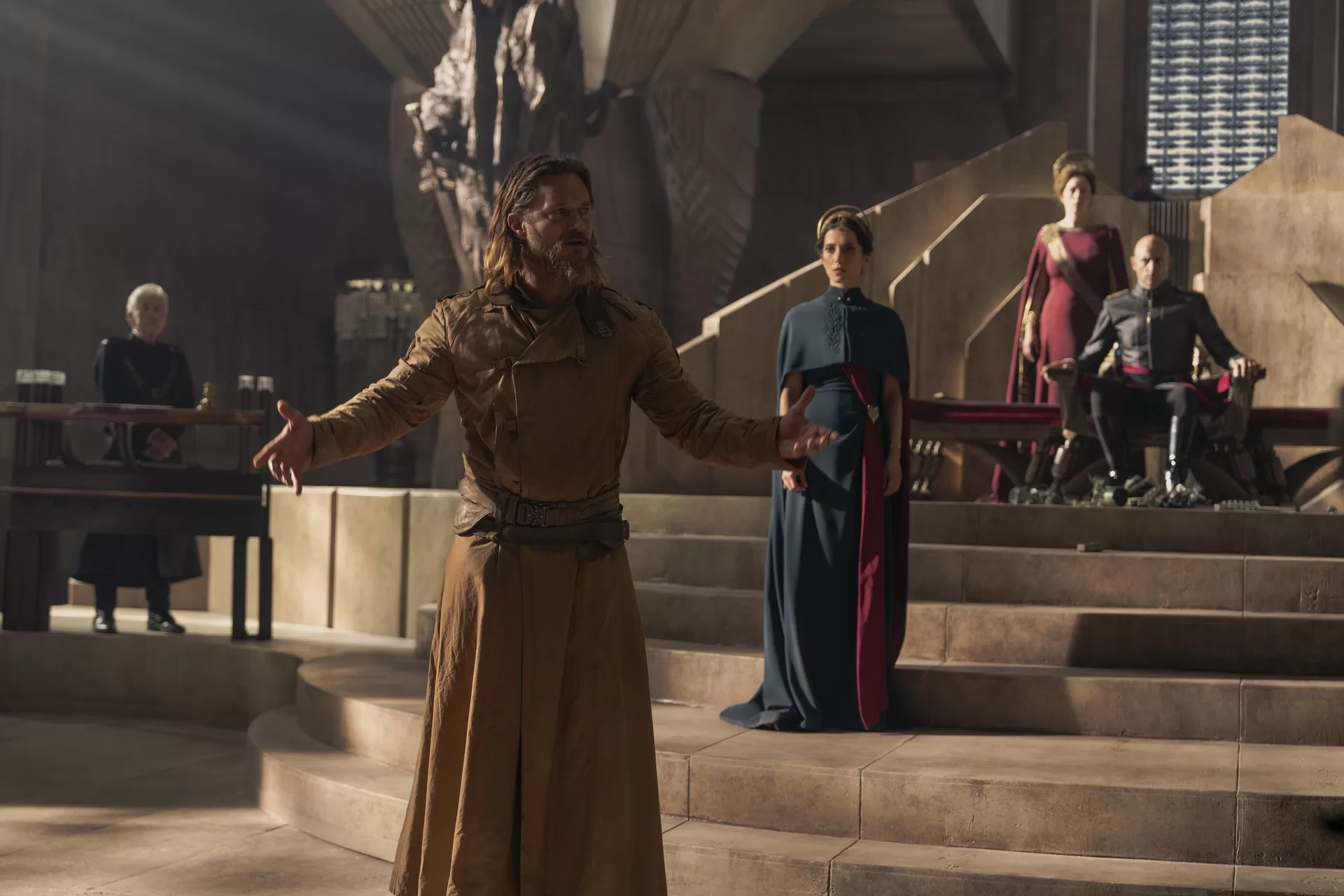
Nikitović: Desmond Hart was another character who was so important to get right. We wanted him to look different from everyone else in the show. From the beginning, I wanted him to have an almost Western duster coat. The idea was to create a mysterious and intriguing figure whose arrival would signal that everything was about to change.
The shot of him arriving with the coat flying around him was meant to signal that trouble was coming. The color of his costume was also different from everything else, but it was related to where he came from, Arrakis. We know he is in the Imperial guard, but his insignias don’t really tell us his rank. He has a special piece of fabric from his past, which is a piece of his mother’s Sisterhood gown. This was something we wanted to include as a part of his costume. He is always using and touching the rings he has, but we don’t know where they came from. The piece of fabric has the same embossing as the Sisterhood costumes, but it’s not shown so closely in the camera.
Season 1 of “Dune: Prophecy” is available to stream on HBO Max, and Season 2 is set to start filming soon with an anticipated late 2026 release.
Want more behind the scenes? Check out our interview with Production Designer Tom Meyer, and interviews with the cast of “Dune: Prophecy”.