
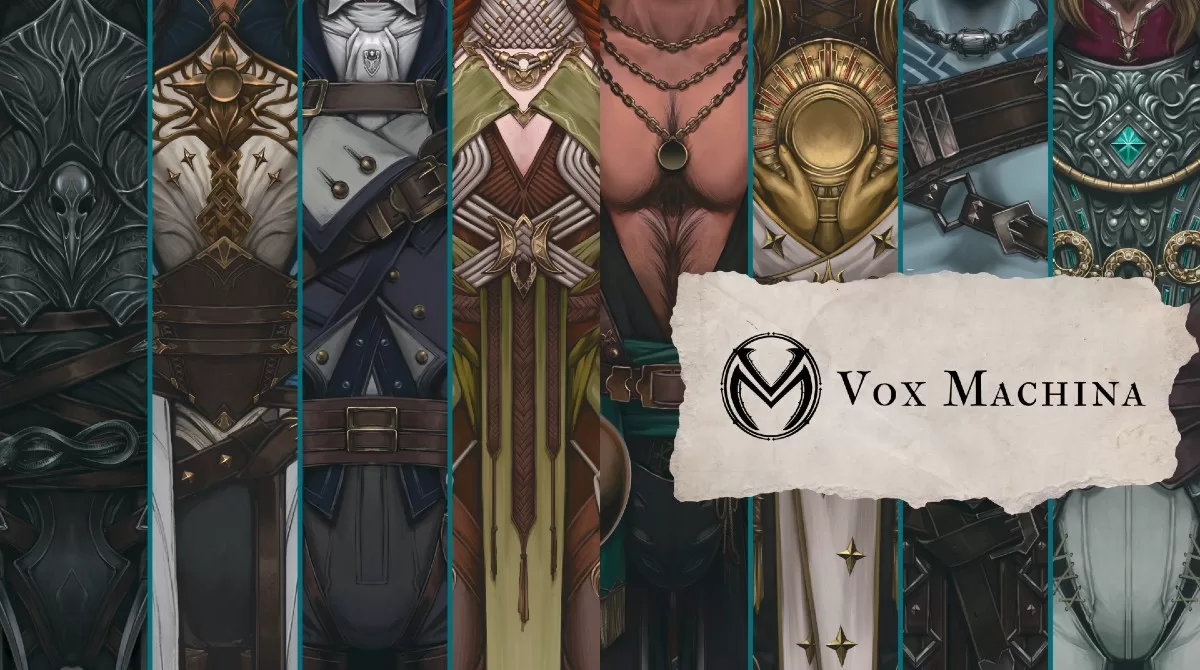
“Critical Role Armory of Heroes” is a deeper exploration into the artifacts and armor used by some of Exandria’s greatest heroes. This includes Vox Machina who very publicly saved Exandria on multiple occasions. The Mighty Nein who also play an important if more covert role in history. And The Ring of Brass who until recently had been lost to the ages.
Martin Cahill who penned the short story, “Under Golden Boughs,” in “Critical Role: Vox Machina – Stories Untold” returns to the world of Exandria. Cahill further fleshes out the lore of Exandria’s saviors from three new perspectives. Inspired by his own Dungeons & Dragons adventures he brings to life a bard, a scholar, and a spy to share these stories.
In an exclusive interview with Temple of Geek Cahill broke down his approach to writing “Critical Role Armory of Heroes.” He shared how he differentiated each author as well as each heroic party. Cahill also explained why he wanted to bring the Ring of Brass into the light after being lost to Exandrian history. Cahill also revealed how Vox Machina felt different from the Mighty Nein by way of the armor and artifacts they are known for.
Bringing New Voices Into Exandria In Armory Of Heroes

Temple of Geek: How did you approach writing from the perspectives of three different characters? That was one of the things that stood out to me. This was three different characters sharing accounts or secondhand accounts about Vox Machina, Mighty Nein and the Ring of Brass.
Martin Cahill:
When I was first approached for this with the wonderful folks at Insight, my amazing project manager, Sadie Lowry. That was the first question, Hey, I know when CR does stuff, it’s normally as in world as possible. I know that that voice just helps keep things super immersive. It makes readers happy and makes lore hounds all very, very excited to see what comes out. Is it going to be different every single time? Is it going to be only a singular voice? Is it going to be just Cobalt Soul or just Wizard, Secret Guild or whatever?
And Sadie very wisely was like, well, why don’t you give us a list of options and we’ll talk it out. I threw a bunch of different ideas up there and things of like, Hey, if it was a singular voice, I had it as like, oh, what if it’s J’mon Sa Ord’s child a hundred years down the road, or one of the sphinxes like Osysa in worship to Ioun, the Knowing Mentor.
When they came back, they were like, Hey, they like the in-universe text idea. Why don’t we do these three? And it was like the Scholar, the Bard and the Intelligence Officer, which I love. Incredible, I love the fact every voice gets to be its own unique insight into the history of all these different groups.
I was trusted with adding a little bit of life to Exandria, but every one of those characters relates back to not just my GMing history, but my playing history as well. So D’Rishk for example, is the name of my very first character who was a dragon born wizard. So way back in the third or fourth year of college is when D’Rishk came around. So I was like, you know what? My old dragon’s got to come back for a little bit.
Temple of Geek: One of the things that I was curious about too, because with bards, especially in this world, we don’t often see them as writers. We’ll see them as musicians or poets and things like that. There was a certain melodic sense to this character where it felt very much like this is a performer that is not necessarily writing things out, but almost having it be like someone’s transcribing what they’re talking about. Can you kind of talk about how you approach Tallulah specifically because they have this connection to Scanlan and Kaylie in a way that I don’t think someone may have anticipated being kind of one of the folks that’s in charge of their history?
Martin Cahill:
There is a part of me now that thinks D’Rishk enchanted a quill just to follow her around because she wouldn’t remember to write anything down, good old Tallulah. So Tallulah real quick is a shout out to the first campaign I ever GM’ed, which just finished actually, seven years in the making. But there’s a character played by my friend Alicia, who was a half-orc bard that I wanted to make sure that I paid homage to.
Part of the fun is these three different voices, you get to explore those different source materials. So it’s like, Hey, my scholar D’Rishk is not going to be familiar with poetry or ballads or songs or anything raucous. My drow Oren, they’re not going to be particularly stuffy or they’re not going to be objective either. They’re going to be very, very biased towards whatever the Kryn Dynasty needs of them. So with Tallulah, I thought of the connection to the Golden Grin sort of right away. I love Dr. Dranzel.
There was something when I was writing her, which I think is maybe some kind of tapping into some sort of universal attitude of bards of they aren’t sh-t. This idea of like, well, yeah, Scanlon’s great. Hey, I love Kaylie, but I’ve seen this guy. I don’t see him when he is heroic. I see him when he’s being a giant goofball. If you’ve been watching Cloudward, Ho! on Dimension 20. There was a bit in an episode where it was like they come back to their ship and all of their other crew members have had their main character moments. I love Brennan being like, yeah, these guys don’t just sit around waiting for you to come back home. Everyone is their own hero in their own adventure.
Especially with Tallulah, I’m sure she has a lot of thoughts, but she is an orator. She’s a singer, she has interest in stories and people and places, and she’s not going to waste a lot of time thinking about the history of Scanlan or other people or other Bards. It’s going to be, Hey, it’s my job to spread my joy, tell people about these other heroic figures. On a personal level, I’m sure there’s admiration and respect for Scanlon, but it’s like I do think there’s some professional feelings of, yeah, he’s fine. But with her it was really like she’s the storyteller. It’s the patter, it’s the alliteration, it’s the rhythm, it’s the music and the poetry that really kind of cemented what her writing style was all about.
It was a very, very good break from D’Rishk who very academic, very stuffy, and Oren who are very ruthless and very objective about most things. It was great for Tallulah to come between the two of those folks and just remind people, yes, we’re doing this because we need to document history, but history still is going on. We’re living in history now. I think there’s value to songs, value to poetry, value to those arts that sort of immortalize these heroic figures across time.
Vox Machina, Mighty Nein, and Ring of Brass, which I was so glad we got to do. I think we needed a few more pages and we didn’t get into Bells Hells because that campaign was still ongoing at the time. So I was kind of like, I would love to do the Ring of Brass. I wrote up that first little paragraph about them and Sadie was like, Oh my heart! Yes, go do it. So that was nice.
Remembering The Ring of Brass Through Armory of Heroes

Temple of Geek: The Ring of Brass part I was so happy about. It was so interesting because you had to walk that line of these are forgotten characters. It’s a really big thing that’s established at the end of “EXU: Calamity.” How did that conversation go with Critical Role of finding that balance between essentially there’s almost lost artifacts and lost notes about these characters that have just been discovered, but you still have to be careful of, we don’t super actually know all the details of what happened.
Martin Cahil:
Actually, I didn’t get a lot of notes from CR on that. Again, when you’re writing from these three perspectives, as long as you stay in those perspectives, a lot of what is being uncovered is speculative. It is the snippets of an Aeoran magi code. It’s like the third source of a third source describing the Ring of Avalir. As long as there’s an ability to maintain some kind of distance to that, I think, is very helpful. It’s in no way stating the fact of the matter. But I did want to couch everything in, this is new territory for us.
I love Matt’s constant descriptions of the Shattered Teeth. Across these dozens and dozens and dozens of incredibly dangerous islands. In my head, there’s some story of some little floating disk of a handful of Cobalt Soul people just fishing for artifacts and really hoping nothing bad happens to them. It’s little bit by little bit. It’s speculation. That was the line I personally was trying to hold was we can have opinions about these people, but they don’t know who Laerryn is. They don’t know Loquatius. It’s this idea of we can only ever surmise, we can only ever just know so much about these people because they are gone.
The way they died was so catastrophic. It was a good reminder of history is always going to be filtered through the lens of whatever the present moment is. Always sort of subject to the hypothetical. Describing technology, describing the Ring, finding the inscription for the Ring of Avalir or describing Cerrit’s axes. Things like that are like, oh, hey, we know what these things are. But knowing enough to be like, I couldn’t tell you what Cerrit was like. I can’t make these assumptions, but can we follow these breadcrumbs to some core of a person who we can only ever think about?
I just love all those characters so explicitly that it was very cool even just to dip a toe and be like, what would an academic think about Zerxus? Because there’s a real good chance out of everybody he’s still not alive, but he’s certainly around. That level of speculation is just fun when you’re a fan and a writer or something. It was a little joy to kind of play out those kernels a little bit and kind of see. When he showed up in “The Legend of Vox Machina,” I was like, that’s my guy! He’s evil, but that’s my guy.
The Ring of Brass Are Remembered As Heroes

Temple of Geek: I like how the Ring of Brass is getting brought into the larger tapestry of Exandria. I think the thing that was most interesting was they were all given the benefit of the doubt. Even Zerxus, where you could very much read it as like, oh, he betrayed everyone. He’s the reason this happened. I thought it was very cool. It was like, oh, he made a sacrifice. And then Laerryn who you can be like, well, it’s all her fault. She made terrible choices. I love that The Wizard’s like, no, no, she was too smart for her time. She’s great. So what was that decision process beyond just, I love the characters, why did you want the characters you’ve created here to give the Ring of Brass, the benefit of the doubt when we as audience members know what happened?
Martin Cahill:
That’s kind of the interesting balance, right? Because we as observer, this is going to go super meta, but it’s like we as observer of story and the way actual play structured and the way that Brennan as GM is responsible for guiding that narrative. That is a table of highly professional actors, gamers, actual players. Brennan as a GM also incredibly professional and very good at what he does, but to guide them towards moments of vulnerability and contradiction, pettiness, arrogance and self-righteousness. I mean, no one’s hands are clean.
Part of course the bittersweetness is even in recognizing all that too late, there is some chance to make amends or make things right. I mean, he says at the end, it is the Ring of Brass that lets Exandria live at this incredibly devastating cost. So we as observer know that. We the people, readers and fans and watchers, we get to carry that with us. So there was sort of a conscious nudge towards, I think in some ways I was looking for a bit more of a positive bent on some of these characters.
But again, history is written by the winners of the victors or whatever. Even if there was some sort of descendant of a descendant of Cerrit and his daughter, and we end up, all those things are sort of answered later in “Divergence.” But even if someone were to sit down and be like, well, I think my great aunt Laerryn, I think she kind of f-cked up and it might’ve been her fault. There’s this notion of I didn’t think that would be the kind of information they’d be uncovering. Because very few people ever want to commit to paper, ‘Hey, I wasn’t very good at this, or I did make a big old mistake.’
There’s not going to be some version of a Magic Notes app from Laerryn and being like, Hey, I saw that I was pushing the bounds of reality too far. And I see that now and I take accountability for that. But I think that also really goes back towards, to go back to several layers now, that’s what makes interesting characters. Aabria was playing Laerryn as somebody who never believed what she was doing was wrong. Maybe the results of that, and maybe the means to justify those ends were murky. But I don’t think at any point, I mean, again, I have to go back and watch, but I don’t believe there’s any point that Aabria was kind of like, Hey, I don’t think I should have done this.
The Meta Of EXU: Calamity & Exandria History

Temple of Geek: It totally makes sense that everything they find is essentially Laerryn and being like, I have this amazing plan. It’s great. We’re going to be pioneers. Everything’s going to go perfectly. And then it’s like, oh, everything went wrong. We don’t know why. It’s probably the Betrayer Gods. So just instantly assuming that, because that’s when the assumption about the entirety of Calamity anyways. You have Vespin Chlor that tried to ascend, screwed it up, and then the Betrayer Gods came and it’s all his fault, and it’s always been thought to be all his fault.
Martin Cahill:
I think that’s like, oh, that’s such a great moment when Brennan has Zerxus’ healing, touch, restore him. But to have him come back and in conscious moment, I think maybe that’s sort of what I was channeling was history will always remember me as the villain. History will not be kind to me. And I mean, I think that is sort of what I was hoping to do was play up the tragedy. No one’s ever going to hear that. We as the audience have the privilege of learning that, and we as the audience have the privilege of knowing the contradictions that are in the hearts of all of our Ring of Brass.
So to read that section and to know that tragedy and to see how everybody’s remembered, isn’t that somewhat of a tragedy itself? That they are not held accountable. There is no sitting Zerxus down and saying, Hey, I think really history got it wrong. You really did a bad thing. Patia, should you have been doing all that political backstabbing and magical, archanic loan sharking? But it’s this very interesting thing of being in the shadow of the Calamity and what counts in history? What is remembered? I don’t think I have anything definitive to say, but getting to play with those aspects and angles.
If there’s ever a chance to revisit the Age of Arcanum, the Calamity, Ring of Brass, and other forms to begin to start piecing what modern Exandria knows about that time is to me a very fascinating thing because people could be very, very cool with everything they’ve learned. And then if the wrong person gets their hands on a scrap of paper from Laerryn’s spell book that they found somewhere and start going, huh, this doesn’t seem like it was a very good idea. I think intentions versus outcome, and between D’Rishk and Oren and Tallulah, it was a lot of honoring intentions.
Honoring the best in these characters and knowing that, wow, there’s probably way more out there. We don’t know, but we know that Laerryn intended for the Leywright to open up whole new doors of magical importance and research. We know that Loquatius intended to protect his ex-wife in the city. So kind of honoring intention, but also knowing that history is perspective, it’s time. It’s really about are you comfortable revising history as it’s being found?
The Mighty Nein Vs. Vox Machina Artifacts

Temple of Geek: What was your approach with the balance of Vox Machina where you can fully delve into their artifacts versus Mighty Nein who have noticably less artifacts?
Martin Cahill:
Vox Machina, we have the benefit of those characters been around for a while. D’Rishk talks about meeting Grog and giving a quote that he would not have known he did. Public opinion being very, very informed by them. And then with Mighty Nein, I think it’s really fascinating. It only just really clicked for me now, but it’s like what the Mighty Nein have and what they’re known for. All of those items are incredibly personal. You have Caleb’s spell book and his journal. Veth’s Mask and Nott’s Flask. Caduceus’s armor made by his sister. Jester’s traveling pack and her holy icon that she made herself.
When they met, it’s really what they were wearing, what they had on their backs. They’re these scrappy underdogs. I really liked exploring that. It’s interesting you said that because I think one of the things that Tallulah was running into maybe why there’s not as much bard in there is they aren’t well known. D’Rishk will know because everything has to be recorded. Orin will know because these guys were real important to the Empire and may still be very important to the Empire. But even Tallulah, I think when I was able to bring her in, it is a lot of digging around. It is a lot of asking.
If you asked around these days, it’s like, oh yeah, well, I know that there’s this professor in Rexxentrum that matches your description. Is that the guy you’re talking about? Or like, oh yeah, there’s this captain on the high seas. His wife’s pretty exuberant, but he’s a fairly straightforward guy. It’s not like anybody’s gone out of the way to hide themselves. But to me it really kind of showed the Mighty Nein. Not to say that the Vox Machina was only ever moved towards action for the fame or the glory or whatever, but they really willingly stepped onto a public stage. And were very, very public especially around the Chroma Conclave. We are people who can be relied upon.
I think it’s this idea of, I read something recently, it was like, oh yeah, Superman wears bright colors because he wants bad guys to come at it. He wants to be very noticeable. And I think there’s a similar energy to Vox Machina. Of like, Hey, my druid girlfriend’s going to drop kick you into the earth while she’s made of earth. I’m going to just stab you until you die. If we get to do that, then that family gets to run away. But I think what’s so funny is that the Mighty Nein, even ’til the very end were just cagey. They didn’t trust anybody. They were paranoid as sh-t.
It’s not untrue to hear from Matt’s mouth of like, oh, I had a whole thing planned for the war and instead you guys left, you went to sea, then you went to Xhorhaus, then you went north. So this idea that obviously again, to look at it from a meta level, these characters are part of a story and Matt will be following them as much as they’re following him, but when they were placed in moments of, well, who else can help us, who can step up? The fact that there was no hesitation to say that it was them. That’s what I love about the Mighty Nein. I try to imbue with all of them is that they weren’t flashy. They never signed up for this. They don’t want to be like celebrities. They only ever just became this family to fight for each other and then together begin to realize, well, we can’t, like the saying goes, we can’t just leave this town without doing something. We have to leave this place better than we found it.
If we leave, these people are f-cked. Who is going to take care of ’em but us, right? Empowering people like them, like underdogs and those without any ability. At a certain point that kind of changes. Obviously they are powerful and became more knowledgeable and all these things. It has always struck me in a very beautiful and bittersweet way the story of the Mighty Nein is most of them when they met were pretty shattered. And to think that it’s not just any one of them rebuilding themselves, but to take all of those pieces and to sort of mosaic-like build something newer and stronger from that. I just love those characters. I love those arcs. To see that in many ways everybody’s like, they should be remembered. These people should be known. Don’t go hound them or anything, but history will not remember them if we don’t do that for them. So trying to really balance all that was a lot of fun.
Temple of Geek: Vox Machina, being in the public eye never had the chance to heal and move on. Where Mighty Nein in Campaign 3 is better than when we met them and where we left them in Campaign 2. Just in the writing, you can feel like they recognize the Mighty Nein is more scrappy and down to earth fighters versus Vox Machina who essentially became generals. I thought that was very, very cool.
Martin Cahill:
It was such a blast to write this. And to show that love through those observations. To look back and be like, damn, Vox Machina really never got a chance to rest. I think even there’s some slight discussions here and there of when we see Vox Machina during everything with Ruidus notions of Percy saying to Vex, well, the kids will be good without us. We’ve trained them to survive. Scanlan and Pike being like, ‘Hey, well we did a good job. We raised our kids and they can take care of themselves.’ This idea that, not to quote the internet, but it’s like peace was never an option. Whatever Vox Machina learned, it was always, there’s going to be something else. There’s always something else. Something else is coming.
Whether you have kids or you wander off or you open a bakery, you’re always looking over your shoulder. That trauma and the idea of adventuring changes you. You don’t go through all of these things. You don’t go to Mount Doom and come back to the Shire the same way. That PTSD and that tragedy and that trauma really, really informs Vox Machina and their descendants where they end up in the public eye because it’s this idea of, to me, there’s a balance of like, oh, I’m the hero again. People are always going to look to us now. People are always going to want us to take care of them. It’s not that we won’t do that, but it’s this life that I found myself in is now one that I can’t really leave or can’t leave without the world having an opinion about it.
I think the Mighty Nein, there’s such humanity and such heart. I think that awareness of when they came together as a group, it wasn’t just to fight monsters and get bounties and facilitate a peace treaty. But it was to be there for each other to heal each other. There are many, many moments where it’s like, Hey, broken soul recognizes broken soul, game recognize game. You’re running from something just as much as I am. Well, I don’t want to talk about my sh-t, but I will help you with your sh-t. Trying to give a mutual shoulder to rest on and then to take that energy out into the world. It says a lot that I think in that last arc with Lucian and the Tombtakers, they never, ever, ever stop trying to save him and save Mollymauk. Get Mollymauk back out there.
I love rewatching those because you just get to see how deeply these characters care about their friend who they lost. That was a defining moment of that campaign. But I think that we don’t get that same story without losing Mollymauk. There’s a whole essay to be written about that death led to a completely different Mighty Nein. When it comes to this book was I really just enjoyed getting into the psychology of those characters because in the world of Exandria, they are not really well known. Vox Machina in a big bombastic history shaking and that was fun in its own way and Mighty Nein to be close to the ground, more personal, more heartfelt, more human. Understanding how we got to where we got with these guys was just a blast.
How The Green Lantern Oath Played Into Armory of Heroes

Temple of Geek: Did you have a favorite character or a favorite artifact to get to flesh out and write about?
Martin Cahill:
I will say the very first one I thought of was for Star Razor. Because for Star Razor, I instantly was like, oh, I have to do a take on the Green Lantern Oath. If you read it with the cadence of the Green Lantern Oath, it matches up. But I was like, come on the Moon Weaver and the Wild Mother come out. That’s the Green Lantern Oath. So that was the first starting point that I had a lot of fun with. For the plate of the Dawn Martyr, having the name of the priestess who wore it into the final battle at Ghor Dranas. Knowing what Brennan had translated Ghor Dranas to in Calamity, a gathering place of shadows. What is that final helmsdeep moment of the sun rising over Ghor Dranas as she’s leading her final charge in the Calamity? I was like, oh, that’s a cool image.
Really a lot of fun’s always looking through the notes and a note from Sadie being like, well, I got chills. Thanks, man. That one was for why did the betrayer Gods hate Sarenrae the Everlight so mucht? And the idea being that in a world of redemption, it means they could actually be wrong. Writing about Percival and his guns and Orthax. Dani being like, well, I’m going to go cry again. Thanks. Tallulah’s song with Keyleth and Vax definitely made people mad at me in a fun way.
It was a different sort of challenge to get the smaller items. Like the Celebones or the Periapt of Wound Closure. Trying to channel my best Pumat Sol on that and hoping that Matt enjoys the voice. Or the fun thing being like, well, what do we call a holy avenger since we can’t call it a Holy Avenger? The illustrations, I got to take a second to shout out Ana Fedina. So good, so beautiful. Even better than anything I’d expected because I wrote everything first. I did not actually see any illustrations until a week before the book was announced.
To run through that and to see Mythcarver with all the strings on. It was chef’s kiss. The Travelers Pendant, Star Razor, and the Rapier of the Serpent King. Just seeing all the vestiges made real. As a fan it gave me goosebumps. I will say, just in terms of writing something, I had something written down for that Serpent King Sword that ends up with Kingsley. They asked me to get rid of it, but it was something that Tallulah had overheard the bar. It was like, God’s damnit. If that Fjord Stone doesn’t stop making pacts with extraplanar deities, he’s going to have more weapons than fingers and he’s going to have no one else to blame, but his damn himself. I was like, he does just say yes to a lot of things.
Temple of Geek: I love that his Ring of Fire resistance got in there and there’s still the poke of you overpaid. That was not smart. Having someone go, he’s got to stop. Is so funny. Jester can be like, actually, we’re not going to do that.
Martin Cahill:
When they get married she gets right of attorney. And it’s like, actually, we are going to pass. But I already gave him these giant cool gauntlets. You can take them back. Even just from a D&D fantasy guy point of view, just getting a chance to flush out characters and little bits and bobs and just add what I could. I think it helped having a better sense of D’Rishk and Tallulah and Oren as I went on. Oren writing about Nott’s mask that she wore when she was Nott before she came Veth again.
I’m like, what is the observation from a very powerful intelligence officer in the Krynn Dynasty that knows a thing or two about wanting to stay hidden? What does that mean to them? What does it mean to this academic to be rummaging through Aeorian war files and coming across codes of conduct and ritual killings and to not bat an eye at those things? For someone who is very frivolous and light and likes to laugh and bring joy and bring music and song. What does it mean to come across a tragic character or a figure who history is not kind to? Do they deserve the same level of remembrance? It just got better and better as these voices became more and more clear to me.
“Critical Role Armory of Heroes” is available for purchase now.


One thought on “Critical Role Armory Of Heroes Author Talks The Ring of Brass, Mighty Nein, and Vox Machina”