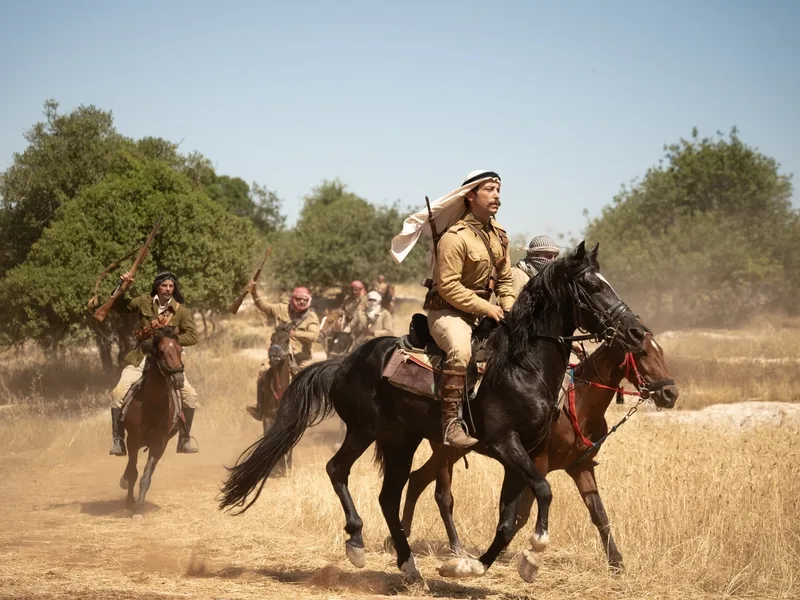
We sat down with director Annemarie Jacir at the 2025 Toronto International Film Festival (TIFF 50) to discuss her breathtaking film Palestine 36. The film had it’s worldwide premiere at TIFF in September, which was met with an over 10 minute standing ovation, and is Palestine’s Oscar Entry this year. It explores the events that lead up to the 1936 Arab revolt against British control in Palestine. In our interview, Jacir delves into the different forms of resistance in her film that played a key role.
The Class Divide in the 1936 Revolt
Suhaila (Temple of Geek): One of the parts that I enjoyed [was] the different forms of resistance. You mentioned the difference between class and you do see different ways of resisting throughout the film between the different characters. Khuloud’s character, her way of resistance, is through the paper, through her voice. And even then being a woman, she can’t put her name to it. She uses a man’s name. Whereas with the farmers, they’re physically in the fight resisting. Could you talk a little bit about those different forms of resistance?
Annemarie Jacir: Absolutely. The revolt of ’36 was sort of happening on two fronts. And that’s also why the idea of the story came about the way it did with Village and the City. The core of the revolt was from farmers. They were the ones who were getting the brunt of the brutality. And they’re the ones who were resisting.
And then the city, there was another kind of resistance which was happening in sort of an upper scale level. But also the Palestinians, upper class Palestinians, were part of British society. They were integrated. They were in front of British diplomats. British, not just the military machine. They were making statements for trying to fight for independence on that sort of diplomatic level.

The Repercussions of the Revolt
Jacir: But the core of it was really on the ground, the farmers. The British knew how to play the game that the upper class was playing. But they didn’t know how to deal with the farmers. They didn’t know how to deal with them. They were doing things in a different way. And that the revolt actually almost succeeded because they could not control the countryside. It didn’t make sense to them. They didn’t know how to control [that], there were rebels all over the place.
So what ends up happening is that the revolt starts to succeed. So they brought in more tanks, more troops, more stringent measures, and end up, of course, completely crushing everything. And that sets the stage, of course, for 12 years later, the loss of Palestine. The leadership was already exiled. Every single village in Palestine, they had what the British called the village files. They had files on villagers who was active, who was intelligent, who was anti-authoritarian. They had notes about people. And they exiled one of those people. The control starts way before 1948.

The Resistance is Not Over
Suhaila: The end of the film, I love how you wrapped it up, but then also left it open-ended. Because the resistance is not done. It’s not done today, even. It was not done back then. But we get to see that the archival footage, the way that you blended those two, was just beautiful and so emotional. Getting to see the resistance in the street, as it actually was back then. And then also seeing for other forms of resistance, like the dabkah being performed in the streets, was so beautiful. Could you talk about how you chose to end the film and still leave it open-ended?
Jacir: The film is hard to watch. It’s very devastating. But I don’t want to end it like that. I don’t want to end in devastation and bleakness, despite all the bleakness that we’re in, the black, black situation we’re in right now. Because there’s always a light. There’s always a crack with the light. And we look for that crack everywhere.
Smiling as a Form of Resistance
Jacir: Yesterday I said about our smiling, that is our resistance. We’ve been doing it for generations. My grandparents did that, my parents did that. I’m doing that, my daughter’s going to do that. It’s how we survive. It’s really a survival mechanism. And so, I have hope. I do have hope and belief in the new generation. It will be better than us, it will be stronger than us, and we will get to freedom. We will.
Suhaila: It was a beautiful way to end, in a way, [one] character’s story, with the smile in the face of the army.
Where to Watch “Palestine 36”
Palestine 36 is out in theaters around the UK and Ireland, with special screenings happening around the US. You can request a screening through the North American distributor “Watermelon Productions” and get updates on showtimes and releases on the “Palestine 36” Instagram page.
Read more of our interviews and coverage of the films that premiered at TIFF50.