
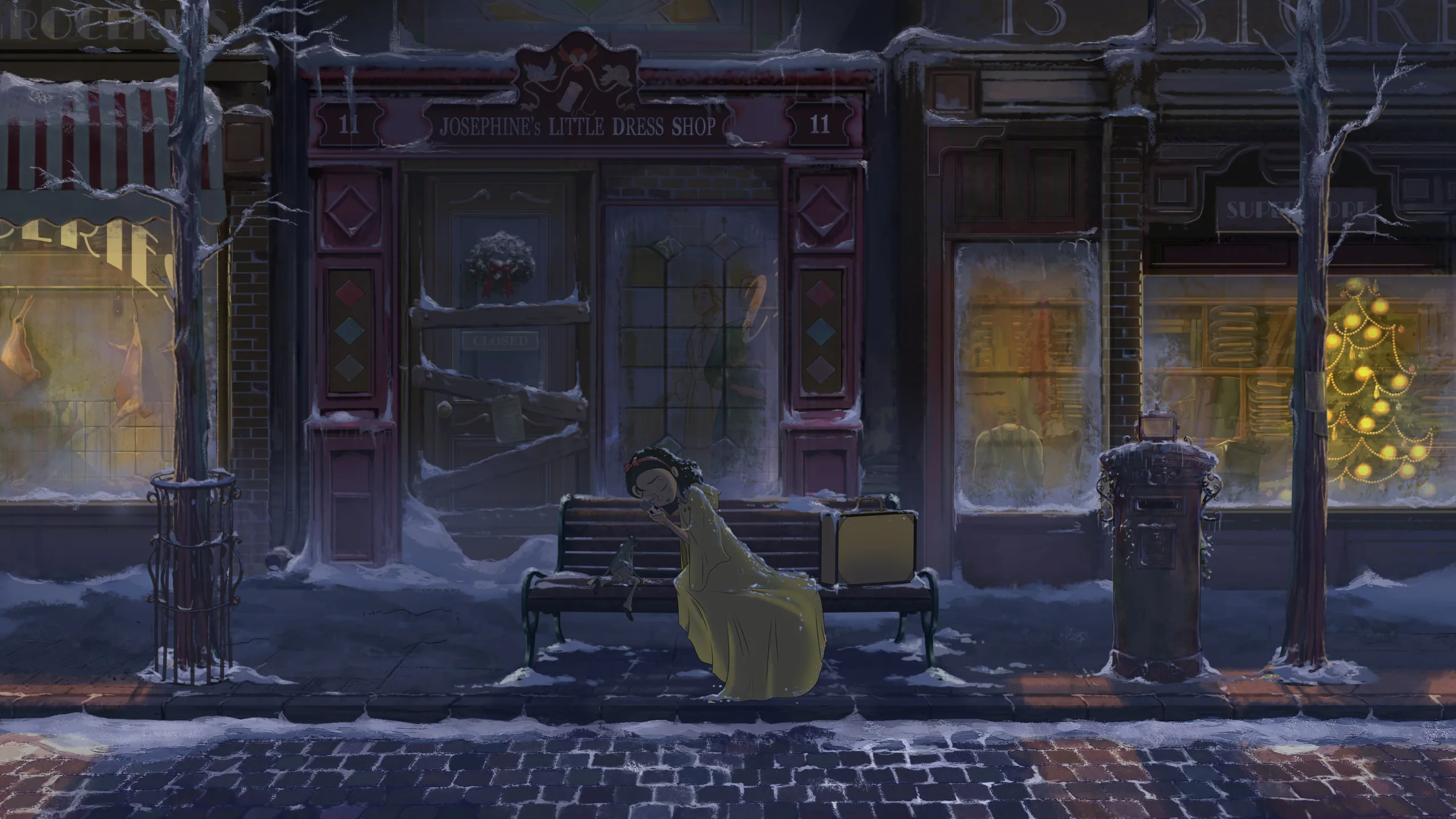
Bye Sweet Carole has quickly become one of the most talked-about hand-drawn narrative games in recent memory, earning major recognition for its animation, writing, music, and performances. We spoke with Italian creator Chris Darril about what the nominations mean, how a small team pulled off true frame-by-frame animation, and the emotional core driving the story.
“I was ready to have dinner when I received the notification, and, with an abrupt loss of control, I started to cry with joy.”
Temple of Geek: Congrats on the awards recognition. Bye Sweet Carole has earned major attention across NAVGTR categories spanning animation, writing, music, and performance. When you saw the range of nominations, what did that tell you about how the game is resonating so far?
Chris Darril, Writer, Artist, and Director of Bye Sweet Carole: Such a blast. I still remember when, in 2019, I received my first (and only at that time) NAVGTR Awards nomination for “Best Writing in a Drama” for “Remothered: Tormented Fathers.” I was ready to have dinner when I received the notification, and, with an abrupt loss of control, I started to cry with joy. And that was only one nomination at that time. Receiving now, with “Bye Sweet Carole”, a record number of nominations for an Italian game at the NAVGTR Awards, including lead categories such as writing and adventure game, was definitely crazy. I had to reload the page, scared it was just a glitch. I am honored, we are all honored, it shows how the game is reaching, yeah, maybe slowly, the people’s hearts, and how it is showing how much love and care we put into it.
“We had a vision, and then that vision took life.”
Temple of Geek: Bye Sweet Carole’s hand-drawn, frame-by-frame animation is being positioned as one of its defining achievements. What was the earliest “non-negotiable” you set for the visual identity of the game?
Chris Darril: To me, from the very start, it was essential to maintain a consistent number of hand-drawn frames between 15 and 24 frames per second. I still remember one of the first meetings with the rest of the team, those heroic tens, brainstorming about this and how they were basically left speechless knowing that tough challenge that would await us from then on. We never gave up; we completed the entire creative part of the game in record time, going as smoothly as silk, without compromising, and respecting the production and delivery estimates to the letter.
I am so proud of the result. We had a vision, and then that vision took life. It was, indeed, like watching an old-fashioned animated movie, one of those evergreen masterpieces we grew up with, but with heavy interaction and a real time gameplay. Same for the environmental arts, this may be the department for which we conducted the most interviews and artist tests. Very few, indeed, were able to recreate the authentic style of those painted or watercolor backgrounds of the classic old-school animated arts.
The research was painstaking, which is why, especially in the early days, many of the backgrounds, in order to optimize the production process, were developed by me, since I was familiar with that technique and had already mastered it in the past.
“It was certainly a feat, but no one said you shouldn’t sweat it if you want to create something beautiful.”
Temple of Geek: Traditional animation is often associated with film, not interactivity. What was the hardest part of translating a handcrafted animation workflow into something that still feels responsive to player input?
Chris Darril: We knew how to face cutscenes and cinematic scenes, that is the typical artcrafting process behind any traditional animated movie. But we were not aware yet, nor did we know exactly, how to face the gameplay side and the multitude of in-game animation variabilities, blend and reactions. Basically, we found out that we needed some “central hook” or, better, a meaningful set of “transition key frames” from which our heroine or the other characters, between one animation and another, always pass by in the process. That helped us hook animations per animation, interrupt them when needed, and then paste a new animation for a reaction to player input or to damage taken by an enemy.
This allowed us to make the animations, even the in-game ones, very fluid and interconnected, giving the feeling of an endless interplay. In fact, Lana and her companions are never static; even the simplest loop always has some movement, from the fluttering skirt to the unruly lock of hair blowing in the wind. Not to mention that, by adopting this graphic style, we didn’t want to opt for any kind of automation or automatic particle effects.
Everything you see on the screen has been drawn multiple times, even the pink sparkle, even the sea waves, or the crackling fire, or even the rain pouring to the ground. It was certainly a feat, but no one said you shouldn’t sweat it if you want to create something beautiful. At least we preferred to remain faithful to a style, including the complex technical process behind it, rather than “just simulate” it.
“We might consider this the major drawback of this choice, but we’re happy we took this path.”
Temple of Geek: The game has been developed by a very small team of artists. What’s one area where the small-team structure became a creative advantage, and one area where it forced difficult tradeoffs?
Chris Darril: Once again, I preferred to remain independent. I have infinite respect for the major video game companies, and clearly, especially at the first Gamescom 2023 and the first gameplay video we showed of “Bye Sweet Carole”, we attracted the interest of several high-level collaborators. However, after careful internal analysis, we preferred to remain consistent with the idea of making the game we would have liked to play, and by ourselves. I fully understand that this resulted in limitations on the development budget and, consequently, on the number of professionals involved, but we were able to make key decisions ourselves for the good of the project.
I wrote the story, I created the character designs for the main characters, or at least their main guidelines to facilitate the characters’ turnarounds, I tried my hand at storyboarding, not just for the cutscenes, but also for the simple gameplay actions, and I even painted myself a good number of game scenarios. We might consider this the major drawback of this choice, but we’re happy we took this path.
We wanted the public to experience the true, hard work of a small team that pays homage to the works that inspired and entertained us most during our childhood, and this has rewarded us with excellent sales results, much to our surprise, especially considering the limited resources we had and the vintage-indie nature of the game itself.
“How fast and progressive we are capable of being with regard to technology, yet how backward we still are in guaranteeing civil rights regardless of sex, gender, ethnicity, and even religion.”
Temple of Geek: Without spoiling story beats: how would you describe the emotional core of Bye Sweet Carole? What do you want players to feel as they move through its world?
Chris Darril: Bye Sweet Carole is basically an allegory. It faces the different phases of grief, pain and slow rebirth because of a loved one’s loss. It’s true: it has the typical structure of a fairy tale, yet it chooses to make the horrors of the human race explicit. How fast and progressive we are capable of being with regard to technology, yet how backward we still are in guaranteeing civil rights regardless of sex, gender, ethnicity, and even religion. In this case, I wanted to dedicate the space to different types of women, each different according to the canons of the time, in an era that has indeed been like this, to a certain extent, in all countries, because history teaches, it’s true, but humans easily forget.
And it’s sad to think that today we still have to debate how to guarantee every individual, regardless of their distinctive characteristics, equal rights solely because they are citizens of the world, and not based on factors that are decisive for a few but irrelevant to the majority. Our heroine, Lana, with her own introverted and closed nature, lives a monotonous life, feeling like a fish out of water and helpless in the face of time’s fury.
She’s unable to face the future because she still has an unresolved past, such as failing to accept her mother’s loss and, after finally finding a foothold in her life, her best friend Carole, having to accept the loss of her as well. In what also becomes a coming-of-age story, Lana learns that “people move, places change, we may love all them, but they don’t represent us; they’re just those elements that shape us as distinct individuals.”
“I had a clear idea: the narrator’s voice had to remain pleasant, like that of a dear father, uncle, or grandfather reading us a story.”
Temple of Geek: The project has been recognized not just for visuals, but for writing and performance as well. How do you approach performance direction (and casting, if applicable) so it matches the expressiveness of the animation?
Chris Darril: This project marks my third collaboration with Lani Minella (Ms. Fisherin) and Brandon Fague (Mr. Baesie), and my second with Elsie Lovelock (Lana Benton). A formal friendship has been established with them, and I know for certain that, in terms of professionalism and reliability, if I choose them, I know they will always do an impeccable job. Auditions for the voice actors, especially for the other roles, I must admit, were no walk in the park, especially because I had a clear, precise idea for each of them. Anthony Ingruber was my biggest bet because I knew how talented he has always been, but I was unsure how he would achieve Mr. Kyn’s creepy-raspy voice.
But, lord, he did it in a way he even exceeded my initial expectations. The same goes for the narrator, Jeffrey Hedquist. I had a clear idea: the narrator’s voice had to remain pleasant, like that of a dear father, uncle, or grandfather reading us a story. Paradoxically, because a man tells us the coming-of-age story of a young girl, as if he himself, despite being part of a society like that of the era in which men made decisions for women, has a kind, paternal tone, as if he himself could gradually put himself in our protagonist’s shoes, and then finally, at the end, give her her space to conclude her own story. For me, it was essential from the beginning that the voices be recognizable and, in some cases, even caricatured and stilted.
Temple of Geek: On the music side, what was the guiding philosophy for the score: should it lull players with warmth and familiarity, or unsettle them by twisting that familiarity into dread?
Darril: It’s a work as unpredictable as it is masterful. Luca Balboni, the lead music composer, spent months studying the musical registers typical of Disney classics and the more vintage works of Don Bluth. The goal was clear from the beginning: we wanted to welcome players and spectators into a world familiar to them, almost as if the music were composed by Churchill or Menken, and then, little by little, when you least expect it, feel caught off guard, where the register shifts and becomes at times even disturbing, chilling, but never out of style.
There are many sequences in which, despite the imaginative context, the colorful settings, and the talking animals, we find ourselves in an increasingly dark, cynical, and ruthless world that doesn’t hesitate for a second before finally killing us. And I’d say this is precisely one of the strengths of “Bye Sweet Carole,” a work recognizable in style and reminiscent of childhood cartoons, with its princesses, fantasy worlds, and beautiful orchestrations, but which then twists, just when you least expect it.
Like our heroine, the player feels helpless and almost out of place because they can’t rationalize the tremendously sudden changes the game and its structure make on more than one occasion. The so-called destruction of comfort zones, which, for the record, aren’t just understood as physical areas where we feel comfortable, but as actual states of mind to which we’re accustomed and in which we feel comfortable, and this is also thanks to the fantastic in-game music.
“As a man myself, I wanted to take my mother’s example and tell a story that would have meant so much to her.”
Temple of Geek: As a creator, what was the single riskiest decision you made during development — creatively, technically, or emotionally — and what convinced you it was worth committing to?
Chris Darril: Definitely, the fact of wanting to base the entire narrative on the key theme of women’s rights. Consequently, which was quite predictable, and especially from the Steam platform and from some press editors incapable of separating the game from the thematic core, is where we received multiple controversies. From those who accused us of engaging in feminist propaganda to those who even labeled us “woke.” But those who actually played the game, who played it to the end, know that the game doesn’t condemn the male gender but holds it—as it has indeed been throughout our history, as it indeed still is in many countries today—if not responsible, then complicit in a homogenizing and marginalizing condition.
As a man myself, I wanted to take my mother’s example and tell a story that would have meant so much to her. She grew up in Sicily, in an old-fashioned family, where women are subservient to men, where men can claim petty rights, even harmful ones, against women, but women cannot. I experienced the relationship between my mother and my father as a spectator. For years, my mother feared the consequences of the separation, despite the toxic relationship and a feeling that had already weakened over the years, for fear of the comments of others, of her family, for fear of being branded, so much so that she gritted his teeth and continued to “postpone” the separation and taking a position.
Because a man who leaves his love-partner, according to the typical culture I myself witnessed with my own eyes as a teenager, is a wounded man who deserves a new life. A woman who leaves her love-partner, on the other hand, was just a bad guy, someone who couldn’t care less about the idea of “family.” This was definitely, more than any other, the choice that, despite knowing it could generate negative reactions, as it in fact did, I carried with pride, always aware and proud of what I wanted to say.
“It’s fantastic to think that “Bye Sweet Carole” has achieved so many firsts for my country, and I’m incredibly proud of it.”
Temple of Geek: Being recognized internationally is also a meaningful moment for Italian game development. What do you hope this visibility signals about Italian creators and studios to the global industry?
Chris Darril: It’s fantastic to think that “Bye Sweet Carole” has achieved so many firsts for my country, and I’m incredibly proud of it. At the same time, I must admit that Italy itself often fails to recognize its own merits. Over the years, art in our country, despite being surrounded by art, just turn around and look at the statues and buildings, even in the smallest towns, has been increasingly belittled and even forgotten. And it saddens me to see influencer x making more headlines than artist y: there’s a significant lack of meritocracy.
And this is a hot topic, especially in the dubbing industry: more and more films and their Italian dubbing are assigned to influencers or those current hit-guys rather than professional voice actors who have put in years of study and experience to achieve a well-deserved professional achievement. I believe the main reason is that art is scary; it’s a harmless weapon, but it’s a weapon that gives freedom and identity, through years of sacrifice and cultivation and, as we know well, governing a heterogeneous country made up of free people with their own distinct identities and skills is much more difficult than, as Pasolini used to say, governing a country made up of standardized replicants.
However, this demonstrates how the perception of our country is gradually changing, especially thanks to a few institutions, such as IIDEA, that want to make a difference, not repeat the same mistakes of the past, and above all, thanks to indie artists in their small studios who simply want to make their voices heard.
“Lana and the other characters in the game might be the furthest thing from your individual nature, but that’s okay.”
Temple of Geek: If you could say one thing to players before they start Bye Sweet Carole, what would you want them to keep in mind as they enter this story?
Chris Darril: May the adult make peace with the version of the child they once were. May they both learn to coexist. “Bye Sweet Carole” doesn’t follow a specific genre; it shifts from adventure game to platformer, from dreamy animation to chilling thriller with hide-and-seek formula. It has a familiar atmosphere, but it takes a moment to break all those habits and overturn them. Experience it fully opened, as a journey itself, not necessarily “just” as a game; enjoy it in its entirety, you won’t get disappointed. And, if you can do it, so much the better.
Lana and the other characters in the game might be the furthest thing from your individual nature, but that’s okay. It’s a story as common as it is atypical, which simply wants to make you try to put yourself in the shoes of those who truly fought to allow us all, nowadays, to feel like an integral part of a colorful society.

Temple of Geek: What’s a misconception people have about “hand-drawn games” — something that sounds simple in theory but is incredibly complex in practice?
Darril: For some, opting for traditional animation may seem like a technological step backwards, and I can understand that, accustomed as we are these days to open worlds with hyper-realistic graphics and where the sense of immersion is unimaginable. But beyond the desired artistic and directorial choice, as Del Toro also said, animation is not a genre for children, but a powerful medium.
And traditional animation remains, even today, despite extremely useful cutting-edge software like Toon Boom Animation or Adobe Photoshop, the most complex to produce: whether due to resource consistency or the sheer commitment required, as if you make a mistake, you don’t have tools that automatically redraw the frame; no, you simply have to redo it from scratch.
Temple of Geek: Was there a specific artistic reference point (film, animation era, illustration style, or personal memory) that helped you define the game’s tone early on?
Darril: Among all of them, certainly the most shining and representative examples of traditional animation are Beauty and the Beast, Mrs. Brisby and the Secret of NIMH, Snow White and the Seven Dwarfs and even Anastasia. In Lana’s face, you can see Wendy from Peter Pan, but also Belle, Ariel, and Anastasia, small touches to make Lana more in line with those heroines of the animated fairy tales we grew up with. Even the choice of color palette: in many cases, we could certainly have opted for much brighter colors, but in the end, we decided to keep everything just the right amount of desaturated, enhancing the feeling of a forgotten vintage film from a bygone era.
“There is an artistic and directorial principle of coherence that, however, assimilates contaminations dictated by different artists, each with their own culture and skills, and their interpretation of that precise model to follow.”
Temple of Geek: How do you maintain consistency in animation quality across characters, effects, and environments when every frame is handcrafted?
Chris Darril: The point is this: we follow turnarounds that show the exact physical and facial features of all the characters, which must be followed schematically, almost mathematically, to keep them consistent across every scene. But despite this key process, and this is the beauty of it, each artist has their own style and signature, and it’s nice to recognize, even in the total of a single animation, when, for example, Laura has dedicated herself to the roughing of a specific action, rather than Alexia or Alessia, and so on. You can see it in those small, almost imperceptible details; Lana is always the same, she remains faithful to the original turnaround, she will always be recognizable, but you can sense the specific personalities of the various artists who collectively took part in a work.
This is just to give an example, and it’s something that has always happened: even the most famous Belle, Alice, Ariel, and Cinderella change small, imperceptible details here and there that only classic animation enthusiasts know how to spot and point out one artist rather than another. And basically, it’s the same for everything else in the game, from the audio to the painted backgrounds, to the in-game illustrations, the cover art, and even the music. There is an artistic and directorial principle of coherence that, however, assimilates contaminations dictated by different artists, each with their own culture and skills, and their interpretation of that precise model to follow.
“The two of them were definitely the greatest challenge, given the very different styles in which they were conceived.”
Temple of Geek: What’s one detail in the visuals (a character movement, a background flourish, a VFX moment) you’re especially proud of — even if most players might not consciously notice it?
Chris Darril: Definitely both Mr. Baesie and Mr. Kyn, respectively the sidekick and the nemesis of our game heroine, Lana. They have a clearly recognizable and contrasting appearance, yet they change shape, size, break, twist, and take on other appearances. The two of them were definitely the greatest challenge, given the very different styles in which they were conceived.
If Mr. Baesie harks back to the Silly Symphonies of the early 1900s, Mr. Kyn has the appearance of a typical sorcerer almost as if he was directly taken from The Lord of The Rings animated movie, and his fabric, while facilitating his development by covering much of his physical features, represented a huge challenge because beneath that cumbersome overcoat, it had to be immediately clear and obvious that something is not as it should be, that he is hunched, as thin as he is skeletal, that his body twists in a hunched manner, that beneath that top hat, in all likelihood, hides not simply a head but something much darker, crepier and more inhuman.
But another big challenge was certainly having to replicate the same animations twice for Lana, twice for both of her different forms: the human one and the rabbit one, and so, consequently, all those multiple variables and consequent blends.

Temple of Geek: What has surprised you most about people’s reactions to the game so far — either from press, awards bodies, or fans?
Darril: While the awards and nominations, as well as the critical acclaim, have obviously filled us with joy and pride, what has certainly touched me most deeply has been receiving messages of thanks. Sincere thanks from people who have lost someone, and to whom Bye Sweet Carole came at the most unexpected moment, to support them and find someone or something to feel solidarity with.
But also the applause from the increasingly large female gaming community, which makes me happy, who expressed their joy to be represented, and that games, more than ever, are addressing such sensitive issues that have perhaps been relegated for too long to other more “authoritative” media. A book, a film, or a video game can’t necessarily change an entire society, but the fact that even just one person felt understood, supported, and represented, or even just that one person understood how a story seeks to present itself as a sincere epic, to be understood and supported, rather than a political crusade, is already a change, a small victory itself.
“The audience wants to have fun and feel entertained while still being guided by a hand.”
Temple of Geek: After shipping (or nearing release), what do you feel you understand now about interactive storytelling that you didn’t understand at the start of this project?
Chris Darril: That the video game medium changes at the sight of the light. It influences other media and is in turn influenced by other media, but that it requires balance more than any other medium, and that a strong narrative context alone, however meaningful it may be, if not supported by an actual video game structure and, perhaps, a good and enough “fun factor,” cannot sustain the judgment of audiences and critics. Nowadays, it’s not enough to pay homage to the “old school,” even if that proves to be a deliberate choice, the rigidity, the backtracking, the lack of guidance for the player.
The audience wants to have fun and feel entertained while still being guided by a hand. And that’s perfectly fine, absolutely right. However, video games are the ones that adapt to film the fastest; for example, they are the most complementary to big-screen products and TV series. And all of this is magnificent.
It teaches us that every new project is a gamble, a leap into the unknown, and in doing so, we sometimes manage, even unintentionally, to influence an entire genre, even bordering on a record, and in a few cases, representing a significant chapter in the history of video games and their rich and ever-changing genesis and, on many occasions, even impacting older media which, in turn, have made video games increasingly bigger and more important, even culturally speaking – increasingly removing that derogatory term of “game to play, as a toy”, as it may be seen by the masses, and increasingly that of interactive work of art.
Be sure to join our Discord for discussions about video games and more at Temple of Geek!


