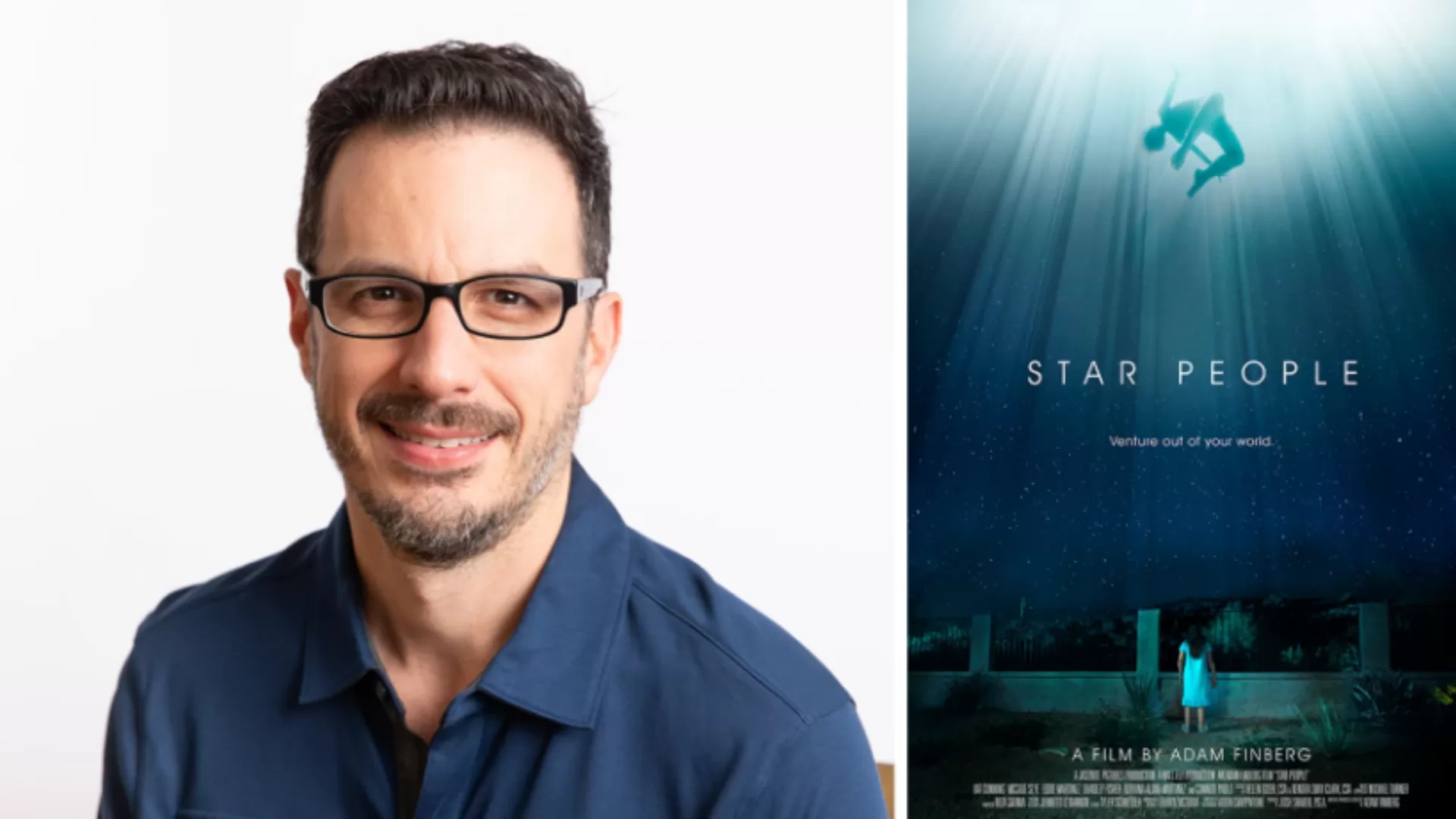
I sat down with creator Adam Finberg to talk about his film “Star People”. The inspiration for the film is the Phoenix Lights phenomenon, a mass UFO sighting that occurred in Phoenix, Arizona, in 1997. It follows Claire, a photographer who witnesses the lights as a child and goes searching for them in the Arizona dessert. Finberg breaks down the film’s inspiration and important themes around human connection.
The Phoenix Lights, a Mass UFO Sighting in Arizona
Although he did not personally witness the event, Finberg lived in Phoenix at the time and experienced the cultural impact. He was intrigued by how this unique event, could be a starting point for a story about human connection.
Suhaila (Temple of Geek): Let’s start at the beginning. What was it about the Phoenix lights that piqued your interest and made you want to create a story around it? Despite not actually see them yourself, you lived in Phoenix and got to experience the cultural side of that phenomenon.
Adam Finberg: I did. I was in high school at the time, and we had a close family friend who did see them and videotaped them. It was something through the years that just was continued to be talked about. It was this mass sighting that a lot of people saw, and there have been documentaries and specials, and TV, and there have been horror takes on it. And yet it still persists as this phenomenon that happened that isn’t really comparable to anything else in the United States. And for me, it was just a jumping-off point to tell a story about human connection. Because the idea of “UFOs and is there life out there” ultimately comes back to this idea of isolation. Are we isolated as humanity, but also are we isolated with the humans that are right around us?
Focusing on Individual Stories
Instead of a large-scale view of the Phoenix Lights, Finberg chose to focus on the intimate stories of a few individuals. The movie’s core is centered on the relationship between Claire and her brother Taylor. He wanted to explore how people process trauma and the difficulties of overcoming personal struggles, which is a central theme in the relationship between Claire and Taylor.
Suhaila: That’s one of the things that resonated. Instead of going big, you focused on Claire’s story and the people she touches. Can you talk about those elements of the story and why you chose to kind of focus the story on these individuals?
Finberg: I was very influenced through my work on a documentary called “The Business of Recovery” that I directed about 10 years ago, which was about the addiction treatment industry. Making that film, I met a lot of people, firsthand, that I would interview and follow around who were either in the grips of addiction problems, had I been on death’s door and back. It really opened my eyes a lot to how people process trauma. Some of the people I met during the making of that film, unfortunately, passed away. Those things that haunted me, having those personal experiences, and understanding the idea of how difficult it can be to process trauma. And so that’s really, when I started writing Claire and Taylor, those experiences were always in the back of my head.
Immigrants in Search of Safety
The movie also features Ricardo and Gabby, immigrants trying to find safety. Having grown up in Arizona, Finberg was always aware of the hardships faced by immigrants, including the many who die while crossing the desert. He notes that the theme of “demonizing people who are different” is a historical trend in the United States. The film remains relevant to current political discussions, despite being written several years ago. Finberg emphasizes embracing our differences and recognizing our shared humanity.
Suhaila: And Ricardo and Gabby being immigrants trying to find safety. Can you talk about that element of the story?
Finberg: Having grown up in Arizona, the stories of immigration have always been very present because people die in the desert out here all the time. And you don’t hear about, the news isn’t gonna report on every death. But there are many, many people through the years that have come to this country to seek a better life. And it’s been very easy, I think in recent times to demonize people who are different. It’s always been a thing. And that has been historically happening forever, since the beginning of this country. I mean, in the early 20th century, there were immigrants coming here that were demonized and blamed for all of society’s ills. And yet we’re still a nation of immigrants and it’s easy to forget that.
Some people may watch this film and think I just wrote this as a response to what’s going on. But I wrote this several years ago and getting a film made takes time. It just goes to the idea that being afraid, being fearful is a very common theme unfortunately in this country. And it just unfortunately persists, the same sort of scapegoating happens today, I think.
Suhaila: It was so poignant to see Ricardo and Gabby’s immigrant story. An interesting thing we see throughout sci-fi media is how UFOs and aliens are portrayed reflects society and current events. Sometimes they’re a dangerous, invading entity which parallels how immigrants and minorities in the West can be viewed. Is this a message you hope people get out of this movie, even if it wasn’t intended when you were writing it?
Finberg: Well, there’s no political intent behind the film. For me was a, the story is about human connection and about embracing our differences, embracing what makes us human. And I think that is what I really want people to come away with this. That we have a lot more similarities to people, to those around us than we think. And that we are connected in many ways to all of those around us.
Guardian Angels
Near the end of the film, Ricardo refers to the “star people” as guardian angels. The characters essentially act as guardian angels for each other, saving one another in different ways. Finberg also draws a parallel between UFO sightings and near-death experiences, viewing them both as a journey into the unknown.
Suhaila: One of the parts that I really loved is near the end of the movie. Ricardo says, “You call them star people, I call them gente de las estrellias”. He sees them as guardian angels. Even though he’s talking about the aliens, that brought the entire story together for me. All of these characters end up acting as guardian angels and saving each other in different ways. Can you talk about that?
Finberg: In my readings about UFO sightings or even people that claim to have abduction stories, there’s a lot of commonalities with near death experiences and none of it’s explained or scientifically proven one way or the other. But I think I just always saw a sort of parallel there between the unknown. Is it a tin can ship with motors, or is it something else that we can’t quite grasp?
And I just saw, I saw for me, I saw the houses is sort of purgatory for the loss, Taylor and Claire were these lost souls that were metaphorically lost souls and Ricardo and Gabby were physically lost souls and they sort of had to come together in order to survive. They all had to sort of embrace each other’s humanity in order to grow and move on. But yeah, I guess that was kind of where my head was writing that.
Being Lost and Finding Home
“Star People” explores the idea of whether we are isolated as a species and as individuals. The characters are metaphorically and physically “lost souls” who are all searching for a sense of home. Claire and Taylor have lost their sense of home due to childhood trauma, while Ricardo and Gabby have been physically displaced. Through their interactions, they begin to find a sense of belonging with each other.
Suhaila: There’s also the concept of home. Claire and Taylor metaphorically losing that from their childhood. Ricardo and Gabby losing that physically with migrating to the US. And I love that they started to find it towards the end. Can you talk about that journey for the characters and what you were intending there as well?
Finberg: That’s interesting that you picked up on that. But the concept of home is, you know, the saying home is where the heart is. I mean, ultimately, if you don’t have anything that you’re connected to, then you might feel sort of without a home. And, you know, the Taylor and Claire’s character, even though Claire had a place that she lived, it was a very intentional, the design of it had a very cold feeling. Because she was isolating, she was isolating herself. And Taylor was isolating himself through his own homelessness because he was going couch surfing. Then Ricardo and Gabby, they were between homes, they felt forced from theirs. And the only home they knew was where their family was.
So, I guess all those things sort of intersected. And yeah, it’s interesting how that concept of home was something that sort of grew out of the story. But I didn’t like start with it, it just sort of happened as it was developed.
The Otherworldly Night Sky
The stunning night sky was important to the tone and aesthetic of the movie, created by a visual effects artist in post-production. He intentionally used real start maps to reflect the experience of seeing the night sky in the remote Arizona desert.
Suhaila: One of the things I noticed from a visual perspective was the night sky. It was beautiful to see the stars as well as the landscape and gave the whole movie an otherworldly feel. Even though we didn’t get to see aliens or UFOs physically, you still felt like there was this presence. Can you talk about that visual?
Finberg: I was inspired just getting out of the city in Arizona, getting to high country. I love camping and just seeing the night sky. That’s to me, one of the biggest attractions of getting out of a city. I knew that it had to play a big part in this film because if you were chasing lights and you were going to remote areas, you would see the skies. In order to create that on film, I worked with Brian Tooker who was our effects artist who did amazing work because all of the stars had to be brought in, but they are actually from real star maps. I believe some of them are from NASA, but they are from real images of the sky up there. He did a lot of work, every shot where you see stars, that was purposely put in there.
Suhaila: Was there anything in particular, like in terms of like constellations or anything that you wanted to show as Claire was looking through her camera lens?
Finberg: Nothing particular, she does see Jupiter in one of them. We didn’t show a particular constellation because it just wasn’t enough time for it to read. But she does reference Dranco, you see milky way. But people may forget, when you get out of the city, you see that intensity out there. It’s big.
Suhaila: It is one of those things that you have to go out and seek. And I love while Claire is seeking out the UFOs she’s appreciating it, but not to the same degree. Because she’s always out there seeing that night sky. It’s a good lesson for us, when we’re chasing one thing and being hyper-focused, we can miss a whole lot of beauty.
Finberg: Yeah, and it’s easy to see without observing. They’re not always the same thing.
Are We Alone Out Here?
Finberg talks about the phrase “are we alone?” often associated with extraterrestrial life. But its original meaning refers to the shared human experience. For him, the film’s message is about finding connection in a disconnected world, and that we are not alone even when surrounded by others.
Finberg: One thing that’s interesting is the phrase, “we are not alone” is often sort of misunderstood in some ways. Cause a lot of people, like how would you, when you hear that phrase, what do you think of when you hear we are not alone?
Suhaila: A lot of times aliens or like extraterrestrial life.
Finberg: Right. And it makes sense cause it’s like, are we alone? But when I was developing that, that phrase was fascinating to me because I found, I discovered that it really started from a biblical standpoint. It showed up in biblical texts many centuries, a long time ago. And then in philosophical texts, it means it’s about the shared human experience. And now in modern times it’s this like, are we alone in the universe? But for me, this movie wasn’t about whether we’re alone in the universe, it’s more about are we alone? Are we surrounded by people, but still alone? So trying to find connection amidst this sort of disconnected world, I guess.
Suhaila: And I love the Rumi quote at the beginning. This idea that the entire universe is inside you or that you are the universe. That sentiment that you as an individual contain these multitudes, this universe inside of you. We don’t appreciate that enough.
Finberg: Yeah, it grabbed, I really grabbed me when I discovered the meaning behind it and from Rumi, I mean, just the connectedness, I mean, that was really what it was about for me.
On Casting Father-Daughter Actors
The casting of Eddie (Ricardo) and Adriana Ricardo (Gabby) as father and daughter was a coincidence. Finberg found out later that it was on Eddie’s “bucket list” to act with his daughter. He believes their real-life chemistry enhanced their on-screen performances. Similarly, the on-screen chemistry between Kat Cunning (Claire) and McCabe Slye (Taylor) was crucial for making their sibling dynamic believable.
Suhaila: I do wanna talk about casting because Ricardo and Gabby are father-daughter in real life and playing father-daughter on screen. Was that something that you had considered in the casting process while you were looking for to cast those two roles?
Finberg: It was destino, I suppose, as they say. When I found Eddie, I knew Eddie was gonna be a Ricardo. He’s so talented and I didn’t know he had a daughter at the time. We weren’t intentionally try to find someone’s daughter, but he was like, would you like to see Adriana do a read of it? I was like, sure. And she was great and obviously they had real chemistry there, which was amazing.
And Eddie told me that on his bucket list, he wanted to act with each of his kids. Apparently all three of his kids are actors. He didn’t tell me this when he did the audition, but later he told me that was one of the, and I understand also as a father, how amazing that must be to be able to have that experience with your kid.
On Casting for the Sibling Dynamic
Suhaila: Again, it goes back to the concept of family and connection and home. And same with Claire and Taylor, the chemistry between those two. If you told me they were siblings in real life, I’d believe it. The care they have for each other with the bickering and the history of real pain and suffering. How did you bring those two together as siblings on screen?
Finberg: Once I found Claire, that was the first step. Like I had to find Claire before I could figure out Taylor, but Kat was just an incredible performer from the moment I saw the audition. I was just blown away. And it was through, I’m watching on Zoom these days with a lot of auditions are. And I just remember feeling like, well, if I can feel this through this two-dimensional space when I’m through a Zoom camera, when we get onto a set, it’s gonna be even more incredible. But then, but yeah, finding the right chemistry is important. After I had Kat on board, then we just pursued finding the right fit for a brother that, because it had to work. I mean, there’s a certain chemistry that has to be there that you believe it.
Star People is available to stream on Prime Video, Apple TV+, and more.