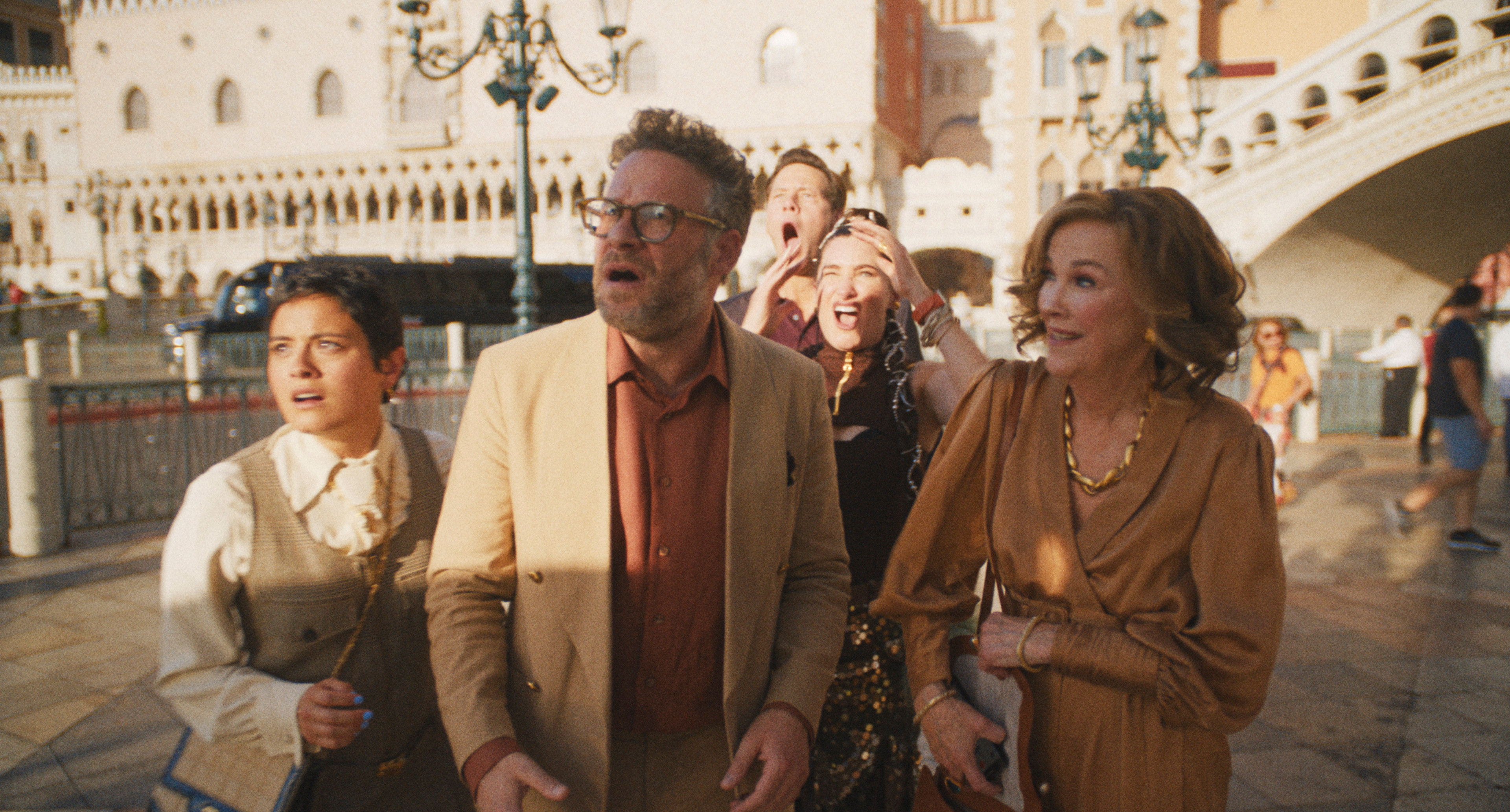
In a Q&A with Maria from Temple of Geek, Emmy® nominee Julie Berghoff discusses her work as a production designer for Apple TV+’s The Studio.
Julie Berghoff Talks About the Challenges and Highlights of Design
Temple of Geek: I want to say congrats again on the Emmy nomination. My first question would be: What is it like creating a set within a set?
Julie Berghoff: Oh, good! Stage, I think 23. I think I can’t believe I’m forgetting this already, anyway. That was the 1st thing up. I think that was the part that was so intimidating for me, it was like, how like we know, we scouted some of the studios like Universal, Warner Brothers, Paramount, and Sony, and looked at their executive offices, and I studied the different architecture, and how they worked and how they functioned. And we needed to create. You know, a Hollywood, our own version of that. So that’s kind of where I started.
Like, back to the feeling. How to create something unique that fits into that Hollywood time of the 19 twenties. And that’s when we came up with the Frank Lloyd Wright journey, and his Mayan period was something that really Seth and Evan gravitated towards a lot because they felt like filmmaking is antiquated, just making only features. And so we wanted to do kind of an antiquated, tomb-like design to embody the offices for our characters.
ToG: What would you say would be the most challenging set to make?
Berghoff: I mean, that was definitely the most challenging. We had like 6 to 7 weeks from concept to build. Yeah. It was the 1st setup that we used. So that the actors and Adam could have had time to kind of figure out how to move the camera through the space, and so it was a lot of pressure to finish something so expansive and so big and so detail-oriented in such a short amount of time.
ToG: So you built on a real studio lot, then I believe.
Berghoff: We built it on Warner Bros. I feel like it was Stage 23. 21. My God! How am I forgetting? It’s 1 of the bigger stages. I built a two-story set to allow the camera to move from going through the doors all the way up the stairs into his office. It was around 8,000 square feet, the overall size of the office, and we had moving parts and doors to accompany the camera being passed off, because, as you know, it was like all one continuous move. So we worked really closely with the camera and a key in the grips and the electric to find a way to accomplish everything each department needed to do.

The Evolution of Design
ToG: So how did the design evolve throughout this series? Because the themes definitely evolved as well.
Berghoff: I feel like we approached each episode individually, so I don’t know how it’s evolved. It’s more like what we wanted to address. And you know, like I said, each episode had its own new locations and new sets, so we just would look at it and figure out the best way to accomplish that between doing as much as we could on the back lot if it’s needed or out in Los Angeles, and you know, each like one or 2. We found that beautiful house in Silver Lake, the Lautner House.
So that was where we shot only that episode there, and outside of there, you know, and then we have, like, the Golden Globes episode. Also, Seth and Evan really wanted to be authentic to their scripts in Hollywood, and so, like, for example, we needed to shoot at the Hilton, like it had to be there.
Even though they were full-on construction, like they were demoing their garage, which is right next to the ballroom, and there were sound issues, they promised us it would be off at 4 o’clock for filming… I was setting up at midnight, and we came in to set up the exterior. We literally had like eight minutes to set it up. Then we were gonna film it. We had to strike it because it was in their valet area, and we showed up, and it was like jackhammering. And we were just like, How are they gonna film today and everything? And then they stopped at 4, so everything was good.
ToG: It’s very. It feels very meta. What is it like working on a show that’s so Meta? But it’s like a behind-the-scenes look at how films are made?
Berghoff: It was cool, it was, you know, to actually, and and Seth and Evan and the writers really pulled it off in a way where it’s funny, but also delivering something that was pretty hardcore, like, as far as like, you know, making fun of ourselves in a way that we could all laugh at it. But how ridiculous we are, you know, from the one, or you know, basically, you know, each person wanting their own thing, like Greta wanting the jet. And you know, Seth, or, you know, wanting to influence the projects that he’s a you know he’s unique. You know, he wants to be a creative.
And so I’ve been in the film industry for over 25 years, and I’ve seen that happen. I’ve seen producers cause total chaos, or someone who was randomly invited to the set. So that was, we’ve all been there, and so I’m really excited to see what they come up with next, like, what’s getting a second season, like what other? You know, foolish mistakes and things that we do in the film industry that we can make fun of.
ToG: I’m glad you brought up the oneer. I’m going to go ask specific questions about each episode, because, like every episode, it is very specific when it comes to the one, or the fact that it is a oneer was very well executed. How? What was the process like to create that? And how many takes? Did it actually take?
Berghoff: I’m not the right person to ask that question. That’s more of an Adam question, but I can’t tell you that the house was all glass. So it created problems with lighting. So basically, they had to rehearse and shoot at the same time every day.
ToG: Would it be fair to ask if you had, like, hidden transitions built? Did you have, like, your own set visually to suggest invisible cuts, so you could join things together for stitching? How did you like building a set so it could run so seamlessly?

Berghoff: We definitely work together with Adam to figure out, maybe, like cutting points in the set. But I mean the sets. The stage build had, you know, an open, you know, lobby area so that they could put the camera mark on a rig and lift him up, and then I had wall pieces that could be pulled out so that they could he could shimmy off to the second floor and then follow Seth. So it was. It was.
There were always rehearsals, like I don’t know if you’ve watched any of the interviews with Seth and Evan, but they talk a lot about how they rehearsed everything. First, they would block it with the app with the camera, and then they would bring in the actors, and they would move through, and they would block it, and then we would just all come together and figure out how to make it happen.
Julie Berghoff Walks Through Inspiration
ToG: So Episode 4. It’s a detective noir. How do you navigate the boundary of a meta influence with the design elements, like how do you create a parody that makes a very believable world with those elements?
Berghoff: Well, Chinatown, mostly what we created in the back lot. I think it was more like we’re just so inspired by the script. So when we read it, we’re like, how can we create this, where thinking about the movement of the set is involved, too? So we’ll find a location. And I will kind of diagnose it, and then I’ll pitch it to Seth and Evan where I want things, and how it would move through the location, and Adam, and we would all decide. And. You know, working with my decorator, Claire, we would, you know, just rebuild that whole back lot to try.
It just goes along with like the whole, like, you know, the behind-the-scenes aspect of that episode, which was, you know, dipping into, you know, detective, and finding something. It was just very unusual, and at first I didn’t think some of the gags would work. For example, Seth hiding in the trailer; it was like a coat rack, it was on like hanging. [And] it was on the wall, and then we found the boat rack, and we just positioned it. And it totally works. So some of those things you’re like, Oh, is this gonna work? And you know, and again, you know, Adam and Seth and Evan. We’re like, yeah, we can put it over here, and we can do it like this. And it’s really cool to see how we present things, and then they take it and make it magical.
ToG: So Chinatown was a very obvious inspiration. Were there other movies that you were inspired by throughout the series
Berghoff: Yeah, I mean Chinatown, and I mean, there was the Scorsese ones. One for Ron Howard when we did the Taxi one. We were giving a nod to certain films and then doing our best to stay true to that. So that was definitely one. And then we looked a lot to different posters for. And you know, for all of the posts, we created a poster for every movie in the series.
I literally had an entire, probably massive wall with posters from the 19 twenties to modern day, and they were a combination of inspiring us for our movies in the movies. Or you know, the studio posters and stuff like that. So yeah, for sure. I, besides Scorsese and Chinatown. Yes, some of them were similar to Cinemacon. We just looked.
How it was done and inspired by the whole process, because again, we wanted to be authentic, and the Golden Globes was the same thing, like we wanted to be authentic. So I do a lot of deep dives into each kind of episode. And is it, is it, you know, like comic con cinema con? Or is it a movie that tries to be authentic to any of those things?
The Importance of Authenticity
ToG: I mean, it translated well, because a lot of my questions are like, How did you make it so authentic? So that is a deep part of my questions. Going along with my questions. My favorite episode is Episode 5 because I love the slapstick comedy of it all. How did you balance the like staff like escalation comedy, with like the environmental aspect of it, like just like the throwing of the burrito, the collapsing sets. How are you able to balance like environmental sets collapsing and just comedy so well, in that way? While creating, consider the escalation between Sal and Quinn, for example.
Berghoff: That one was really fun. You know, it’s kind of like that episode grew originally. I guess we did. You know we had the. You know, the French troops like we’re playing up on how Apple basically has rented out the whole lot. We can’t even find our own movies there. And so then we could. We could use that as an annoying source for Sal to be like interacting with, because the chaos of that with Sal, like when it starts with him, not being able to find a parking space. I mean, I love that they had a little bickering moment that started. That was kind of underlying the whole time, but really came to fruition in that episode, and I love that. She found her voice to stand up to him. And you know basically one out at the end where he’s groveling towards her.
But we were the whole like visual effects of the set falling in the background. Originally, we built a little model of it, and then we were going to build some of it, and then we were gonna do visual effects. And like. So it was like a journey to find a way to accomplish that within the time and the budget, but still have an impact. We found a way by just bringing some of it in between the stages and just having it be off in the far off, so that you know what happened. But you don’t have to see every second of it.
ToG: That is true, and it makes it as you could. I think the far-away shot makes it easier to see the impact that way, too. So it’s a very good shot.
Berghoff: I loved Chase when she was like. Come on, bring it on like, you know, and he’s just, he can’t even hold it inside. He’s just like, and then he lets it loose. So that was really fun.
ToG: I think what I really enjoyed about the episodes is that, like everything else, it’s a little larger. To scale these big studio heads with these like celebrities, these movies. But then there’s this internal conflict between them. It was just like this, back and forth. But then the studio I really love is like that; it’s a very. It’s like a bottle episode. But it’s like, within the studio, this is under Lot conflict. It was very well done, but going back to the Golden Globes and CinemaCon.
What I really appreciate about the Golden Globes is that not only is there authenticity, but you were able to, like, have this very fine line of showing the pageantry of Hollywood while also giving this commentary about, like, you know, there’s almost like this cynical look into it. How are you able to give that authenticity as well? This commentary about that look while creating this great environment of the Golden Globes.
Berghoff: That one was also very different. I’ve never done a variety show before, which is something live. And so, I approached it as a theater, a theatrical situation, because we had such a short time frame. But also like the comed came in just like with Seth trying to figure out a way to be, you know be thanked was the journey on that one. And we tried to create space when we made the space working with Adam, the Dp. We just found ways for him to move around the set and kind of just inquire what’s going on, or just be bewildered, or have moments with people.
And so my approach to that was, you know, making something theatrical that we could bring in and out really quickly. That was beautiful that was in our color, palette of like the rusts, and just like kind of old Hollywood and support, you know all the movement through the space along the way.
Guest Appearances in “The Studio”
ToG: So, along with that, you also had, like multiple guest appearances or celebrity appearances throughout. How did you manage that? Multiple celebrity appearances in that episode, but in general, like in a series like the studio, how do you handle multiple guest cameo appearances throughout a series, along with the set designs?
Berghoff: Well, unless it’s someone’s home. Specifically, like we’re just creating the environment. That’s, you know, more written into the script, like, for example, the Golden Globes were the Golden Globes, you know, with Scorsese. We, you know, talked about doing his office, Scorsese’s office, and having Seth show up there, but then we wanted it to be kind of a neutral space that set.
And then you know, Seth again wants to be as authentic as possible. So he’s like, I meet in penthouses, or you know, private rooms all the time. To hold meetings, he sometimes goes to an old Hollywood steakhouse, or to the Smokehouse or other restaurants. So we just followed their lead and their authenticity in meeting people, and just recreated that.

ToG: In the later episodes we have the cinema con episode. But we also have where Zoe takes psychedelics. There’s a turning point in the party where you know that the drugs actually hit. What were some design elements that could help change, like those total shifts that you’re particularly proud of, and creating that type of high stakes and creating the tension in that moment?
Berghoff: Well, I feel like again, we wanted to create a Badass party. So we found we found the biggest suite and added all those nuances that make the Hollywood party, which, of course, you have the Hollywood buffet right? And so, working with my prop master, Andy Siegel, we worked on what that authentically would look like with Seth and Evan. On that set, besides the tent that I created for Zoe, which I can’t remember. If you see her crawling out of it.
We, you know, we worked with Seth and Evan. We’re like, okay. And even Zoe, like, what if you were high on mushrooms and you were stuck in a room. What would you do? So I think at 1 point we created a tent out of the bedding, that if she were to be in there. And so it’s just like those coming together and talking about just different weird nuances, and then the rest of it pretty much played as a penthouse.
ToG: So, in comparison to the Golden Globes, how is it creating CinemaCon?
Berghoff: Cinemacon was pretty straightforward. I mean, basically, we had to create a lot of graphics because it’s basically this huge theater with a lot of graphic presentation, music, and sound. And so we worked. We worked with the Venetian and used their LED screen and prefab, and made all the graphics that were projected on all the LED screens.
ToG: Then the last question was how you approached creating this like pitch room environment that reflects this high-stakes pressure cooker atmosphere. That’s essentially the Continental studio boardroom.
Berghoff: Thank you. That was a really important room. It was first written as like a couple of different rooms. So that’s why, in episode 101 in the pilot. You see going into another room, because originally there were three different. We did create 3 different sizes of boardrooms there, and one was a marketing room like your pitch room, slash marketing room a lot of times in these big studios. They have those room like the one I don’t know if you’ve been to the one at Universal, it’s massive. It’s like. I think it’s almost like 60 chairs are in there. And Evan was like, I want it that big. And I was like Evan, that’s like the size of our stage, you know.
So we just we really I wanted everyone to be able to see everyone on that set. So Seth’s office is a little is 3 steps higher than everybody, but he’s still in a goldfish bowl, like he’s all glass. All the offices have glass. That boardroom pitch room has glass. So basically, anyone who’s meeting in there or anywhere in their offices can almost see each other. So it creates a vulnerability. And also, you see how they’re kind of like they’re always listening, like who said what, and they almost have to pay off the assistants to get information. So I wanted that to be. If you could read lips, well, you could find out anything that was going on at the office.

Julie Berghoff Found Joy in Designing for This Series
ToG: It translated very well, because it was very cinematic at the same time. What are you most proud of when it comes to the production for the studio?
Berghoff: Oh, the office, for sure! That was quite the feat to do in a short time, and I got to do all the levels of detail that I wanted to. I got to do like all the little stories downstairs. And, like, you know, there’s the nod to cinema. There’s a nod to the history of the Continental with all of its awards. And then there’s the story of cinema on the mural when you’re walking up the stairs like that for me. I almost didn’t get that done.
That was literally like sweating that one to design it to make it unique, but also the story of comedy, because they wanted it to be all about screwball comedies. We have the studio. So I had to do a deep dive into, you know. screwball comedies from the twenties, and who knew that, like Cary Grant, and all these romantic little comedies were defined as screwball comedies, and a lot of those actors. It was just like, you know. That was the history of a lot of cinema that came from then.
ToG: Oh, wow, yeah, I guess that answers my next question. I was gonna say, every episode has its own like story. And there are so many Easter eggs. But I’ll say, is there an Easter egg or hidden detail that you really love, that you think audiences missed, or you would like to highlight from the show?
Berghoff: Well, one of the hardest things to create was the logo, the Continental studios logo. And so I think it’s not necessarily an Easter egg, but I’m not sure if people really notice how often I use it throughout the studio. It’s in the windows, it’s in the shades. It’s in the columns.
It was something that kept production. I was almost. I was getting a lot of heat from my construction coordinator to have that done because I wanted to implement it in so many places in the set. But I was having a hard time getting approval on that, so it took a lot. We designed over a hundred Logos to get that logo.
ToG: And my final question, is there any hints about season 2, that you can share at this time.
Berghoff: I have not read anything. I was asking yesterday. Evan, do you have anything for me to read? And he said, Not yet.
ToG: Okay, great. Thank you so much for your time. I love the show. It is so wonderful. It is a great commentary on cinema and shows. And yeah, it’s just every episode is like it’s its own masterpiece in itself.
All ten episodes of The Studio are now available to stream on AppleTV+.