
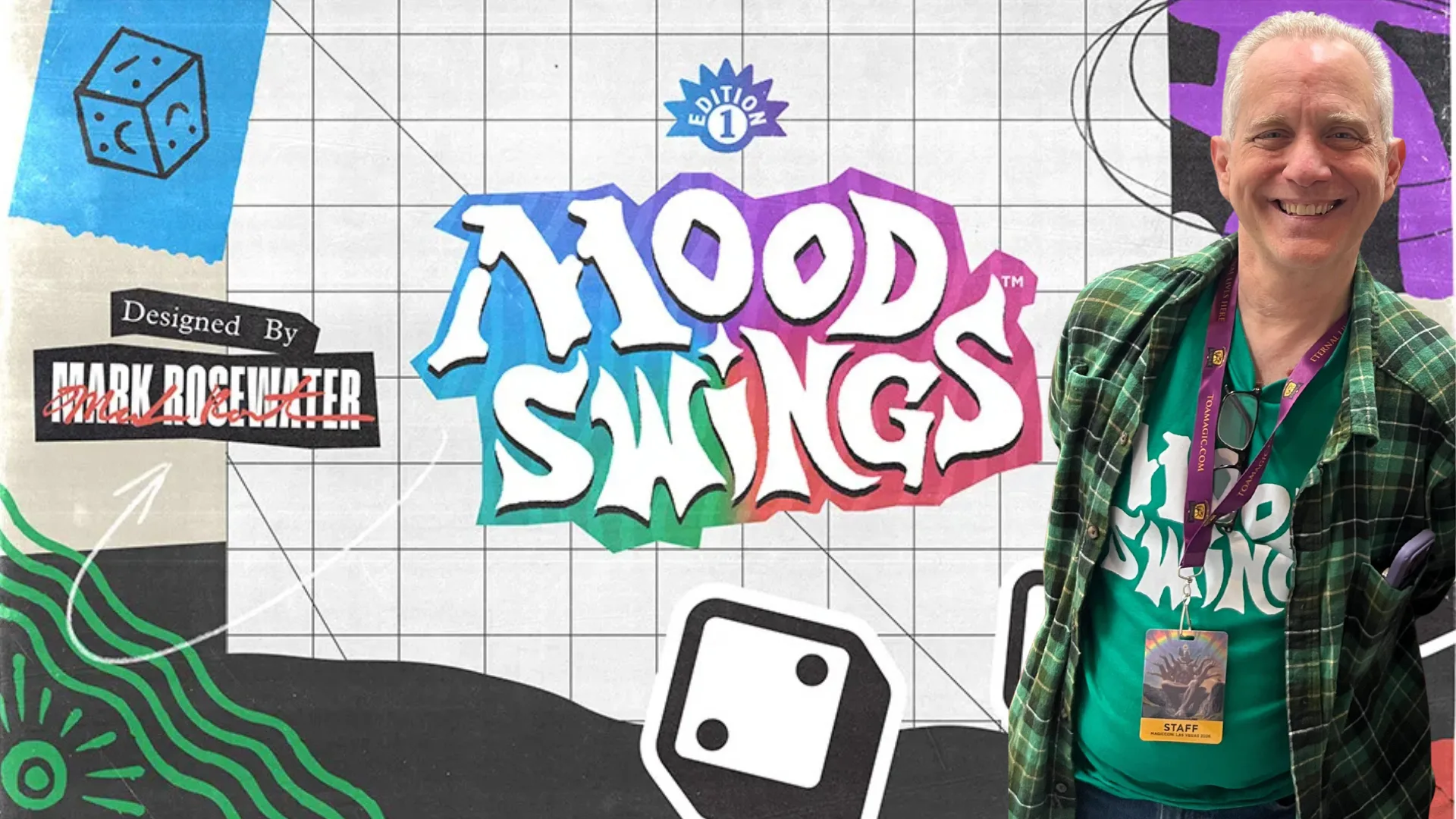
Mark Rosewater, head designer for Magic: The Gathering for decades, has always loved card games. As a game designer, he believes that they should be accessible to both new and veteran gamers. With Mood Swings, his passion project card game nearly 28 years in the making, he hopes that casual audiences will find joy in the simplistic gameplay loop. He wanted to remove the complexity of popular TCGs like Magic, like removing a resource system and streamlining the rules, with games “only lasting five minutes for new players, maybe 10 minutes for more experienced players”, he says after we play a quick round of the game during MagicCon in Las Vegas.
“It’s All Situational in That There’s Fun Interconnectivity to It.”
To play Mood Swings, each player plays one card on their turn, and at the end of each round, whoever has the highest score (represented by a D6 in the upper corner) is declared the winner. Win three rounds of Mood Swings, and you win the match. But even with its simplicity, there’s still plenty of room for more seasoned TCG players to find depth and strategy in it. Cards all have certain abilities, colors, and nuances for more complex games.
“This is my love letter to card games”, Rosewater explains. “I adore [TCGs]. One of the things I love about them is that they’re very modular. There’s a lot of pieces that do individual things, but they mix and match in really fun ways. And one of the things that I really wanted to capture, which I feel I did, is that you can play a game where there’s a card that dominates, and the next time you play that card it’s worthless. It’s all situational in that there’s fun interconnectivity to it. And that’s a lot of the fun for me, the game’s very different from place to place.”


“The other thing that’s fun with a [TCG] is the fact that I’ll play my deck and learn it. I’ll understand the strategies. Then when I go to my friend’s house to play their deck, it’s not quite the game I know. I know how to play, but the card that I’m worried about is not always in the deck. There’s a lot of the exploration [in Mood Swings] that comes from [TCGs] that I think is very fun. There’s a meta environment to it where other players can play the game and it’s not quite the same.”
Rosewater continues, citing that he’s very proud of the design, and one of the trickiest things about design is the idea that simple is actually the hardest thing to do.
“It’s much easier to add a lot of rules onto something than it is to make it as simple as possible. I’ve been showing people who don’t play Magic and they enjoy it. And I show Magic players and they have fun too. Because it’s a TCG, there’s ways to draft it, there’s ways to play team games. It’s a modular game . . . Even though the game is very simple, the [world and environment has depth]. Lenticular design is a design philosophy intended to mask the complexity from a beginner. But a more advanced player will see the complexity. This game has a lot of lenticular qualities to it.”
“In My Very First Version of It, It Was Always Called Mood Swings, It Was Always Emotions.”
Mood Swings is game about emotions and the human experience, and I was curious where the 30+ year Magic veteran got the idea from.
“One of the ideas was that I was trying to make a very accessible trading card game. A lot of people like fantasy and there’s people that don’t like fantasy. So I was trying to find something kind of universal. My mom’s a psychologist, I’ve always been sort of fascinated with emotions. I just felt like everybody understands them and it’s . . . the universal human experience. In my very first version of it it was always called Mood Swings, it was always emotions. It just was my initial idea.”
I’m personally fascinated by game design and the many processes behind bringing games all types to life. I asked about how he went about balancing a game where all players play from the same single deck.
“One of the cool things is that you’re playing off a shared deck, which means you don’t have to be perfectly balanced. The reason you want to have balance is, if we each can take our own [deck], we make sure that our independent decks have a balance with each other. But when it’s all shared, if there’s a card that’s more powerful than other cards, maybe you draw it maybe I draw it. We did balance it but the balance is not nearly as important when you have a shared deck.”
He continues, “[t]he other thing is, this game is meant to be a little more casual. So when two people play each other the more variance there is, the less skilled player can win . . . Variance tends to be fun. The only strike against variance is that it makes less skill-testing. But this game isn’t about [that], it’s about having fun.”
Rosewater went on to explain that the core gameplay has remained relatively unchanged during the long design process. “There’s so much of the game where the very first thing I made it up with made it all the way to the very end. It’s kind of impressive how much I got right at the first shot,” he says, resulting in a bit of shared laughter.
Mood Swings is a passion project that took 28 years to get off the ground. I was curious about what changed between when Rosewater first dreamt it up and now. He explains that Secret Lair was the catalyst to finally get the ball rolling. Secret Lair, an online storefront that sells directly to the consumer, has been selling exclusive Magic drops for years. So when Rosewater had the chance to play a game with an executive around eight years ago, he remembered it and asked to make it.

“My Dream Is That Other People Embrace It as Much as I Love It.
It’s clear that Mark Rosewater is one of the most passionate designers of our time, and this was extremely evident in my chat with him. I could hear in his voice just how ecstatic he was to finally be sharing his vision with the world. I asked what he hoped for the future of his self-described “child”, and how it feels to finally have it out.
“Honestly my dream is that it’s a big hit. Maybe one day we make it for stores. I really want to make it a booster pack. There are other cards I’d love to do. I’d love for it to be a full fledged game where we can revisit it and do other things. It’s something that I really wanted to get out into the world. My dream is that other people embrace it as much as I love it.”
Rosewater jokes that his boss, Vice President of Magic Design Aaron Forsythe, says that his super power is his persistence. He explains how he never gave up on Mood Swings, even after 28 years of coming close, citing the classic Charlie Brown gag where Lucy pulls the football away at the last second. He explains further, “[e]ven though I never gave up on it I can’t say there weren’t times where I was like, ‘I don’t think this is ever happening’. It’s hard to be 24 or 25 years in and be like, ‘yeah any day now’. I had great faith in it. Emotionally, I didn’t know if it would ever happen. And so even when they said yes there was a part of me that thought, ‘are they really gonna make the game?'”
He pulls out the conveniently small prototype box from his breast pocket, the first game with his name printed on the box, a glint in his eye. “Once I finally had it in my hands I thought ‘maybe we’re making this’.”
Mood Swings launches June 1 exclusively at Secret Lair for $25.



One thought on “Magic Design Lead Mark Rosewater Talks All Things Mood Swings”