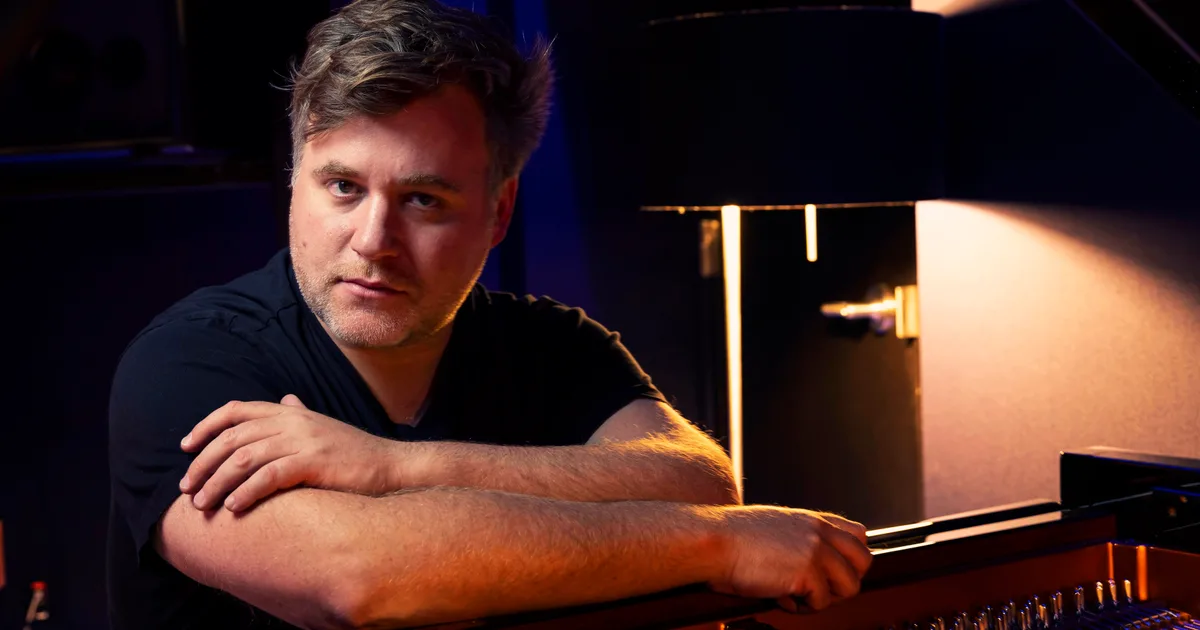
In a recent interview, acclaimed composer Benjamin Wallfisch reflected on his musical upbringing, creative process, and the ambitious task of returning to the world of IT for the new prequel series Welcome to Derry. Known for scores ranging from Blade Runner 2049 to The Flash and The Conjuring franchise, Wallfisch continues to be one of the most versatile figures in modern film music.
Before we began, I let Benjamin know that – even before this interview was scheduled – my Spotify Wrapped had revealed he was my number-one artist of the year. I’ve always loved his music, and when the email arrived offering the chance to speak with him, it absolutely made my day.
A Childhood Scored by Bach and Memory-Filled Piano Keys
Wallfisch grew up surrounded by music in its purest, most organic form. With musician parents and a pianist grandfather, his earliest memories include waking to his father practicing Bach, falling asleep under the family piano during rehearsals, and watching his grandfather’s cigar ash fall onto the keys as he played. Those sensory, musical memories formed a foundation that Wallfisch said he didn’t realize was unusual until adulthood.
Despite the strong classical lineage in his family, film music captivated him early. John Williams emerged as a defining influence, especially during the prolific blockbuster era of the ’80s and ’90s. Wallfisch described the experience of growing up with Williams’ work as “a treasure” that continues to inspire him today.
Finding Emotion in Harmony
When discussing his musical process, Wallfisch explained that he typically begins not with melody – despite often being praised for lyrical, memorable themes – but with harmony. To him, chords carry the emotional weight of music. Even as a child, he gravitated toward exploring chord progressions over practicing assigned pieces, fascinated by why certain harmonies resonated so deeply.
Melody, however, remains equally important. Wallfisch described it as “elemental,” noting that singing is humanity’s most ancient form of musical expression. Its power, he said, can feel timeless and instinctive.
Crafting a Score: Discovery, Improvisation, and Throwing Out the Rulebook
Wallfisch’s scoring process often begins at the piano, where he improvises freely while absorbing the tone of the film. Early experimentation generates musical “core concepts,” which he refines independently before presenting them at the initial spotting session. He arrives with several ideas – not necessarily aligned with the director’s expectations – to spark a creative conversation.
He emphasized that film scoring is fundamentally an act of empathy. Composers join a project late in its journey, often after the filmmakers have lived with it for years. His responsibility is to understand the emotional truth behind the story and translate it into music that supports, rather than manipulates, the audience’s experience.
Revisiting the World of IT: Building the Sound of Welcome to Derry
Having collaborated with director Andy Muschietti for nearly a decade, Wallfisch described their creative partnership as instinctive, surprising, and always challenging in the best way. Muschietti’s musical notes often come from unexpected directions, prompting Wallfisch to explore ideas that initially seem unconventional but frequently lead to breakthroughs.

For Welcome to Derry, the goal was to honor the musical DNA of the films while crafting a fresh, more intimate sound suited to a series format. Because the show takes place decades before Pennywise’s full emergence, Wallfisch had to create a musical identity for the IT entity itself, long before it manifests in its iconic clown form.
Developing that sonic signature proved one of the most challenging aspects of the project. The entity needed to be present in subtle, evolving ways throughout the early episodes, requiring a thematic language that hinted at its essence without revealing too much. Once that sound was established, the musical path to Pennywise’s later appearance became much clearer.
The series also features a broad ensemble cast, each with unique emotional arcs. Some characters received explicit musical themes, while others were represented through motifs tied to their abilities, personalities, or relationships.
Heart Over Horror
Though well-known for his work in horror, Wallfisch approaches the genre through the lens of emotion rather than fear. For him, scoring begins with character relationships – the emotional backbone of films like The Conjuring. Only once that foundation is established does he layer in the atmospheric and experimental textures that define horror.
That philosophy extends to Welcome to Derry, where moments of deep emotional resonance – even heartbreaking ones – take precedence over sheer shock value.
The Orchestral Experience: Still “Miraculous” After Hundreds of Performances
Despite conducting hundreds of concerts and recording sessions, Wallfisch still finds the experience of standing before an orchestra “miraculous.” His early career in the classical world, performing works by Brahms, Mahler, and Ravel, sharpened his instincts for orchestration and for maximizing limited rehearsal time.
Recording Welcome to Derry required coordinating orchestras across Europe – including in Budapest, Vienna, London, and Macedonia – due to the ambitious schedule and the decision to treat each episode as its own standalone film.

Experimentation, Easter Eggs, and the Musical History of IT
Horror offers fertile ground for musical experimentation, and Wallfisch embraced that freedom. Developing the “shine” sound for Dick Hallorann, for example, required extensive trial-and-error before settling on a strange, haunting vocal motif.
Similarly, familiar musical ideas from the IT films appear in Welcome to Derry in transformed ways – sometimes inverted, sometimes re-harmonized, sometimes hidden entirely inside new arrangements. Wallfisch intentionally embedded musical Easter eggs for attentive fans to discover.
The Struggle of Watching His Own Work
Although audiences revisit his work frequently, Wallfisch finds it difficult to watch projects once they are finished. After viewing a film or episode hundreds of times during production, he tends to focus only on moments he wishes he could refine further. Even after episodes were locked, he occasionally revisited cues when late discoveries opened up new musical possibilities.
Life-Changing Moments: From Hans Zimmer to Blade Runner 2049
When reflecting on career-defining experiences, Wallfisch highlighted many moments, though none greater than the birth of his daughter. Creatively, he recalled the profound impact of working alongside Hans Zimmer on Blade Runner 2049. Sitting in a small studio with Zimmer, editor Joe Walker, and the filmmakers while listening to the early version of what would become the “Sea Wall” cue remains one of the most extraordinary moments of his career.
Zimmer’s mentorship, both personally and professionally, significantly shaped Wallfisch’s approach to storytelling, collaboration, and artistic humility.
Advice for Emerging Composers: Find Your Voice in the Age of AI
For aspiring composers, Wallfisch emphasized the importance of developing a unique musical voice. In an era dominated by loop packs, presets, and now AI-generated shortcuts, he warned that young composers risk missing the journey of discovery that is essential to finding one’s artistic identity.
He encouraged newcomers to seek mentorship, immerse themselves in storytelling, and remain curious – always asking why certain musical choices resonate and what makes their voice distinct.