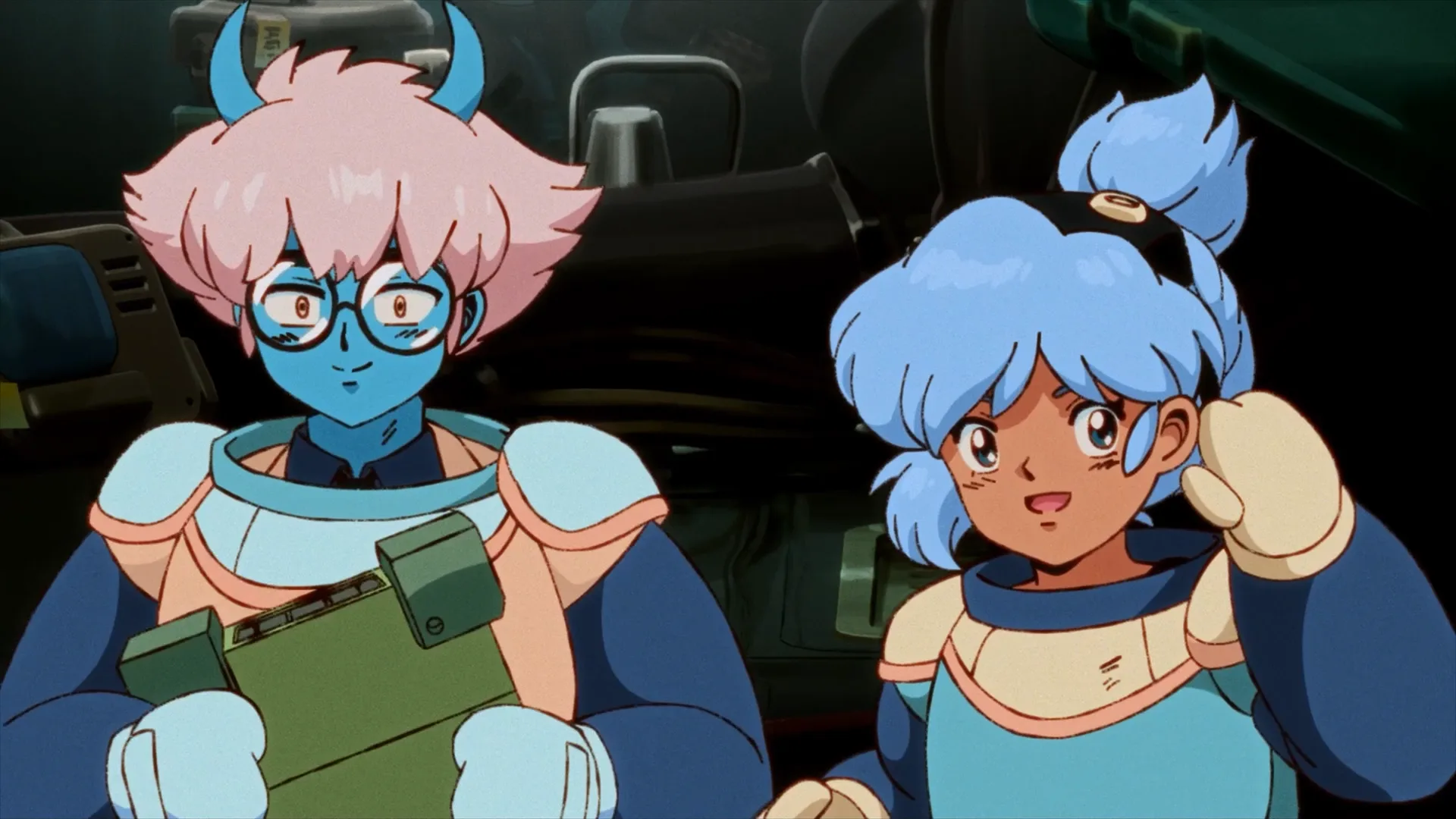
Cooperative multiplayer games are nothing really new. Thanks to great titles like Hazelight Studios’ It Takes Two and Split Fiction, we’ve seen a few other developers try their hand at the genre. One of them is Orbitals, developed by the Tokyo-based studio Shapefarm. Orbitals takes the cooperative multiplayer puzzle and platforming gameplay from other games in the genre, but adds a retro 90s anime skin by Studio Massket to the mix. This results in an a complete experience that’s fun and entertaining, but it isn’t without its hiccups. The “playable anime” goal the team sought out was definitely achieved here, I just wish there was a bit more depth in the game’s plot.
In Orbitals, you and a friend (shout out to Temple of Geek contributor Adriana Rodriguez for being my co-op partner. She also handled our Summer Game Fest preview!) take on the roles of Maki and Omura. They’re a pair of passionate explorers who are tasked with braving the far reaches of space to save their home, a satellite that houses a colony of older residents. I won’t delve into spoiler territory, but the plot here is relatively thin.
The story starts with the playable duo heading out on a scavenger run, and for most of the game’s roughly six hour runtime I was a bit lost on what the character’s motivations were. Without giving too much away, it wasn’t until much later in the game (nearly the end) where the rest of the plot came together. It’s still worth to see Orbitals through to the end thanks to other factors, but the story took awhile to grab ahold of me.

Cooperative Chaos
The real bread and butter in a co-op focused multiplayer game such as this is its mechanics. It doesn’t matter which character you pick, since both Maki and Omura have the ability to run, jump, and dash. But where the difference comes in is when choosing tools for each level. Throughout the game you’ll unlock four different items to help you solve puzzles and traverse each level. They’re super varied and contextual for each level, and you can only bring in the requisite tools when the game tells you. For example, there’s a sort of water gun that can clean soiled surfaces or help plants grow. Then there’s a microwave-like object that allows a player to control certain objects. Either player can grab whichever one they wish, but it’s up to them to communicate their preferences, strengths, and weaknesses to get through a level.
The puzzle and level designs in Orbitals are exemplary. They’re thoughtfully crafted to ensure each player thinks outside of the box, so as a multiplayer game communication is key. Adriana and I were on voice chat during our entire playthrough, and even with both our heads together there were a few puzzles that stumped us. I appreciate that the game really encourages its players to think as critically as possible, but sometimes the puzzle solutions were a bit more obvious than we had anticipated. Either way, the core gameplay of working together to finish levels is easily Orbitals’ greatest strength. There were no puzzles that didn’t feel creative or well-designed.
There’s a nice variety in level design and biomes to explore, too. Each stage has unique mechanics tied to its exploration, with cooperative elements strewn about at the core its design. Orbitals is primarily a 3D puzzle platformer, but there are a few 2D sections that are some of the best in the game. Some of these are tough platforming sections where one player’s progress is hindered. That’s where your co-op partner comes in to use their tool to open the path forward, allowing you both to escape successfully. These moments were fast, chaotic, and, most importantly, super fun. Adriana spent most of the game yelling and laughing throughout our time with the game, and it’s mostly thanks to moment to moment gameplay elements like these.
Two Ways to Play

In between levels you’ll head back to Maki and Omura’s ship, a sort of hub area where you can play minigames. These are hidden throughout a few levels, and are the only real reason to replay missions as even we didn’t find all of them. They’re fun little distractions, like a jump rope competition or laser tag, but ultimately don’t serve much of a purpose. But the real reason to head back to the ship is both to change tools and decide who gets to fly the ship and who mans the guns. The other half of Orbitals’ gameplay loop is traversing the final frontier of space. While fairly linear most of the time, exploring space comes with its bespoke set of puzzles and light combat encounters to get through, all while working with your partner.
Whether on foot or flying the ship, controls are snappy and responsive. Success during difficult platforming sections or ship missions against heavy fire relies solely on player reflexes. But luckily, dying in any way doesn’t set you back at all — you’ll just rematerialize in the same spot. So even though some encounters are admittedly difficult, it’s a welcome pace for busy adult gamers to just keep the action going without any backtracking.
A Gorgeous Retro Throwback
Visually, Orbitals is one of the most aesthetically pleasing games around. The 90s retro-futuristic art style is done by Studio Massket, which has worked on dozens of anime over the years. The hand-drawn art and VHS filter help to recreate this vision, and the intentional 24 and 12fps movements give it a more authentic feel. Flying through space was a scenic jaunt of spaceship ruins juxtaposed by gorgeous ambient light. And the animated cutscenes are exactly what you’d expect to see in an anime from that time, and one of my biggest complaints is that there aren’t more of them. They’re few and far between, but are visual feasts that I couldn’t get enough of.

The soundtrack consists of a handful of bangers, as well. The main theme song is a face-melting hard rock-inspired track that plays during explosive set pieces throughout the game, and it works extremely well every time. The international voice cast is just as superb. We played in both English and Japanese and both options added even more authenticity to the 90’s anime style the studio is going for.
Even compared to other games like it, Orbitals is a extremely short. It’s roughly half the time of what you’d expect when playing through It Takes Two or Split Fiction, on average. We finished the game at around six hours. Normally this would be fine, but it doesn’t offer any sort of post game or replayability outside of hopping back in the ship to play minigames. You can select specific chapters after beating them to check them out any time you want. But at its $40 price tag, the juice isn’t necessarily worth the squeeze.
Verdict
Orbitals is an a visually stunning homage to 90s anime. Its amazing soundtrack and voice performances add to its authenticity — it truly does feel like a playable anime. Puzzles are a masterclass in design, forcing each player to really think outside the box more often than not. But its story is a surface level sci-fi tale that doesn’t quite hit any high notes, and replay value is virtually nonexistent. But to me, its highs outweigh its lows. Orbitals a recommendable co-op adventure for fans of the genre and those looking for a gorgeously crafted hit of 90s anime nostalgia.
Score: 7/10
Orbitals launches September 3 exclusively on Nintendo Switch 2. Review code provided by the publisher.