
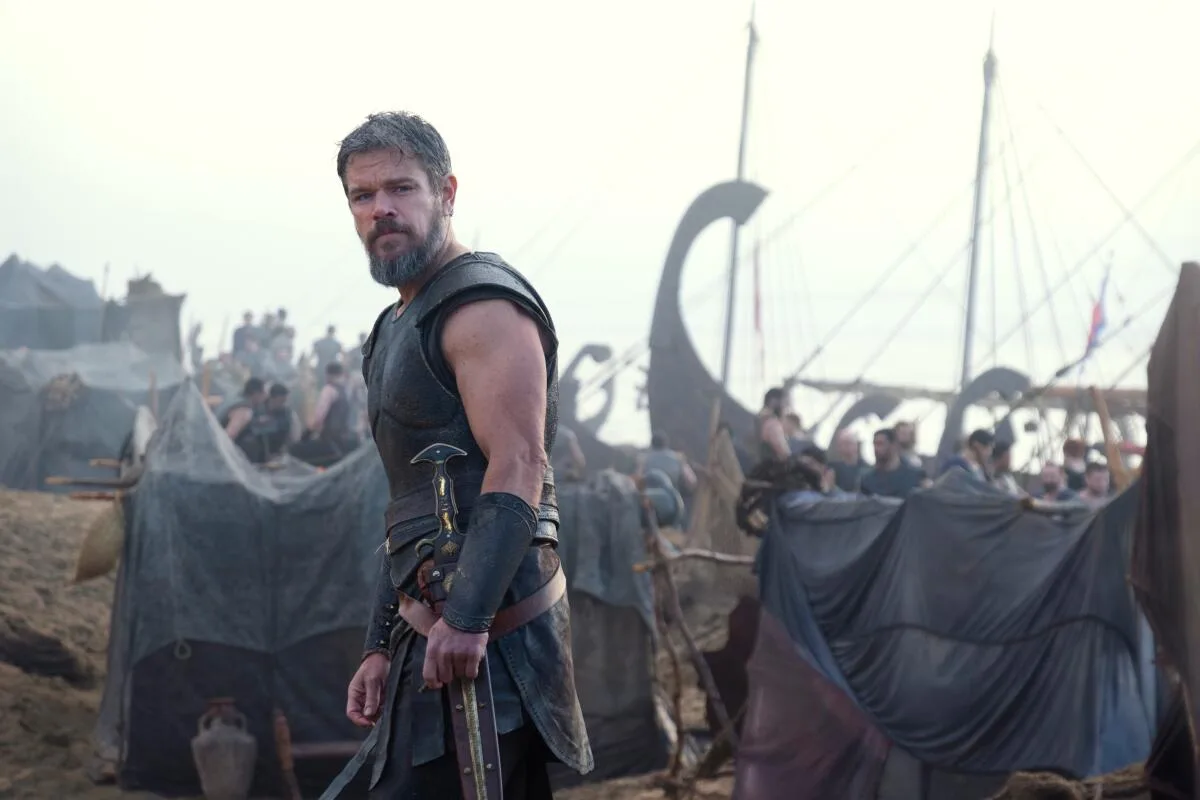
At almost three thousand years old, Homer’s epic poem may well be one of the most famous works of fiction ever made. There are countless translations and adaptations in every imaginable medium to exist. The hero’s journey that Odysseus goes on has become one of the most influential tales in all of western literature, recurring in numerous forms for centuries. Just like any other totemic work, each new version is a reflection of the time it was made, and its creator’s unique interpretation. That’s certainly the case for Christopher Nolan’s “The Odyssey”, and in many ways feels like a direct follow up to his Oscar winning blockbuster “Oppenheimer”. So although the story of “The Odyssey” is known even to those to those that haven’t even read it, there are a few things that will be discussed in this review unique to Nolan’s vision that could be considered spoilers.

One way that Homer’s tale is a perfect fit for Nolan is the non-sequential storytelling, something he’s seemingly been obsessed with since his first film, “Following.” Both film and poem begin with Odysseus (Matt Damon) stranded on an island with only the mysterious Calypso (Charlize Theron) as his companion as he recounts his adventure. Meanwhile, his wife Penelope (Anne Hathaway) and son Telemachus (Tom Holland) have awaited his return for two decades. As Odysseus begins to recall his travels following the end of the Trojan War, Penelope staves off a group of greedy suitors inhabiting her home.
Zeus’ Law
These two threads are more interconnected thematically than one might expect. “Zeus’ law” and how characters obey it, or don’t, becomes the recurring motif of the film. The law, as explained by the film, requires that those seeking food or shelter not be turned away, and treated with respect. It’s why Penelope can’t just dismiss the suitors. Among them is the devilishly nefarious Antinous, played by a scene stealing Robert Pattinson. The law is a two way street however, and visitors must also treat those that take them in with honor.
In a broader sense it’s just a way to say to treat people with decency, an ancient version of the golden rule. But as we see over Odysseus’ travels, that law, once iron clad, is becoming less and less relevant. Society as it exists is in danger of collapsing as the mysterious Sea People pose an existential threat to civilization. These raiders that have disavowed Zeus’ law and threaten to overrun all of Greece. Their impending danger is what motivates Ithaca, the kingdom Odysseus rules over and has been absent from, to fill its vacant throne. Whether that is a returned Odysseus, or one of the 108 suitors, is one of the film’s key points of tension.

As these suitors eat his food, drink his wine, and live in his home, Odysseus and his men must overcome a gauntlet of troubles at sea. The dangers they face include a cyclops, giant warriors, a perpetual gigantic whirlpool, and the wrath of the sun god Helios. But the stand out moment from his episodic journey comes when Odysseus and his men land on the island inhabited by the witch Circe. In a true body horror moment she horrifically turns his greedy soldiers into pigs.
I Am Become Death the Destroyer of Worlds
It’s become clear that both Odysseus’ men and the world at large have disregarded the law of Zeus, and are doomed because of it. In a twist that feels appropriate for a Nolan film, we learn that, in an incredible flashback to the sack of Troy, this is all Odysseus’ fault. His desire to return home causes him to devise a clever, yet callous trick. Using deception he lets the Greeks into the city walls, where they violate every rule of civility there is. This comes to a head when the temple of Athena is desecrated and her priestess is murdered. The Sea People have been the Greeks returning from Troy all along, their decency long gone. Like Oppenheimer, contemplating how he may have ended the world with the creation of his bomb, Odysseus laments his actions at Troy and what the inevitable destruction they have wrought.
Here Nolan ties his story to history and the late Bronze Age collapse, which set civilization back hundreds of years. Some historians say Homer, who wrote “The Odyssey” centuries after the supposed events in the story, alluded to the Sea People and the Bronze Age collapse. This film, however, makes those allusions explicit text. Therefore the film is an argument for compassion, as no civilization that disregards human decency and morality can ever survive.
As Nolan intended…
But no discussion of Christopher Nolan’s “Odyssey” would be complete without discussing the IMAX-sized elephant in the room. A common complaint I’ve heard is that it’s almost impossible to view the film “as Nolan intended.” That is to say, to view it in true 70mm IMAX. In fact, “The Odyssey” holds the distinction of being the first feature film to shoot entirely with IMAX 70mm cameras. This is no small feat. IMAX cameras are enormous, difficult to move, and very noisy. This makes them both hard to shoot complex action scenes with dynamic camera movement, but also quiet dialogue scenes.

That’s because films like this were never the intended subjects for IMAX film at all. Many of us that went on field trips in the 90s to museums may remember watching documentaries on oversized screens. Filmmakers like Nolan, however, began to push the envelope, shooting more and more of their films with IMAX cameras. “The Odyssey” being shot entirely in this way gives it a distinct advantage over something like “Interstellar.” That film, which is about half IMAX, constantly switches aspect ratios. If you watch this movie on an IMAX screen you are getting the entire thing in a full IMAX format. Not letterboxing this time around. That took a lot of creative work arounds and technical innovations.
IMAX or Not?
This has lead to some discourse about “losing” part of the picture if you don’t see the movie in true IMAX. After all, there are only twenty-five theaters in the entire US that can project it in that format. Otherwise you’ll have to settle for a 35mm IMAX screen, a digital projection, or, god forbid, a standard format. But I’m here to tell you there is nothing wrong with that. Filmmakers like Nolan and his cinematographer Hoyte van Hoytema take into consideration how these films will look on all screens. James Cameron even shot “Titanic” with an eventual full screen version in mind back in 1997.
I’ve now seen the film multiple times in multiple formats, and it looks amazing regardless. It’s certainly a technical marvel, but more than that it’s a film about regret and mistakes. It’s also a warning for us, and how the decisions we make may have consequences we could have never foreseen. So go see it. But make sure when you do, you are kind to the theater staff. After all we need to obey Zeus’ law.
Derick’s Rating: 9/10


