
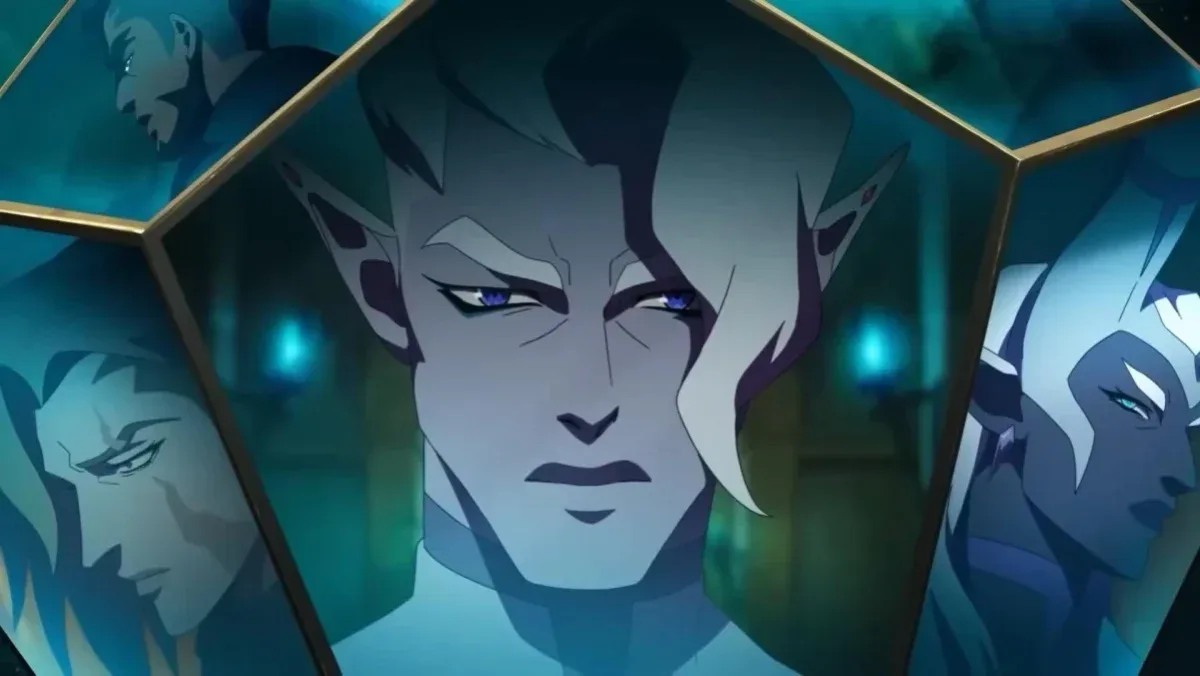
Matthew Mercer has created countless NPCs across three campaigns that span over ten years. This includes terrifying villains, heartwarming allies, and everything in between. Some of these characters quickly ingratiate themselves to fans, becoming favorites. One such character is the morally ambiguous Kryn Dynasty mage Essek, who was introduced in Campaign 2.
Dani Carr had an ambitious task in telling Essek’s story given how beloved the character has become. During the campaign he quickly became a fan favorite as his affection for the Mighty Nein grew. However, Matthew Mercer teased a darker history in Essek’s past. Some of which has been explored in “The Mighty Nein” animated series. Carr further delved into Essek’s darker history, but from his perspective, pulling apart his psyche and thought processes.
In an exclusive interview with Temple of Geek, Dani Carr reflects on the pressure she felt when taking on the fan favorite character of Essek. Carr also explains how “The Fall Will Kill You” fits into the larger story of Essek with campaign 2 and “The Mighty Nein” animated series.
How “The Mighty Nein” Animated Series Fit Into The Critical Role Essek Puzzle

Temple of Geek: One of the things I was really curious about was, did you write this before or after the animated series had been—not necessarily come out, but even just written—and you kind of knew his storyline in the animated series?
Dani Carr:
I wrote it during. I sat down with Matt and was like, okay. Actually, no, I wrote it. Yeah, I wrote it. I wrote most of it. Sorry, I’m trying to remember because so much of this, everything happens at once. So I wrote it both during the. Yes, yes, yes, yes. I wrote it during the whole, while everything was in production. It wasn’t out yet, but I had heard of a few things that had happened. And so I sat down with Matt and was like, okay, how much of what Essek goes through and his backstory and everything that y’all had for the animation, how much of that is cross-canon compliant?
Because the animated series has its own canon. There’s lots of things that obviously are the same for both, but the animated series, not everything that happens in the animated series is considered core Canon and that sort of thing. So I was like, how much of this do you want to be true for the backstory that I’m going to be playing with? And so there was some threading of the needle that needed to happen with a few aspects, especially his relationship with his mom that were just like, we weren’t sure how much of it we wanted to fully keep to complete Canon because so much of Essek’s backstory was –
Temple of Geek: Still a mystery
Dani Carr:
It’s still a mystery and there’s still thoughts of things that I and the animated series was able to expound upon that and show off a lot of things. But there was also a level of just wanting to make it so that still a little bit like we’re not quite sure how much of it is true and all of that because I think that it was important to Matt that he be someone who could still be mysterious, someone who could still be someone that. I’m trying to decide how do I want to say this?
Someone who could still have things to be revealed, if that makes sense. But anyway, the important thing was really just that we were trying to make sure that we kind of walked a line of how much I wanted. Also, I really liked this idea that he was too scared internally to even let himself think about certain aspects of his past because they hurt too much. So it was just fun to be able to walk that line because number one, I couldn’t know certain things because the animated series wasn’t out yet.
Temple of Geek: You’re revealing aspects of his backstory without telling the full story.
Dani Carr:
Yes, exactly. Exactly. Sorry. I’m so out of the loop on so much of the animated stuff that it’s hard to. I don’t want to say the wrong thing.
“Matt [Mercer]’s Always Said Essek Was Neutral Evil”

Temple of Geek: I think it’s so rare for that, not just in stories or media, but in general for people to really talk about that or think about that. I do think societally we’re so stuck in like, “Well, I already spent so much time and I invested so much of myself or whatever to have that moment where it’s like, ‘Did I make the wrong choice?'” And if I did make the wrong choice, can I now make the right one and will that matter?” That was the other thing I thought was really cool in the story: he’s not having the moment of like, “Well, if I change courses, it fixes everything.” It’s why he’s still stuck in the “I can’t be wrong because then I did all this horrible stuff pointlessly” and “I can’t process that right now” mindset. So I thought it was really cool.
Dani Carr:
Very – Yeah. Thank you. Thank you. Yeah, it was definitely, because what happened is such a snowball effect. I genuinely don’t think that it was the kind of thing that he truly, I don’t want to say that he didn’t think it through, but there’s always that, okay, well, I’m going to do this thing and it’s going to be bad, but it’s going to be fine because it’s going to, again, ends justify the means. I’m so locked in on my needs and what I want done and how it’s going to help this thing that I’m so focused on and it matters so much to me. And then you see the knock-on effects. And it’s like, oh boy, I knew it was going to be bad. This is bad. And then allowing that to matter, allowing that to not just keep staying in your head of like, yeah, but I’m doing it for the right reasons. Or even not doing it for the right reasons. I’m doing it for the reasons that I find important for you to finally go, “Ooh, this probably wasn’t the best idea.”
Temple of Geek: The added element of him, because I think he was always motivated by his want for knowledge and feeling like an outsider. But there’s also that motivation of his mom. At the end of the day, to me, I’m like, “I’d do bad stuff to try and save my mom too.” Kind of not a question. So I think it was really interesting. Because when you do have to fundamentally question everything, he doesn’t really say, “Well, this made it okay.” He can’t even really get into that because of how much it hurts and everything. So I think it’s interesting that there’s still that element of, “I didn’t feel like I had a choice, but maybe I did.”
Dani Carr:
And also, I didn’t want it to come across like Essek truly regretted his actions. I didn’t want it to seem like he fully regretted his actions because I don’t think he does. I think he regrets what came of it. I think that he thought he would have more control. And to realize that it’s not in his control and to realize he was never in control is a really awful feeling. And to realize that everything has spiraled beyond what you can do. Because if he had done this thing and he had been able to be part of the research and be in it within every single aspect of it, I think it would’ve been very different. And he would’ve felt more.
Again, I think it would’ve made that whole ends justify the means more potent. But then to not even be able to get the answers that he’s seeking, to not even be able to access that knowledge that he’s wanting so badly to then to be like, “Okay, here’s the thing, please go study it. Okay, at least tell me what you find out.” And then to not even be allowed that aspect. It’s like, “Well, what the heck did I do this for? Why did I do all of this?” So yeah, it’s that frustration. It’s still that self-serving desire, and then that self-serving desire starts to make you start to see those knock-on effects.
Temple of Geek: I like flawed characters. They’re more interesting. So having a character like Essek, who is inherently very selfish, and that doesn’t change. It’s not all of a sudden “I’m the most generous person ever.” As time goes on, his circle of what he cares about gets bigger. I feel that happens with people who tend to have things like that happen. I love that this is an anchor point in Essek’s story. It was very fun to first get that glimpse into him doing the really sketchy stuff in the animated series. I feel like that gave this story itself a bit more depth too. If I had read this without seeing any of the backstory, I would’ve been like, “Okay, so he’s definitely more messed up than we saw.”
Dani Carr:
Yes. Yeah, because Matt’s always said Essek was neutral evil. I don’t remember.
Dani Carr Was Inspired By Aabria Iyengar’s Shaun Gilmore Short Story

Temple of Geek: Anytime someone tries to talk to Matt about Essek, he’s always like, “He was bad though, guys.”
Dani Carr:
Yeah. Yeah. Again, that was the thing that was I find bad to be so relative. I mean, everybody’s the hero of their own story. And so I don’t like just lumping characters, especially fictional characters and things like that. I find it more, especially somebody like Essek, I think it’s hard to quantify him as somebody who was just bad because he had reasons. He had points behind it. He had a specific desire behind, “Well, I wanted this. I wanted this. This was the reason.” But at the end of the day, that’s still an excuse. I’m always a big fan of you’re not giving an excuse, you’re giving a reason, but that doesn’t change what happened. And so again, it’s walking that line.
His whole story is very much him walking that line because he is a character who walks the line the whole time. He eventually really does start to realize, “Oh yeah, this was not great. This thing that I did was not great.” But again, he had reasons. They were not fully altruistic. Yes, he wanted to be able to help his mom. Yes, he wanted to be able to help future Umavi, things like that. But he really, really just wanted to be able to study as well. He really wanted to be able. There is that aspect of he really wanted to be able to stick it to the people that had told him, “No, no, it’s only for religion. It’s only for worship. No, we’re not going to study it.”
He wanted to be able to stick it to those guys. And all of these things can be true. All of these things can be real and tangible reasons. And then a lot of people still died. And so it’s like you have to hold both of these things in your hand of the self-serving desires, the altruistic desires, and then the tangible reality. Because desire and reason don’t mean anything when you’re faced with the tangible reality of what happened.
Temple of Geek: Ever think how you had to capture all that in a short story? Oh, you did, for sure. The conversation we’re having is so about philosophy and morality and everything. I’m like, “This is a short story, man. You need to do all this in a short story.”
Dani Carr:
Yeah. I had 10,000 words to try to get that across. I hope I did it justice. I feel like I really kind of bit off more than I could chew with it because it’s like this is a lot to try to figure out how to make this work and keep it interesting. It was hard to not just have the whole thing just be him sitting frozen on a Devon and be like, “Oh my gosh, oh no.” And to figure out ways to get him to move around and do something so that the whole thing isn’t just happening in his head. I was really, really inspired by Aabria Iyengar’s story from Vox Machina Stories Untold, her story about Gilmore and how all of that takes place over also a morning. Of him just waking up and going about his morning routine and thinking about this thing that has just happened and how beautiful it was.
And so I hope that it’s sort of my homage to Aabria [Iyengar] as well and her beautiful, beautiful story because it was so inspiring and so lovely. Because again, these are characters that become so beloved, Gilmore and Essek, and you just want to get in their head. You just want to get in their head and walk around in there and be like, “What are you doing?” And move through the folds of the brain and just be like, “What’s going on in here?” And so yeah, I really, really loved that she had this. I really just wanted another story that allowed you to just sit in that character’s head and just kind of walk around in it for a little while to put on their shoes and go, “Okay, I’m here. What are we thinking about?”
So yeah, it was very much an homage to her beautiful story about Shaun Gilmore because I think that’s the thing I’m most excited for in stories like this is to just be able to, with the characters that are as beloved as they are, to be able to let people try them on for a minute. And that people are going to agree and people are not going to agree with how these characters are portrayed and things like that. But at the end of the day, it’s still just like my interpretation. It’s still just like one look at someone. And it’s one look at someone on a really rough night where they had to deal with, again, he’s having an anxiety attack the whole time. So there’s going to be aspects of it where he’s not being fair to himself or also not being fair about other people or not seeing the bigger picture, seeing too much of the bigger picture or something like that.
Because that’s the other thing is that you start to get really bogged down and the world is massive and I am very small and somehow me flapping my butterfly wings meant that there was a tsunami. And it’s like, oh God, how did this happen? But yeah, it’s definitely, it was all done with the sincerest love and attempt to have him be understandable. Because to me, it’s not that. Essek’s not different from his family because of his intellect. He’s not different from his family because of his specific desires and things like that. He’s different from his family because of his ambition. And that’s one of the things that I think Deerta really sees in him is they’re both deeply ambitious people. Whereas his father wasn’t that ambitious.
Veron is ambitious, but not that ambitious. He’s happy as the soldier taking care of people. And so that drive and that ambition, but ambition isn’t a negative. It’s only when you start to allow ambition to run unchecked and without considering the bigger picture that it can become a negative trait. And I definitely didn’t want it to feel like his ambition was a negative, but it is the thing that sets him apart from his brother, is the thing that sets him apart from his father. It’s one of the reasons he and his father butted heads because by this point.
To me, it’s like having older parents and you’re younger and they’re kind of set in their ways and very like, “No, this is how we do things,” and stuff like that. And you’re like, “Okay, well, I’m 22 and I really want to go traveling and I’d really like you guys to think that this is cool for me.” And they’re like, “Well, we went to Japan once and it was fine, but I don’t know if you should go.” And it’s like, “Okay, well, I’m going to.” Yeah, it’s people who are set in their ways, people who have decided that this is the right path and this is what they’re going to do. And bucking against that, going, “Well, I still have to make my own choices. I still have to write my own story.” And trying to just fight against that pole.
Writing Essek’s Story [Was More Terrifying]

Temple of Geek: Because you’ve written in the Critical Role world before with the Mighty Nein art book, how did you approach this? It’s a short story, and it’s an established character versus telling a story through the art and also with a character that you got to create.
Dani Carr:
Well, this one was more terrifying. I knew that this one was going to be polarizing because I knew that people love Essek so much. And so there’s just certain things that people are going to have opinions on and have their own perspective on. And I love that. I love that he’s so beloved. And so I just wanted to make sure that. The thing that mattered most to me was that when I wrote it, that nobody felt like I didn’t also love him, that I didn’t also have that care because again, he’s beloved by so many people, he’s their guy. And so I wanted to take care of him and I wanted to have it be like, okay, I’m doing my best. I’m going to try and treat him with both respect and care and try not to tell a story and to tell the story that Liam [O’Brien] and Matt [Mercer] both approve while also respecting how people see him and how much he is loved by so many different people in so many different ways.
So it was definitely more challenging in that, again, having that love, not that I didn’t respect and love Iva, Iva’s my baby girl forever, but having to make sure that the character felt true to what we’d seen. Because when I was writing Chronicles of Exandria Volume Two, we’d only had two or three scenes with Iva by that point. And she was just a cookie bookshopper. And so it was like, okay, well how do I. So I could give that character depth because there wasn’t as much to work with, so I could kind of make up a whole bunch of stuff. Whereas this one, there was a lot to work with. And so in a lot of ways, I knew that by, again, I asked for it, so I knew what I was doing. I knew what I was asking for.
But I wanted the challenge and I wanted to take on the task of, I really felt like I could give him a good story. And that’s where it all stems from; if you feel like you can actually do something right by the character. And I knew I’d be able to work hand in hand with Liam and Matt to be able to ensure that he was portrayed well. Again, Liam and the Sierra team I mentioned earlier, Chanette and Nikki and Maggs, we’re all in. We all read all the stories. We all gave all of our feedback, all of the things. So every single story is extremely stamped as approved.
But it was really, really important to me that he felt like Essek. He felt like the Essek we had seen, and he also felt like the Essek that we knew was bubbling under the surface. So it definitely was more terrifying, but a really exciting challenge to take on. Because again, we had all these scenes, we had all these moments with him, and I knew where he was going, but I wanted to make it clear that he didn’t know where he was going yet. And for the first time, he was allowing him to see that there was a possibility beyond just where he knew he’d end up. Because we always have the benefit of hindsight in that, okay, we know the whole story. Not the whole, whole story, but we know the story. We know that he starts here, he gets to here.
I’m going to tell a story right here. And he has this starting point A, and he’s going to get to Y, we haven’t quite, or X or whatever. We’re not at Z, we’re not at Z, He’s got to get to X. I’m going to tell a story at N. And to ensure that. Not even N, probably H. But to ensure again that he felt real, he felt right, and that it didn’t seem like the care wasn’t taken. That was the most important thing to me, that people could see that the care was there.
The Mighty Nein Changed Essek’s Path Forever In Critical Role

Temple of Geek: When you watch Essek scenes now, you get that insight into how his brain works. You’re like, “Oh, there’s so much going on.” And we see so little of it in part because we’re seeing it through the eyes of Jester’s interactions with him or Caleb’s interactions with him and the rest of the Mighty Nein that interacts with him. So it’s very, very cool to be able to see how his brain works and see this moment that had the Mighty Nein not met him, he would not be who he is.
Dani Carr:
Again, sometimes it only just takes one person to help you look in a different direction. Point out like, “Oh, hey, there’s also this over here.” I think the way that I was describing it was like you’re on a path and your path is very clear. And then one person goes, “Oh, hey, look, there’s a trail.” And it’s like, “Oh, I didn’t even see that. Oh, interesting.” And then suddenly there’s two paths. And it’s like, okay, so I could keep going down this path. I know where that path’s going to lead. But then there’s this other one. It’s the first time you’ve let yourself realize there’s even another option. And I found that really interesting because there had to be that moment of a switch. There had to be that flip of, again, him not making the decision, him not choosing to do better, him not even trying. It’s the moment that he even just sees that there’s another path and goes.
Temple of Geek: Yeah, like the blinders came off a little bit.
Dani Carr:
Yeah. It’s like, oh, I guess I could make a different choice. I guess that could be a possibility. And then I think it puts the parasol scene into even greater perspective, because again, it happens fairly soon after this night. And then to again, have this gift given to him after he’s just now seen, oh, there’s a potential other path, it then hits harder. He’s not just like, “Oh, thank you.” And he’s like, “Oh, thank you. That was really nice.” Because you can only really recognize the kindness of the gift like that when you’ve allowed yourself to start seeing what kindness is. And so then it’s like, oh, oh my God, thank you. Oh, I really needed this. Thanks. Thank you so much.
He’s trying his best, man. He’s making decisions and boy howdy are those decisions having consequences. And he’s going, “Ooh.” The story’s also very much like him for the first time letting himself realize that, not realize, but really sitting with the fact that there were consequences. That this isn’t just. Because I think one of the things that happens whenever you are having that Machiavellian sort of head space is you keep those blinders on, you keep your eye on the prize. Because if you let yourself think about the effect that it’s having on other people, you can falter.
And so this is, again, one of those first times where he’s let himself think about all these things that are happening and to recognize that there is a bigger world than just his own desires. And to allow himself to sit with that and to, again, just now start to take his eye off the prize and think, well, maybe there could be something else. Maybe there could be another option and I don’t have to keep just these blinders on and keep trying to just forge ahead and not recognize the fact that my horse is tromping over everything in the background because it is. And if you don’t let yourself turn around, then you never have to deal with it. And now he’s letting himself go like, “Ooh.” Whoops.
Temple of Geek: Having a character that’s very ends justify the means, meet a bunch of characters who recognize the importance of the means-
Dani Carr:
Yeah, that’s the crux of him. That’s what makes him so interesting. It was very much, what is it? An unstoppable force meets an immovable object. And it was that. Essek is this unstoppable force of like, “No, I’m doing this. I’m doing this. Okay. Okay, what do I do?” Where it’s like they both meet and it’s that moment of impact and something has to happen. The only thing that can happen is an explosion. And that’s kind of what he is. What happens to that relationship is an explosion. And it works out. In a way.
“Critical Role: The Mighty Nein – Stories Untold” is available now. The book includes stories written by Betsy Aoki, Kiri Callaghan, Dani Carr, Mae Catt, Mike Chen, Rin Chupeco, Nino Cipri, Nadia El-Fassi, and Chase K with a foreword penned by Taliesin Jaffe.


