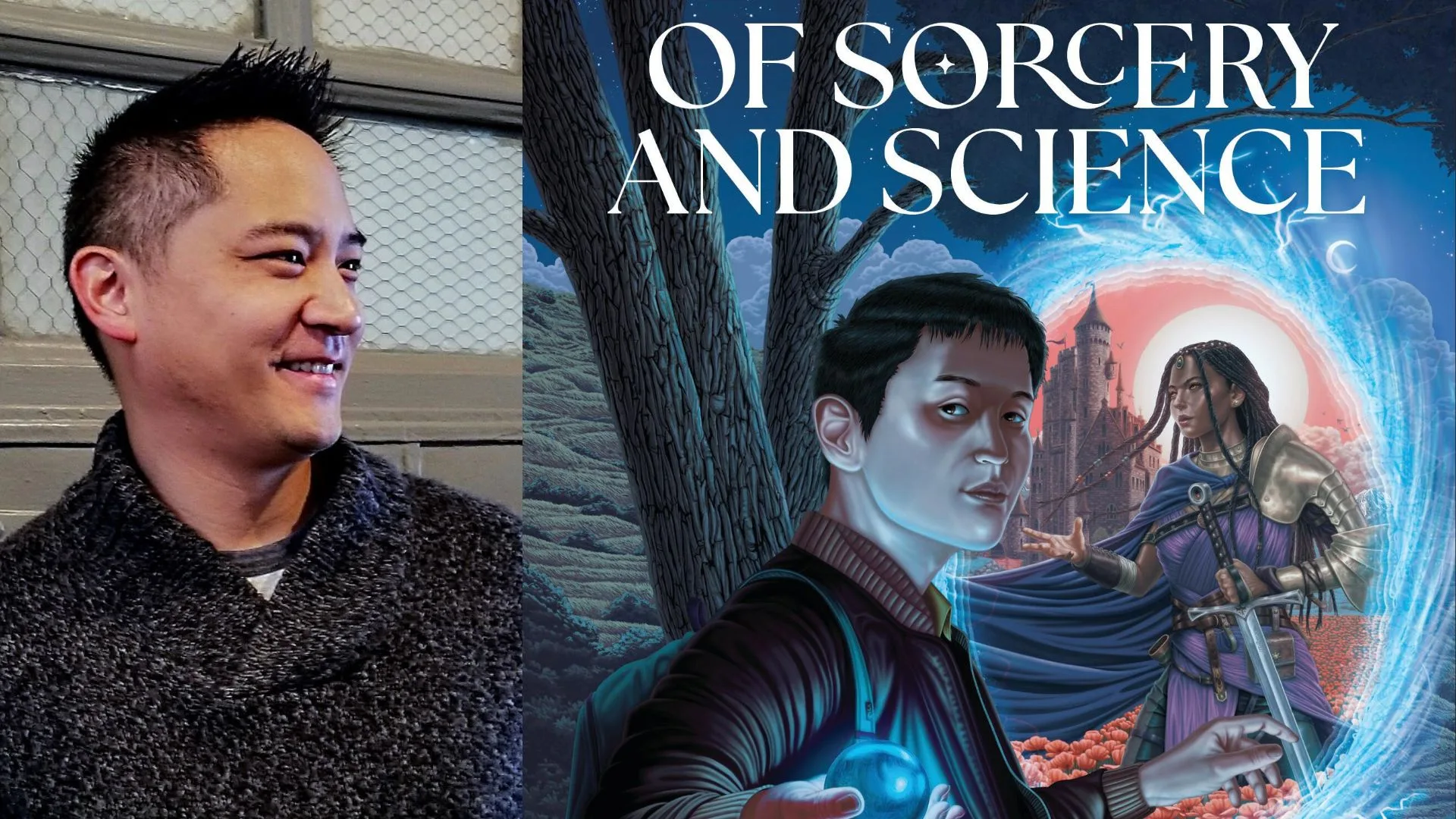
What happens after you get portaled to a fantasy realm, train as a mage, and become the conquering hero who saves an entire world, only to get sent right back to suburban California? For teenage protagonist Andy in Mike Chen’s YA debut, Of Sorcery and Science, saving the land of Garyod was the easy part. The real nightmare is returning home three months later, struggling with trigonometry, panicking over college applications, and dodging texts from overbearing parents.
Mike Chen on How “Of Sorcery and Science” Mixes STEM, High School, and AAPI Identity
In an interview with Monica Duarte of Temple of Geek, Chen detailed how his novel subverts standard fantasy tropes by blending scientific logic, modern high school pressures, and the first-generation Asian American Pacific Islander (AAPI) experience. He dives into the real-world inspiration behind the story, balancing high school life with fantasy tropes, code-switching, and how sci-fi and real-life experiences shaped his world-building.
Subverting the Chosen One Trope Through AAPI Code-Switching
In classic portal fantasy, the hero’s return home is usually the end of the story. Chen flipped this narrative on its head by exploring the awkward aftermath. Andy returns from his epic adventure with quiet confidence, only to immediately face standard teenage insecurities and parental pressure.
For Chen, balancing Andy’s double life served as a direct metaphor for the first-generation immigrant experience and Asian American identity. “During your teenage years, most people are constantly kind of between different worlds,” Chen explained. “As a child of immigrants growing up in the ’90s… cross-cultural things were not quite as accepted then, and so many children of immigrants tried to assimilate and like hide what their family life was like.”

When Andy returns to high school, no one believes his magical exploits, forcing him to filter who he presents to the world. Chen likens this struggle to the daily code-switching performed by minority teens balancing family expectations against their own desires. “You stop code-switching when you become comfortable in yourself, and you feel safe in your environment,” Chen said. “One of the big takeaways I want from this book is that if you don’t meet your parents’ expectations, that’s actually okay.”
Applying an Engineering Brain to Fantasy
Rather than relying purely on mystical hand-waving, Chen brought a distinct STEM perspective to the novel’s magic system. Drawing on his background as an engineer, he approached world-building with strict scientific mechanics. “I have an engineering degree. I have a very sciencey brain. I would still try to apply scientific principles to understanding how magic worked,” Chen noted. “If magic invaded our realm, how would we, with all of our tools and technology, apply it?”

This logic extends to how the public reacts when magic leaks into modern Silicon Valley. Instead of panicking, burned-out locals write off video proof of magic as CGI, high-end LARPing, or drone tricks. Chen treats modern cynicism as a societal safety net, people are simply too pressed for time to accept that the impossible is happening right in front of them.
Reframing Representation: Beyond Stereotypes and Issues
As an AAPI author, Chen actively sought to avoid tired media tropes, prioritizing subtle, organic visibility. “Growing up in the ’90s… most Asians were this stereotype of either the computer nerd or the kung fu guy,” Chen reflected. “I don’t want that. I just want to be like a person who exists.” That philosophy shapes the book’s core dynamics like organic inclusion. Rather than framing characters purely around “issue media,” representation is woven into their daily lives. Besides Andy, the main group includes Julia, a Black female paladin inspired by actor Imani Hakim, and Rich, a non-binary character physically modeled after Mason Alexander Park. The story also intentionally highlights male-female platonic bonds rather than forcing romantic subplots.
By combining hard-coded STEM logic with portal fantasy, Of Sorcery and Science offers a grounded, inclusive story about navigating competing worlds, proving that finding yourself is the most heroic quest of all. The book will be released on September 8, 2026.