All good stories start with the classic trope of a sister stabbing their brother out of a coma with a mysterious artifact before disappearing in the midst of a full-blown supernatural disaster. Right? Remedy is back with a narrative follow up to their 2019 game Control, if not a gameplay follow up. Props have to be given to Remedy for never resting on their laurels. Max Payne was a completely different genre of game than Alan Wake, which in turn played nothing like Quantum Break. Alan Wake II didn’t even play the same as Alan Wake, and now Remedy continues that tradition by having Control Resonant be a huge departure from the original. We have gone from a third-person shooter Metroidvania to a melee-focused action-RPG.
An Unexpected Sequel
Control Resonant might be the most “video game” video game that Remedy has made. I say that not as a pejorative, but more of a reflection on how the mechanics found in this game are decidedly more similar to other games in the genre. The game boasts a pseudo-open world portion, has melee combat with skill trees and a dodge mechanic, and fast paced platforming and traversal. But it also has Remedy’s patented weirdness, penchant for storytelling that evokes more Twin Peaks than Marvel, and a knack for writing characters that feel fully fleshed out. The end result is a game that, while having some issues that detract from the whole experience, works incredibly well to deliver a fun time and a gripping narrative.
It’s been seven years since the Federal Bureau of Control’s director Jesse Faden sealed off the Hiss in the first Control. Seven years since the Oldest House became the permanent home for herself, the employees, and her comatose brother Dylan. And now, for reasons only she knows, Jesse has awoken her brother from his sleep and disappeared into Manhattan for reasons and destinations unknown. The containment has been broken, and the Oldest House has been breached. Hiss have spilled out into Manhattan and corrupted it in supernatural ways no one was prepared for. Unfortunately, the very existence of the secretive FBC has come to light. With skies turning red and the architecture of the city gone full topsy-turvy, a lot has changed.
“Part of why I enjoyed this game so much was because of how delightful Dylan is as a character”
To put it bluntly, things aren’t looking too hot. But that’s ok, because Dylan Faden is on the case. As he searches for his sister and for a way to atone for what he has done in his past (and even searches for a way to interact socially with other humans) Dylan is a man constantly in flux. In the first game, Dylan was the goal; the tortured brother of our protagonist Jesse. Now, Dylan has flipped the script, off to help his sister against circumstances far worse than she had to go up against.

Part of why I enjoyed this game so much was because of how delightful Dylan is as a character. He’s awkward and socially clueless, yes. But he’s also earnest and almost pure in a way that makes you want to root for him so badly. We kept hearing about what a monster he was, and all the bad that he did, so it was so rewarding to see him on this self imposed redemption arc. One of the highlights of the Dylan experience was anytime he had to interact with another actual human, but especially Zoe De Veras, his handler who didn’t sign up for all this.
Their back and forths injected a lot of well needed humor to break up the seriousness of what was going on all around them. I also really loved when Dylan interacted with characters from the first Control, like Emily Pope. Overall Dylan is a really great character to get to know, and his quest to reunite with Jesse provides a ton of the emotional core of this story.
Visually Stunning
Graphically, Control Resonant is so pretty and deliberately designed that it’s a shame there is no photo mode yet. The way Remedy uses lighting and color and shadows to emphasize a location or a moment is unrivaled. Even though they aren’t the first to do it, the way they use the big bold white letters to showcase a new location on the screen is so effective and satisfying to see. I really can’t stress how cool the world around Dylan is, especially once you start encountering the [redacted] and everything starts getting really surreal and radial.
There are frequent moments within the game where the way the environment is presented looks like they were ripped directly from Inception. A lot of credit also has to be given to the enemy design teams – they have done a great job expanding on the range and types of enemies Dylan tackles. Compared to the relatively sparse amount of types Jesse contended with, Control Resonant really helps to diversify its combat with the types of enemies you come across.
I played the game on a PS5 Pro and noticed no stutter or frame rate issues while in both the Performance and the Balanced Mode settings. Balanced Mode was a great compromise on both graphical fidelity and performance, so I guess they named it pretty aptly. Remedy has done an excellent job optimizing the game for the PS5.

“Remedy could’ve told me this was their take on Prototype and I would have 100% believed them”
Maneuvering through the world is a delight and one of the core reasons I enjoyed Control Resonant so much. The game rapidly throws Dylan a slew of mechanics that make traversing this altered Manhattan fun and snappy. Before you even encounter your first boss battle, you will have unlocked double jumps, air dashes, hovering, and a sprint, with more mechanics like a grapple warp coming not too long afterwards. Dylan controls like a dream, without any of the floatiness that can sometimes plague the genre when platforming is involved. It all gels together to make movement a blast.
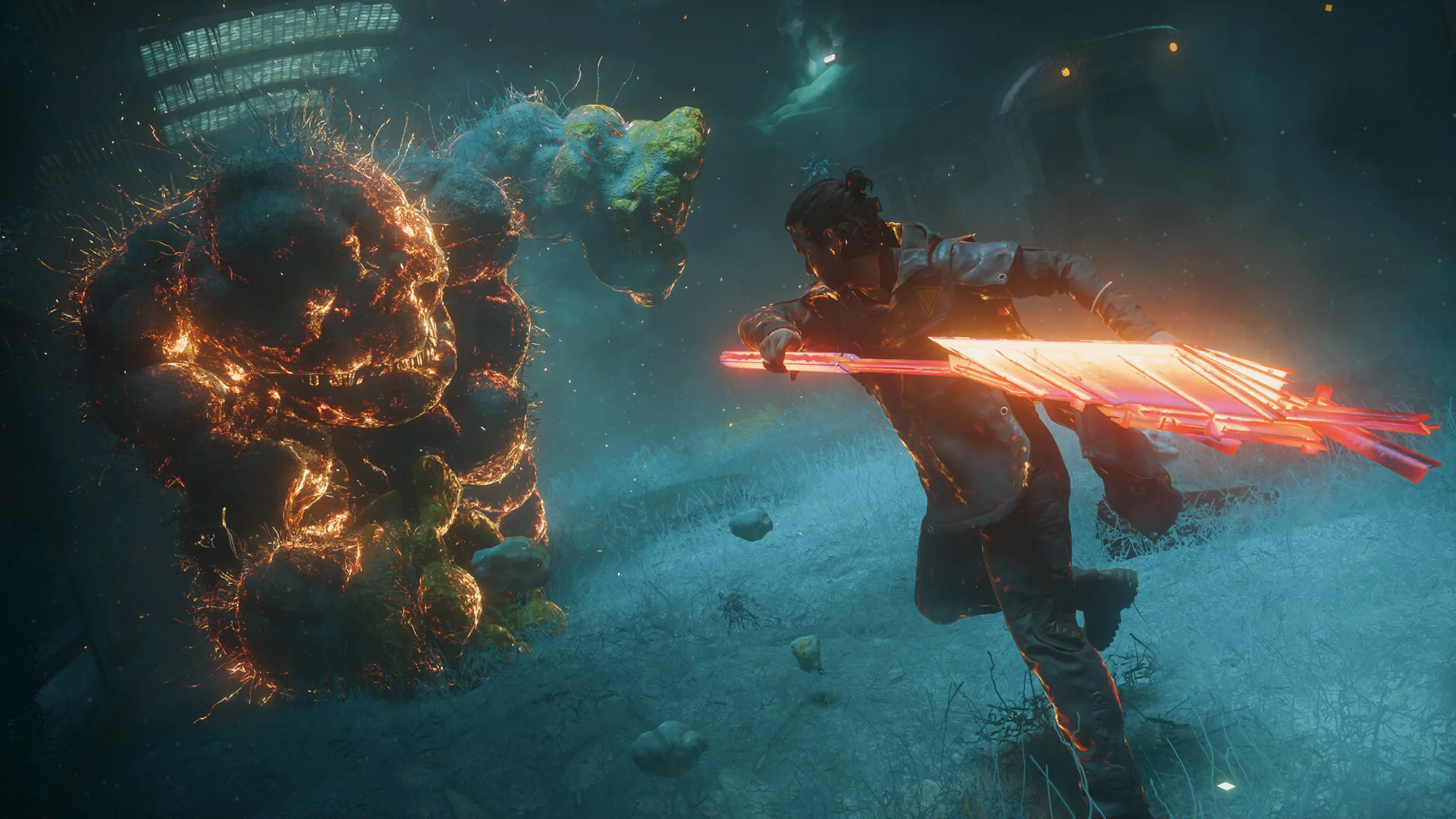
In Control, Jesse made use of the Service Weapon, a shapeshifting gun that lent itself perfectly to the third-person shooting in that game. In Control Resonant, we get a distinct shift towards close quarters combat, with Dylan using the Aberrant. This is a shapeshifting melee weapon. To say that I got slight Prototype vibes from playing as Dylan would be a bit of an understatement. Remedy could’ve told me this was their take on Prototype and I would have 100% believed them.
Dylan is granted a wide range of possible weapon configurations, shifting between things like a scythe, short swords, a flying sawblade, a drill, and so much more. These weapon types are split between the primary attack method, chosen from a pool of three, and another pool of three secondary weapons designed to inflict heavy Falter (stagger) damage to enemies. You also unlock multiple choices for Combo Enders that give you even more control over how you can pack the biggest punch.
Many Ways to Fight
Pairing itself to the Aberrant are a series of Resonant Abilities, powerful supernatural and telekinetic techniques. These range from ripping rocks from the ground to toss at enemies, a Shield, a powerful ground pound attack, and many more. These moves are essential in combat to both survive and triumph over waves of diverse enemies. I really appreciated how the amount of choice provided to me let me cater Dylan’s playstyle to my own preferences. I found myself sticking with the short swords for faster, weaker hits rather than the slower hammer that I found left me open to attacks far too often.
One aspect of combat I really loved was the dodge. Dylan can execute a Perfect Dodge of sorts when timed properly, and the input for it always trumped any attack animation Dylan was currently performing, allowing dodging to be executed at will instead of a punishment for attacking at the wrong time. Dodging an attack while at low health and getting to pull off an Execution move on an enemy to win the day was always a situation that left me feeling amped up.

Now, pre-patch, Control Resonant had a huge issue that really dampened the overall experience. Enemies were straight up damage sponges, making fights against fodder feel like a slog, and fights against bosses be an exercise in patience. It really was a big red mark on what was overall an excellent game. Thankfully I played the bulk of my game post patch, where that issue was pretty much resolved and balanced properly. Now fights lasted a length that felt appropriate to what they were.
“The core gameplay loop has Dylan fighting off respawning fodder enemies”
Control Resonant has a ton of combat, and removing that particular source of justified frustration has gone a long way towards making the game really easy to recommend and enjoy. The core gameplay loop has Dylan fighting off respawning fodder enemies to build up the ability to really put the hurt on larger, hulking Heavy enemies to put an end to the combat encounter. With this happening so often, having the fights be less tedious is great.
When you’re in the flow of things, pulling off combos and juggling attacks, launching enemies into the air, executing perfect dodges, and flipping around the combat zone, one would almost half expect to see a giant S Rank appear in the corner of the screen as you fight. Much like the Prototype vibes, you can also feel that a little Devil May Cry DNA has snuck into the Remedy studio.
Play Your Way
One thing keeping Dylan’s combat feeling fun and fresh over the course of the game is the constant upgrades given to the player. You are given multiple skill trees to work through, passive abilities, different artifacts with different effects to find, and even weapon specific upgrades. All of these combine to further the ability to customize your Dylan to your own preference. You can end up with a Dylan more adept at crowd control for masses of fodder types, pure unadulterated combat and damage potential, a defensive focused Dylan for higher survivability, or even hybrid types leaning any sort of way. It’s impressive, and something Remedy has never really provided before.

My biggest personal gripe with the combat and gameplay is that enemies level up alongside you. So Dylan never felt like he was getting too powerful. Even traveling back to earlier areas was a bit of a downer to never have that “and now I am a god compared to you” moments that I love in games. It keeps the game a bit more balanced, but I do love when a game just lets you really feel your growth compared to those around you.
Special notice must be given as well to the boss battles. Dylan has to go up against a bunch of fantastically disturbing designs, humans forever altered and called, appropriately, Resonants. Each Resonant battle was memorable in their own way, and involved shifts to the combat that made them feel a lot more than just a larger version of a standard combat section. Even the first boss battle against a transfigured artist in a museum, led to a lot of spectacle and some really cool combat moments as you dodge taxi cabs and contend with her traffic light cudgels.
Verdict
Control Resonant feels like the kind of game Infamous would have become had Sucker Punch continued with the series, but married with the storytelling and aesthetic sensibilities we’ve all come to love from Remedy. I also want to give a huge amount of credit to Remedy for the amount of accessibility and assist options baked into Control Resonant. Even though I didn’t end up personally utilizing them, the vast range of choices that grant players different benefits and help is staggering
Changing enemy behaviors, difficulty sliders, granting full on immortality or one hit kill capabilities, damage scale sliders, and more – there are so many options and granular choices within those options to truly craft a Control Resonant that is perfect for any player. My time spent with Dylan was one of slight frustration and tedium overshadowed by a lot of fun gameplay and traversal paired with a fantastic story and characters that kept me invested from start to finish. I loved the first Control, and I now also love Control Resonant, despite minor missteps with combat.
Score: 8/10
Control Resonant is available now on PS5, Xbox Series X|S, and PC. Reviewed on PS5 Pro with a code provided by the publisher.