
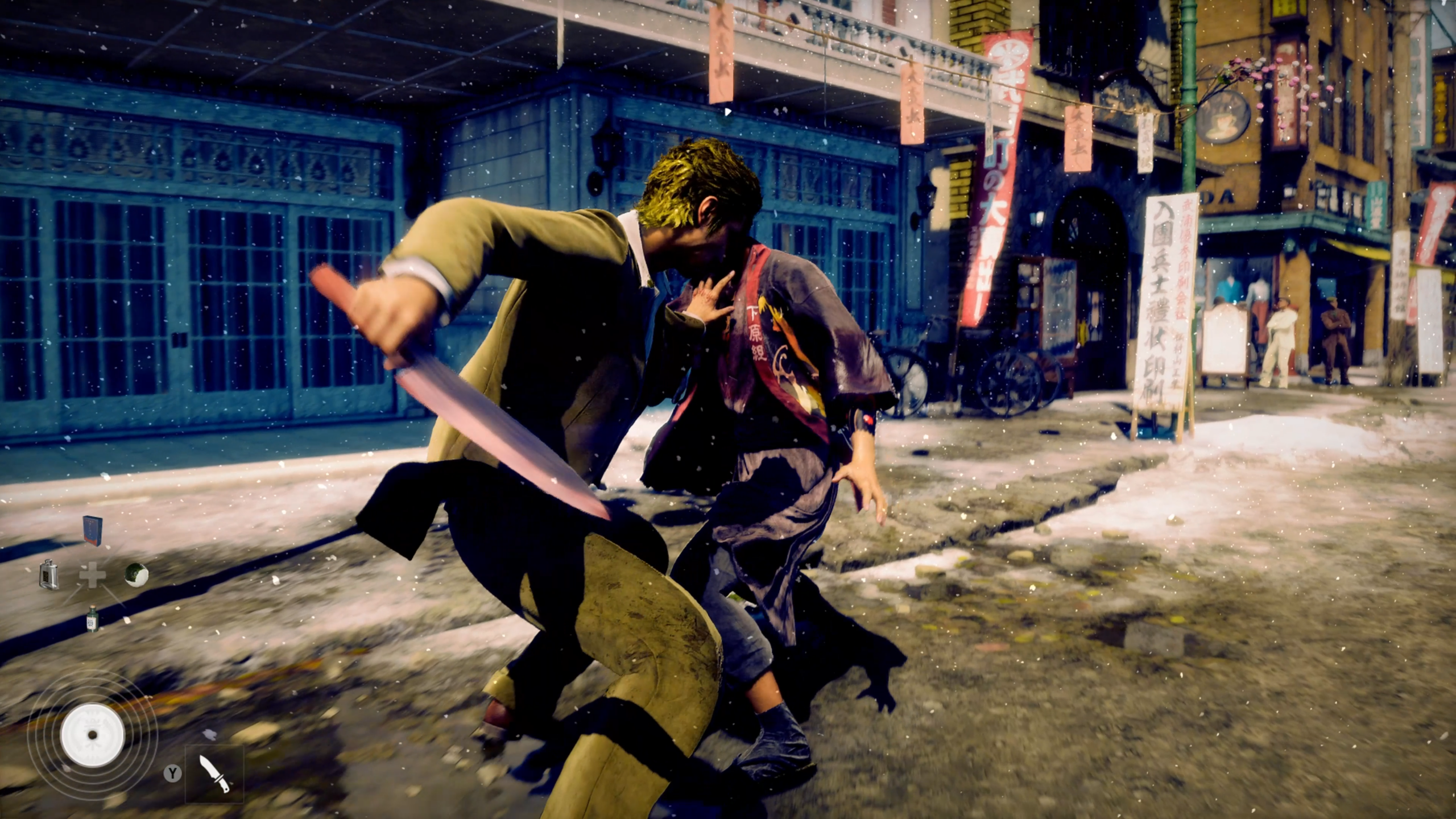
At Summer Game Fest I had the pleasure to be invited into a behind closed doors hands-on session with Ryu Ga Gotoku Studio’s latest outing, Stranger Than Heaven. I’ve been playing their games for decades now, starting with the original Yakuza on PS2. I have played them throughout the numbered series and throughout the spinoff series. Hell, I even own Yakuza: Dead Souls on PS3. I played the Judgement series, the remakes, and I particularly fell in love with their new RPG mainline games, Like A Dragon 7 and 8. All of that is to say that I came into this demo thinking Stranger Than Heaven was going to be a Yakuza game spinoff style game gameplay wise. And I could not have been more off base.
Not Your Daddy’s RGG Studio
Stranger Than Heaven is not what you’d expect, especially if you’re a longtime RGG Studio fan. In fact, the more you come into this new game expecting more of the same, the more it will shock you and grind you under the heel of its new combat system. The developers seem truly invested in surprising fans with this game, for good and for ill. Announcing that the game’s plot would take place across five distinct eras. And announcing that Snoop Dogg would be an actual character with an important role to play. Announcing, of all things, that Tupac would be… Tupac?

I’ve got to be real with you, this one feels the weirdest. And not in a good way. I don’t claim to have some sacred connection to Tupac and his music like some I know. But something about it feels off, and the fallout of the announcement is overshadowing the game itself. Which is a shame, because this combat system rules.
If I had to describe the combat system in Stranger Than Heaven in a short, succinct way, it would be: Brutal and Deliberate. If I had to describe the combat system in Stranger Than Heaven in a cliched way, it would be: Hey what if Yakuza but Soulslike? I like the first description better. If these games treat combat with a wink and a nod to over the top silly action, Stranger Than Heaven treats it like a gritty martial arts film. You won’t be grabbing a giant Bluefin Tuna to smack around a thug in this game, that’s for sure.
“[T]his combat system rules”
At the heart of its combat lies the unorthodox control scheme. The left bumper and trigger control your left arm, while your right bumper and trigger control your right arm. Bumpers are used for light attacks, triggers are for heavier attacks. There is a dodge button and a block button, with a stamina system tied to them. You can utilize items in the environment for contextual attacks, and you can pounce on a downed enemy for a follow-up strike. There’s also a very robust and challenging parry system. This involves not only timing your block button, but also pairing it with an equally well-timed left or right arm button, depending on which direction the attack is coming from. There are also weapons to utilize. The demo gave us access to three of them, but they said thirteen will be available when the game drops.
Across the Ages

The demo was clear in the developers vision of this new combat system. We were given three fights to tackle across three of the five eras the game takes place in. The first fight took place in 1915 Kokura. As Makoto, you stumble across thugs demanding a toll for safe passage. Dialogue was not an option. It was time to let my fists do the talking. I ran in swinging, smashing buttons and trying to overwhelm the group of enemies.
I was quickly and brutally humbled. Stranger Than Heaven is not a game where you can feasibly button mash to victory. I approached the fight once more and treated it more methodically. Then used the arm that was closest to the enemy I needed to hit. I blocked. Then tested out my parry timing. I did a ground pound finishing attack. I backed off when needed. There was one moment where an enemy grabbed my right arm, and I had to use the left bumper to beat him away while then cracking his head against his companion, knocking them both down. It was incredibly satisfying.
Speaking of satisfying, the second battle of the demo took place in 1929 Kure, and introduced weapons and a larger array of enemies. I opted for the slower, heavier crowbar over the quick dagger. The game gave my attacks a real sense of weight behind them, with each crowbar hit connecting with remarkable feedback. I managed to triumph in this fight on my first try. The parry system got a little more manageable for me by this point.
“I walked away from Stranger Than Heaven really impressed”
The third and final point was brutal. It was against a boss character, a yakuza with a sword and a grudge in 1943 Osaka. It was a 1v1 matchup, but it didn’t matter. This guy did not relent. His attacks came as a series of blows, requiring multiple parry inputs to be pulled off in succession to avoid a deadly slash. But when I tell you pulling off the defensive maneuvers was the most incredible rush of that entire day, I say it with no hyperbole. The demo was one of the hardest demos of the entire Summer Game Fest, and I could tell because when I beat the boss on my first try, I actually got an ovation from the devs and SEGA staff. I guess I am a true Gamer after all.
With a unique hook for its plot, some questionable choices in guest characters, and a battle system that I can almost guarantee will be insanely polarizing for RGG Studio’s fans, I walked away from Stranger Than Heaven really impressed with what I played. The shift towards more grounded and realistic combat versus what Like A Dragon usually gives gamers feels like a gamble, but if the fights in the main launch are as hectic and pulse pounding as the demo, I think they might have something special on their hands.
Stranger Than Heaven launches January 15, 2027 for PlayStation 5, Xbox Series X|S, and PC.



One thought on “Summer Game Fest Preview: Stranger Than Heaven”