
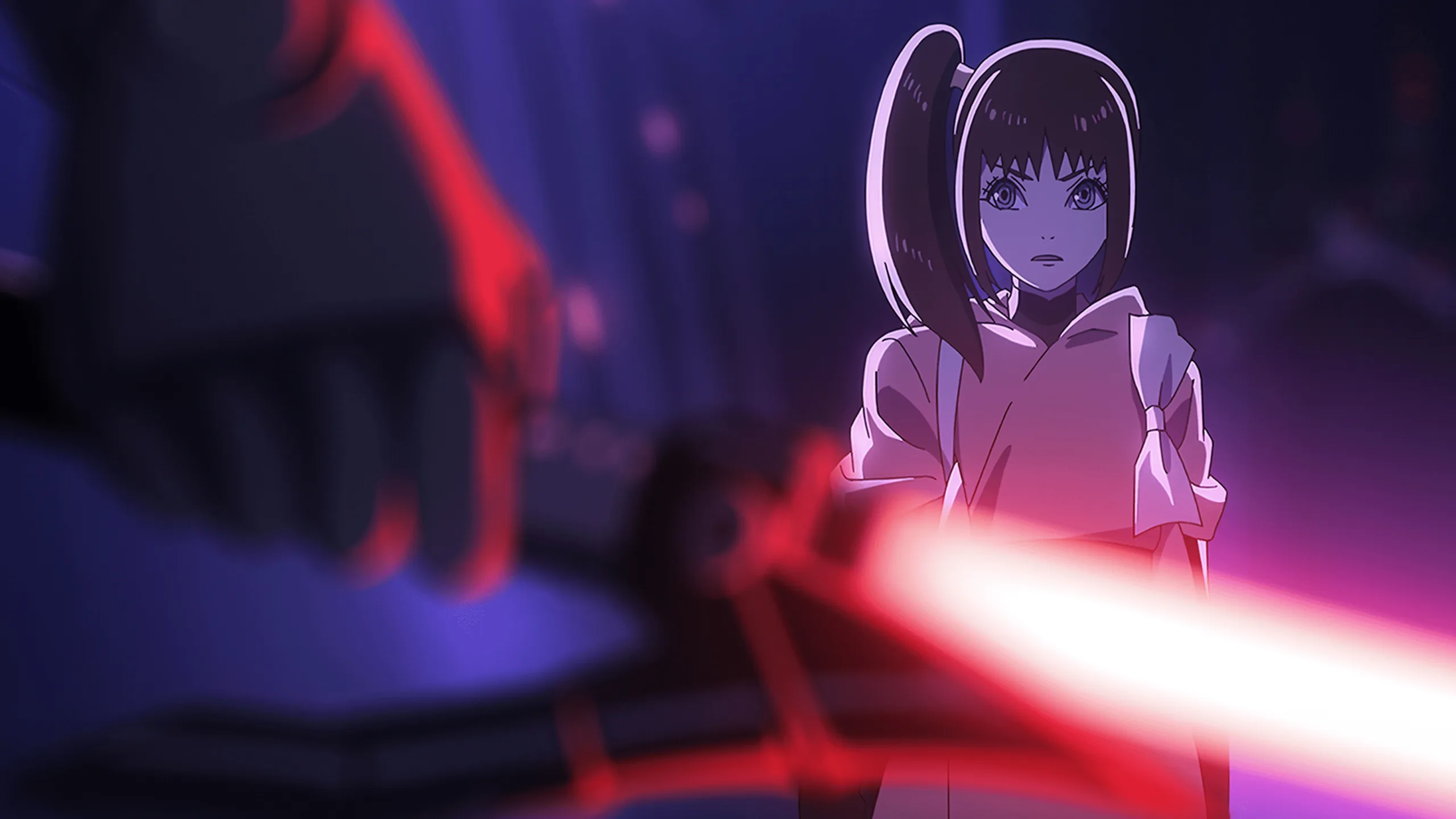
Premiering on August 5th on Disney+, The Ninth Jedi is an anime that takes place in the beloved and vast world of Star Wars. Following Kara—who was first introduced in Star Wars: Visions in 2021, alongside her friends—the series depicts a world where Jedi and Sith, once highly revered and feared, respectively, have become little more than legends.
Director Kenji Kamiyama spoke to us about The Ninth Jedi and how Kara and Nawaam are portrayed in a way that differs from previously-established characters, such as Luke Skywalker and Darth Vader.
The Emotions of Lah Kara

In Star Wars: Visions, we were able to get a glimpse of Lah Kara, but in The Ninth Jedi, we see this world through her eyes. As she works with Magrave Juro to rebuild the Jedi Order and looks for Zhima, her father and one of the last sabersmiths, we learn that Kara exhibits a wide range of emotions.
Kamiyama says that because Kara is more true to own feelings, that allowed her to become relatable to fans. He also thinks that, because she is portrayed differently from characters Luke and Yoda, she is able to become more open.
By openly showing her vulnerabilities, she’s able to receive good advice and support from those around her. Luke, on the other hand, was rapidly thrust into a position where he had to embody the ideal Jedi and Jedi Master; consequently, his way of life became incredibly restrictive and difficult in the later stages. Kara, however, isn’t bound by those same constraints, allowing her to form connections with good adults and friends who naturally gravitate toward her. That’s part of their appeal, and I think many people wish they could live that way themselves. Even though it’s hard to do in reality, the fact that they act with such pure intentions is perhaps what has made Kara so beloved by fans.
The Darkness (and Lightness) of Nawaam

Though the antagonist, Nawaam, follows a similar role to that of Kylo Ren and Darth Vader, Kamiyama says he is a character who stands in counterpoint to Kara. Rather than writing them as polar opposites, he and Kara are seen as embodying both the dark and the light side. Though the darkness is obviously more prominent, each of his actions are done in the name of righteousness.
Even regarding those aspects that appear to be the dark side, he is actually using that power for the sake of others—for people other than himself. So, as long as he is considering how to use that dark side for the benefit of others, he remains, in a sense, a Jedi. It really comes down to a difference in the ratio; I intended for him to be a character who contrasts with Kara. He embodies the question of where that balance lies—what the specific proportions are—and what causes that balance to tip to the point where one truly succumbs to the dark side. That is where I think he differs significantly from Kylo Ren or Darth Vader. I feel that the concept of a “line” that changes color based on one’s own Force and mental state was a perfect device for expressing this; that is the key difference.


One thought on “Kenji Kamiyama Explains Kara and Nawaam in Ninth Jedi”