
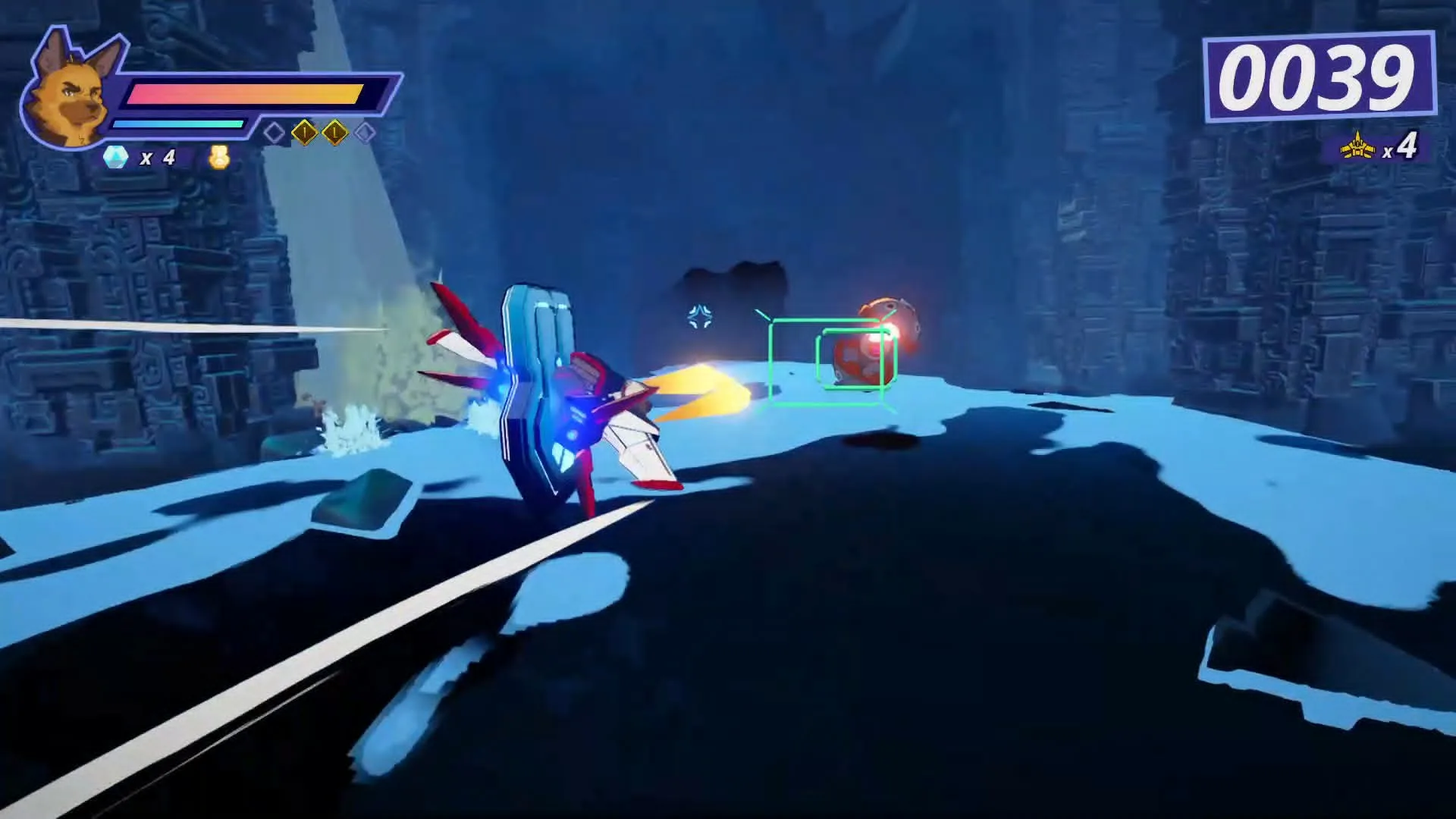
Wild Blue Skies is a cautionary tale of homage. It’s fun and I like it, or rather it has fun moments that I like. The problem is, and what makes these two points linked, is that much of the fun stuff is nearly beat for beat taken from better games, yet not done as well. Couple that with many decisions that attempt to differentiate the game from its influences, but negatively, and you’re now aware of the oddly sour tone this review is going to take on.
Frequent Flyers
Wild Blue Skies makes no apologies for being influenced by the likes of Star Fox 64. You’re the Blue Bombers, a team of anthropomorphic animal fighter pilots seeking to defeat a great evil called Grimclaw. You’re beseeched by an aged, decorated general to do so. It’s even implied that this is a “sequel” since war with Grimclaw happened before with another cohort of pilots stopping him prior. Now, this new generation lead by Bowie Stray (that’s you!) must stop Grimclaw again. You fly agile planes with upgradable lasers and lock-on capabilities, shoot bombs, barrel roll, and there are even multiple paths for the story missions.

Herein lies the beginning of the issues that Wild Blue Skies makes for itself. Because it likens itself so much to Star Fox 64, it can’t help but fall victim to comparisons. Going toe-to-toe, even in an exercise of flattery by way of imitation, with one of the most revered games of all time is certainly a choice, and one that buries Wild Blue Skies before it can properly soar on its own.
“This Game Will Feel Immediately Familiar, Comfortable Even.”
For some reason, the adventure begins with an intro cutscene that’s unskippable. Your first time playing, I get it – pay attention, get immersed! Every time you get a game over, you’re expected to rewatch it with no way to skip subsequent viewings. While it’s not the end of the world, it does set the scene for just how intricately annoying Wild Blue Skies is.
Getting Your Wings
This game will feel immediately familiar, comfortable even. The art is colorful and pops. It mostly controls well, the characters settle into their archetypes, and the mission structures are ubiquitous and solid. Banter among the team isn’t standout and quippy as you might expect. Bowie is mission-focused, steadfast and loyal like the dog he is. Thorne is the meek, nervous lizard guy, and a cute one at that. The bull Chuck is the seasoned veteran on the team, always ready to give advice. Roe, my favorite, is a headstrong doe (get it?), confident as she is daring. They all feel like duller, weaker version of the characters they’re clearly emulating, but they’re fine. Same goes for your rival squad, the Prowlers. They are just sauceless, pushover versions of Star Wolf.

Missions run the gamut of fun and engaging, to teeth-grittingly vexing. Hurricane is a cool, tense trek through a raging storm, but later on Foundry clips your wings with a rough turret-heavy level. Temple is an earlier fun free-flight mission to counter Foundry, but Grotto dampens that with tight cave formations and challenging enemy placements. Do not do a barrel roll here!
“I Would Highly Recommend Turning on the Continuous Fire Option in the Settings Menu.”
Piloting itself works well enough, until it doesn’t. You have a boost that’s invaluable for obstacle evasion and closing distance between you and enemies. Brake slows the action, but is only good for slowing momentum, not so much to assist in steering unless you’re in free flight mode. Braking and trying to maneuver during on-rail sections only got me in trouble, crashing into the environment, missing pickups due to an unavoidable altitude drop, and so on. In free flight, you can do a 180-degree turn with ease while braking, so the difference in usefulness is apparent.

My biggest gripe is the dodge roll, or barrel roll if you prefer. You do it by double-tapping either of your buttons to bank your plane to a vertical position. The problem is, if you do it to the right for instance, your ship moves horizontally about a plane’s length in that direction. You don’t stay in the same position and spin to reflect projectiles back. If you’re near terrain or an object and dodge roll in that direction, you will almost certainly hit it which greatly devalues this as a defensive technique and redundantly overlaps with others. If I wanted to move my plane to dodge, I can do it better and faster by banking and maneuvering in the same direction. It’s baffling and, frankly, disappointing when you can’t depend on this as much in harder, tighter levels.
“I Really Wish I Could Practice Levels I’ve Unlocked.”
By default, your laser blasters aren’t automatic. I would highly recommend turning on the Continuous Fire option in the settings menu. Since firing your blasters and charging them up for a charge shot are on two different buttons, this is absolutely the ideal way to play. You can hold down your blasters for auto-fire, but slide down your thumb or press charge shot at the same time to prioritize that for a quick lock-on kill.
Turbulent Times
Overall, aside from the control complications above, the game is pretty difficult. Your life bar feels scant in harder missions with some damage sources erasing around a third of your bar. Most attacks like enemy projectiles just knock a smaller chunk off, but if you’re alert, they’re not too much of an issue. Unfortunately, enemies really enjoy crashing into you, especially in free-flight when you’re not on rails. This is made worse by the fact that your ship’s transparency to see hazards is minimal, and there’s no cockpit view. You will crash into stuff and you will get hit by enemies often until you learn patterns well.

There’s no upgrade path for your health either, just healing silver diamonds, but they hardly heal you. It’s not just you that can get your ass kicked; your teammates get lit up very easily by enemies as well. Save them fast or you’re flying solo. You don’t even heal much after a successful mission! Despite all this, I got special ribbons for more levels than expected, obtaining high enough scores via kills and other conditions like keeping my crew alive or collecting the hidden letters that spell “WILD” in each level. It was either that, or I was falling victim to the same stuff outlined above and dying often. It was really feast or famine with this game.
I really wish I could practice levels I’ve unlocked. I understand the game insisting on you performing start-to-end runs of its story to unlock levels themselves, but it’s hard to think of some justification why you shouldn’t be able to “git gud” at a level giving you trouble in an isolated manner and on your terms. A modern accoutrement that simple would have gone far in easing me more into this game’s sporadic difficulty.
Technical Difficulties
Aside from more functional issues I have Wild Blue Skies, there’s a few technical ones compounding it as well. There’s immense slowdown on the Iceberg level. The game runs at around a third of its intended and otherwise solid 60 frames per second performance. Smaller dips can be noted elsewhere, but not as bad. This absolutely needs addressing in a patch.

I also encountered a smaller issue where character voices and captions stop appearing if you return to the game after suspending it via the PlayStation 5’s sleep mode. It was fixed by fully closing and relaunching the game. But this is also likely fixable with a patch of some kind.
Not being able to remap your controls is also concerning and limiting. It would be cool to have the option to fly with the right stick with shooting on the triggers. Perhaps banking and boosting could be on the D-pad, or at least the left stick then. Also, for some reason the PS5 DualSense touchpad also shoots your blasters. You can’t use it to move your cursor or plane though. Odd, but not bad I suppose.
Budget Airline
Once I finally beat Wild Blue Skies, I felt empty. Nothing happens except a credit roll, you don’t unlock anything, even with the true ending. Maybe it’s because I haven’t played and beaten every mission. I can’t find out how the hell to get to the hidden path from the Canyons mission and because of all the issues I contended with, the motivation to find those other paths is low.
The problem with Wild Blue Skies is it was too laser-focused on taking influence for concept, level design, and overall structure. There’s not enough borrowing from aspects that would have absolutely benefited the game more like stronger movement and approachability. I, and many others, want one-to-one copies of other games no matter how good they are, but when the game seems to learn the wrong lessons, purposeful or not, it becomes a problem. You can’t help but unfavorably compare it to the gold standards of the past. Worse yet, the itch within to simply play that gold standard game instead grows after playing something lacking like this.
This feels harsh to say, perhaps to read as well, because the game has some charm and is foundationally decent. The elements it contains are built with good intent, it doesn’t amount to an experience you’d expect based on all of the facts and influences. There’s something to be said for player expectation and letting something exist as its own thing. Honestly, the evaluation would be the same sans the direct comparisons if this game were made in a vacuum.
Verdict
Wild Blue Skies is a downhill endeavor, and not necessarily in an invigorating and lively manner. It starts strong, feels familiar and nostalgic, but its annoying and bewildering aspects are made apparent with all the subtlety of strong airplane turbulence. Even the parts emulated well ultimately come up short because they feel undercooked in a framework that deserved more creativity. Hell, 2026 in general demands more period. To quote Big Daddy Kane, “ain’t no half-steppin’.” Approach with caution, even at its wallet-friendly price.
Score: 5/10
Wild Blue Skies lalunches August 13 for PS5, Xbox Series X|S, and PC. Reviewed on PS5, review code provided by the publisher.




Excellent article, very informative. As someone who spends time at poker chip resources, I can say this type of content is exactly what our community enjoys. Keep it up!
Great breakdown — you really captured what makes this stand out in the genre. The detail and passion in your analysis is impressive. Love pairing gaming content like this with other fun stuff at toontone.fun!