
Over the last year, I’ve had the privilege of getting hands-on time with Pragmata at various conventions and private previews. Every time, I’d come away impressed and hungry for more. Its third-person shooting mechanics are simplistic on the surface. But when you add the simultaneous hacking and the game’s unorthodox use of the controller, it quickly became one of the most unique experience I’ve had. Now, after months of delays, Pragmata is upon us, and I can finally give my thoughts on the complete package.
Capcom’s newest sci-fi IP has gone through a bit of a tumultuous development history. It was constantly changing release windows, but I can confidently say that it was worth the wait. With some of the most responsive, intuitive combat I’ve ever played and a pair of protagonists whose relationship is the stuff of envy, the roughly 12-hour jaunt around the moon is one of the best games of the year.

Daddy Daughter Dance
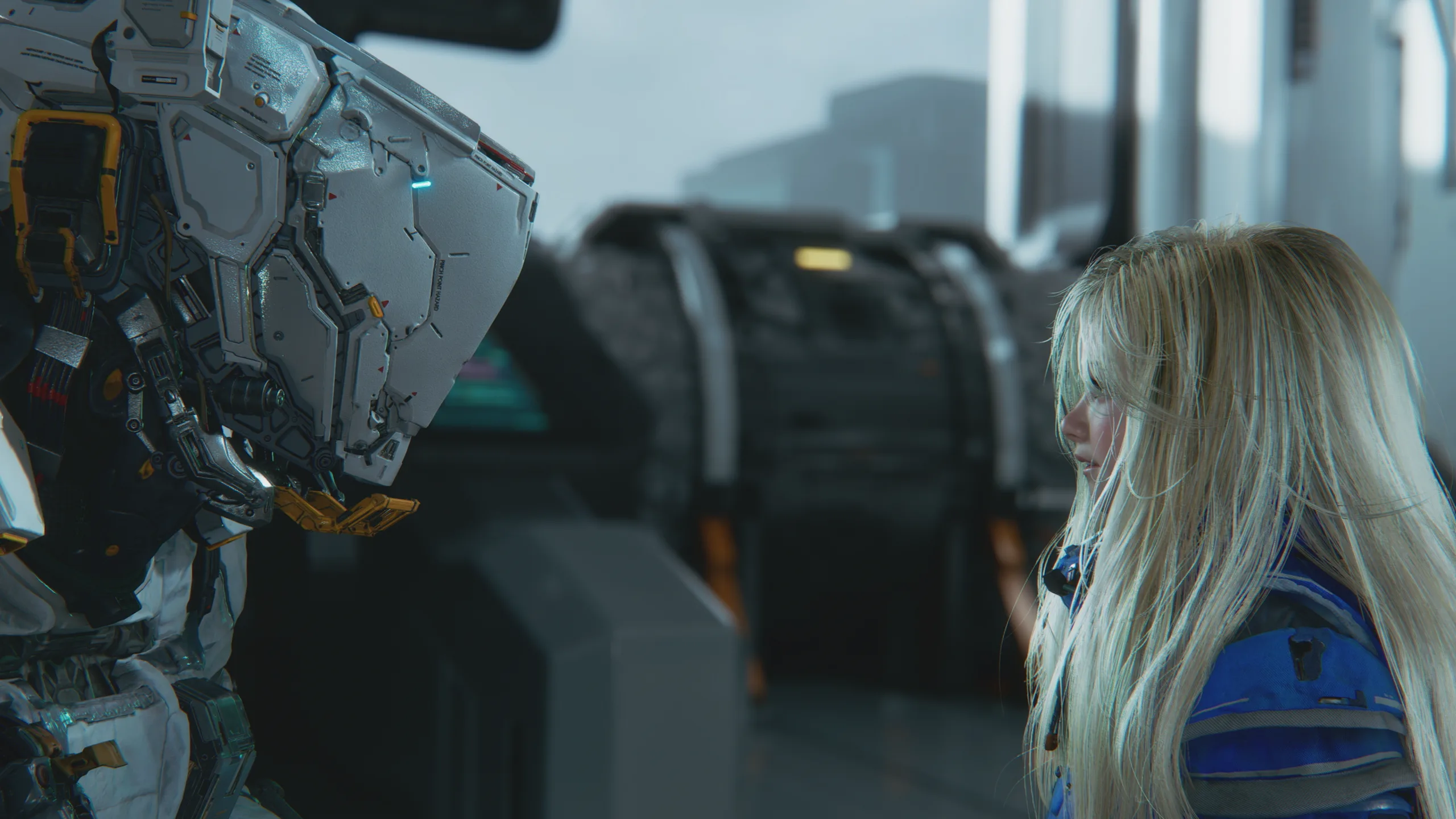
In Pragmata, you’ll play as Hugh Williams. He’s one of four members of a special team dispatched to the moon to investigate the cause of a planet-wide loss of communication with Earth. Shortly after arriving, a gargantuan lunar quake rocks the space station and the surrounding facilities. This separates Hugh from his team (apparently taking them all out) and knocks him unconscious. He’s awoken by an android designed to take the appearance a six year-old girl, known as a Pragmata. Her designation is D-I-0336-7, but Hugh quickly and affectionately dubs her Diana. She’s made from Lunafilament, the substance found on the moon that allows humans to 3D print almost anything. Structures like buildings and bridges are made from this, as are the many deadly enemies you face along the way.
I won’t be diving into spoiler territory, as the big moments are best experienced unsullied, but the story is one of my only small gripes with the game. That’s saying something, because I rather enjoyed the story. It’s well-paced and emotional, but I just couldn’t help but scratch my head at certain decisions. But it’s how Hugh reacts to them that felt off. His whole team is seemingly brutally killed and he just moves on in an instant. I was hoping for a little more emotional character moments to come from that, and maybe that’s reserved for future DLC, but I felt like it missed the mark, if only a little bit.
“I may or not have shed multiple tears”
But the real draw here is the dialogue and relationship between Hugh and Diana. You find out early on that Hugh was an orphan, and that his foster parents were some of the most kind, loving folks any kid could ask for. That’s evident in how Hugh treats and teaches Diana throughout the entirety of the game. He quickly takes her in and assumes the role of father figure, even though he knows perfectly well that Diana isn’t human. But he can’t help but feel endeared by her innocent ignorance to life on Earth, and he relates to that feeling of being abandoned.
This sort of father-daughter dynamic is emphasized even more back at the Shelter, Pragmata’s central hub. This is where you can upgrade gear and weapons, read lore, change your skins, and so much more. But you can also engage in deep conversations with Diana. You’ll talk about the current mission, life on Earth, teach her lessons, and so on, in what is one of the most adorable new relationships in video games. She even presents Hugh with crayon drawings of their time together, and I may or not have shed multiple tears each time this happened.

A Couple of Hacks
The real meat and potatoes of Pragmata is its incredibly fun, frenetic combat. At first glance, it’s an over-the-shoulder third-person shooter with surprisingly a few Soulslike elements. But what sets Pragmata apart is the hacking mechanic during combat. When you aim your weapon, Diana’s hacking matrix pops up and you play a sort of minigame during combat. You’ll use the face buttons to maneuver around the grid, and each node you pass through has different effects that stack once you finish the hack. Depending on how you outfit your arsenal back at the Shelter, you can equip hacks that apply specific debuffs or have different effects. The Heat hack, for example, makes it so enemies are staggered faster from Hugh’s weapons. You’ll be able to equip more than one as you progress, so mix and match to find the right build.
At first, I found the hacking ability a bit difficult to get used to. There’s definitely an inherent learning curve with having to rethink how you approach combat, especially in a genre as familiar as third-person shooters. I often found myself aiming and shooting with Hugh, then stopping that action and moving entirely to focus on hacking. Doing both simultaneously is possible, and it’s how you’ll have a successful combat encounter on harder difficulties. But it definitely took some time to get used. Once I did, however, I was off to the races.
“I never once fell bogged down by its systems”
I was blasting enemies with my Shockwave Gun (Pragmata’s shotgun), dodging at the right time, and uploading a Multihack to make groups of enemies vulnerable at once. Pragmata has some of the most fun, intuitive combat in any game I’ve played in years. I never once fell bogged down by its systems or dreaded any encounter, and boss fights were varied and a spectacle in their own right.

Suit Up
Customizing your loadout back at the Shelter is another one of my favorite aspects of Pragmata. Hugh can hold four different types of weapons, each offering their own abilities and uses for any combat scenario. He can equip mods, this game’s answer to a perk system, that’ll help buff his stats. For example, the Overclocked Weaponry mod allows you to charge certain weapons faster. The possibilities are endless, and each system informs the others in a way that’s extremely synergistic. If you’d rather focus on a hacking build, Diana can be kitted out just as much as Hugh. You can increase the amount of hack slots you’re able to equip, allowing you to stack multiple debuffs in combat. With the right combination, bots don’t stand a chance.
None of this is overly complicated. And finding new weapons, mods, and hacks is tied into optional exploration, of which there’s plenty. The puzzles and secrets in Pragmata aren’t the the most mechanically complicated around, and it’s all the better for it. Straying off the beaten path is both beneficial and recommended. You’ll come across groups of enemies to take out to rack up more Lunafilmanent, the game’s main currency. The map in the main menu is relatively useless, offering mostly just an overview of the area instead of a detailed breakdown. Luckily, the environments themselves are brilliantly designed in a way that makes sure you can get around easily. Often times, simplicity is the best course, and Pragmata nails this.
“I don’t have to waste time navigating my menus”
As I mentioned earlier, mastering Diana’s hacking matrix in combat comes with a bit of a learning curve. But the game’s UI as a whole is wonderfully streamlined and user-friendly. While you can pause the game, which brings up a loadout screen and a tracker for whichever materials you’re carrying, I never really felt the need to do so. When you approach a fast-travel point to return to the Shelter, a menu pops up in real time that shows which materials you have and how much. I appreciated this detail immensely. It means I don’t have to waste time navigating menus to see if it’s worth it to go back to the Shelter with what I have. A quick glance, a press of a button, and bam, we’re upgrading. It’s a super frictionless but small detail that goes a long way, and helped with the game’s overall pacing.

Sights and Sounds
I played Pragmata on base PlayStation 5 on a 4K TV, and was blown away by its visuals. Capcom’s proprietary RE Engine has given us some of the best visuals of this generation, and this game is no exception. The environment designs are gorgeous, especially during moments where you can see out into space and view Earth from a distance. The minute details on Hugh’s suit are impressive. Even the animation of equipping and stowing away your primary weapon is given plenty of love. The sound design is immaculate, with classic sci-fi noises baked right in. I can’t begin to describe how satisfying it feels to successfully hack an enemy. And that’s only bolstered by the high-tech Iron Man-esque sound effects that accompany it.
Verdict
In short, Capcom’s Pragmata has been well worth the wait. The sum of its parts add up to one of the best video game experiences of the year. But analyzed through a microscope, every aspect of the game is a well-polished, expertly designed work of art. Its frenetic combat and hacking is extremely fun to engage with, and mixed with its robust loadout system will offer plenty of reason to return. And aside from gameplay, Pragmata’s strongest pillar is in its exploration of what it means to live as told through Hugh and Diana’s relationship. The unlikely partnership between these two is a wholesome dynamic that’ll be in the conversation for years. Pragmata does not try to be anything other than just a fun video game, and its relationship between its dual protagonists is just icing on the cake.
Score: 9/10
Pragmata launched April 16 on PlayStation 5, Xbox Series X|S, Switch 2, and PC. Review code provided by the publisher.




One thought on “Pragmata Review”